

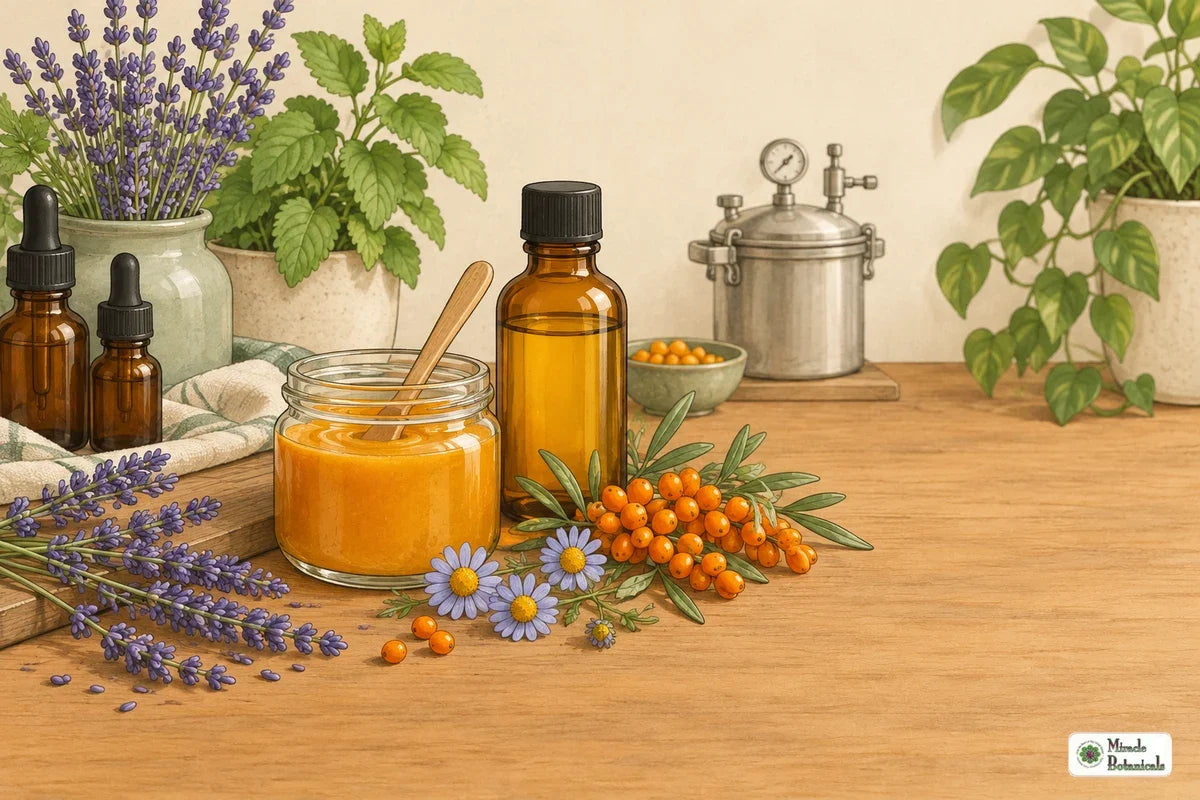

A CO2 extract is a plant extract made with pressurised carbon dioxide instead of steam or a chemical solvent, and most aromatic CO2 extracts are made at 31 °C to 40 °C (88 °F to 104 °F) above 73.8 bar. The carbon dioxide returns to a gas when the pressure drops, so the extract holds no solvent residue. CO2 extract oil comes in 3 types, which are select extracts, total extracts and CO2-extracted seed oils. A CO2 extract is diluted to the same 1% to 3% for adult skin as the distilled oil of its plant, which is 6 to 18 drops in 30 mL. The sections below define the CO2 extract, its 3 types and their contents, supercritical and subcritical extraction, and the difference from an essential oil. The supplementary part answers whether a CO2 extract counts as an essential oil, and how to use, dilute, store and choose one.
What is a CO2 extract?
A CO2 extract is a plant extract made with pressurised carbon dioxide instead of steam or a chemical solvent, with the carbon dioxide held near or above its critical point of 31.1 °C (88 °F) and 73.8 bar (about 1,070 psi). The dense carbon dioxide dissolves the aromatic compounds of the plant and, at higher pressure, its fats, waxes and pigments. The defining attribute of a CO2 extract is the solvent, because carbon dioxide returns to a gas when the pressure drops and leaves no residue in the bottle.
The term "CO2 extract" on a label names the method, and a full label adds the grade, written as "CO2 select", "CO2 total" or "CO2-to". Most aromatic CO2 extracts are made at 31 °C to 40 °C (88 °F to 104 °F), so compounds that steam at 100 °C (212 °F) would change reach the bottle intact. The solvent is food-grade carbon dioxide, which EU Directive 2009/32/EC permits for all food uses. The extracts it yields fall into 3 types, set out next.
What types of CO2 extract oil are there?
CO2 extract oil comes in 3 types, which are select extracts, total extracts and CO2-extracted seed oils, and the type is set mainly by the pressure used and the plant part extracted. A select extract pours like an essential oil. A total extract is often a thick liquid or a paste. A seed oil is used like a carrier oil. The table below compares the 3 types on pressure, contents, texture and use.
| Type | Pressure | What it holds | Texture at 20 °C (68 °F) | Typical plants | Main use |
|---|---|---|---|---|---|
| Select extract | About 90 to 120 bar, or split from a total by fractional separation | Volatile aromatic compounds, with few waxes or fats | Thin liquid that forms drops | Cardamom, clove bud, coriander seed, juniper berry, ginger | Perfume, diffusing, drop-counted skin blends |
| Total extract | 300 bar or more | Volatile compounds plus fatty oils, waxes, pigments, resins and pungent compounds | Thick liquid, paste or semi-solid | German chamomile, calendula, vanilla, turmeric, black pepper, frankincense | Balms, skin oils, perfume base notes |
| CO2-extracted seed oil | 300 bar or more | Triglycerides (fatty acids), tocopherols, carotenoids, phytosterols | Liquid oil; some cloud in the cold | Pomegranate, raspberry, sea buckthorn, black cumin seed | Carrier oil, alone or in a blend |
Many plants are sold in both aromatic grades, such as ginger, frankincense and black pepper, so the label, not the plant name, tells the buyer which product is in the bottle.
What is a CO2 select extract?
A CO2 select extract is the lighter grade of CO2 extract, made at about 90 to 120 bar or split from a total extract, and it holds mainly the volatile aromatic compounds of the plant. The scent of a select extract is close to the distilled oil of the same plant, with a rounder base. Cardamom (Elettaria cardamomum) and clove bud (Syzygium aromaticum) select extracts replace the distilled oils drop for drop in perfume and skin blends.
What is a CO2 total extract?
A CO2 total extract is the full grade of CO2 extract, made at 300 bar or more, and it holds the volatile compounds together with the fatty oils, waxes, pigments, resins and pungent compounds that dissolve at high pressure. German chamomile (Matricaria recutita) shows the value of the total grade. The extract keeps matricine, the colourless compound that distillation heat turns into the blue chamazulene of German blue chamomile oil, which holds 2% to 15% chamazulene.
What is a CO2-extracted seed oil?
A CO2-extracted seed oil is a fatty carrier oil taken from seeds with supercritical carbon dioxide instead of a mechanical press, and it holds the seed's triglycerides, tocopherols and carotenoids with almost no aroma. Pomegranate seed oil, at 65% to 80% punicic acid, raspberry seed oil and sea buckthorn seed oil are the common examples. The closed vessel keeps oxygen away from fatty acids that oxidise fast. A CO2-extracted seed oil is a fixed oil, not an essential oil, and the fatty acids and skin uses of sea buckthorn seed oil are covered on their own page.
What does a CO2 extract contain?
A CO2 extract contains the compounds that dissolve in dense carbon dioxide, which are terpenes and their oxygenated forms at every pressure, and fatty oils, waxes, pigments, resins and pungent compounds at higher pressure. Carbon dioxide acts as a nonpolar solvent, like hexane, so sugars, tannins, proteins and most flavonoid glycosides stay in the plant. The aromatic compounds belong to the same chemical families as those in a distilled oil, such as monoterpenes, sesquiterpenes, esters and phenols, which the guide to essential oil chemical families explains. The table below lists 10 common CO2 extracts with their usual grade, their signature compounds and what the CO2 route keeps.
| Extract (Latin name) | Usual grade | Signature compounds in the extract | What the CO2 route keeps |
|---|---|---|---|
| Ginger (Zingiber officinale) | Select or total | Zingiberene, gingerols, shogaols | Gingerols and shogaols, the pungent compounds of fresh root; the distilled oil is 20% to 40% zingiberene and has none |
| Turmeric (Curcuma longa) | Select or total | ar-Turmerone, alpha- and beta-turmerone | A fuller turmerone profile; neither route carries much curcumin, which is too polar for pure CO2 |
| Black pepper (Piper nigrum) | Total | Beta-caryophyllene, limonene, piperine | Piperine, the pungent alkaloid that does not distil |
| Clove bud (Syzygium aromaticum) | Select | Eugenol at 75% to 90%, eugenyl acetate, beta-caryophyllene | More eugenyl acetate and a softer, less sharp scent |
| Cardamom (Elettaria cardamomum) | Select | 1,8-cineole, alpha-terpinyl acetate | The warm, sweet base that steam thins out |
| Frankincense (Boswellia carterii, Boswellia serrata) | Select or total | Alpha-pinene, incensole, incensole acetate | A larger share of heavier diterpenes such as incensole |
| German chamomile (Matricaria recutita) | Total | Matricine, alpha-bisabolol and its oxides | Matricine, which heat converts to chamazulene |
| Vanilla (Vanilla planifolia) | Total | Vanillin, about 6% in common extracts | The full aroma of the dried bean, because vanilla gives no distilled oil |
| Calendula (Calendula officinalis) | Total | Carotenoids, faradiol esters, fatty oil | Almost everything, because calendula gives almost no oil under steam |
| Sea buckthorn seed (Hippophae rhamnoides) | Total | Linoleic and alpha-linolenic acids, tocopherols, carotenoids | A seed oil made without oxygen; the alternative is cold pressing |
The CO2 route adds most to plants whose character sits in heavy, pungent or heat-sensitive compounds, and little to lavender, peppermint and tea tree, whose light esters and monoterpenes pass through steam almost unchanged. How the dense carbon dioxide reaches those compounds is the subject of the next section.
How are CO2 extracts made?
CO2 extracts are made in 5 steps inside a closed steel system, from grinding the plant to recycling the gas, at a pressure and temperature the operator sets for each grade. One run takes 1 to 4 hours, depending on the plant and the grade. The 5 steps run in this order.
- Dry and grind the plant material, so the carbon dioxide penetrates it faster.
- Load the extraction vessel, a steel cylinder rated for several hundred bar.
- Pump carbon dioxide through the plant bed at the chosen pressure and temperature.
- Drop the pressure in a separator, where the carbon dioxide turns back into a gas and the extract collects at the bottom.
- Recycle the carbon dioxide by recompressing it, until the yield stops rising.
Two separators in series split one run into a heavier fraction of waxes and resins and a lighter aromatic fraction sold as a select extract, a technique called fractional separation. CO2 extraction is 1 of 4 commercial routes from plant to bottle, compared by heat, residue and plant part in the guide to methods of essential oil extraction. The state of the carbon dioxide in step 3, supercritical or liquid, decides the character of the extract.
What is supercritical CO2 extraction?
Supercritical CO2 extraction is extraction with carbon dioxide held above both its critical temperature of 31.1 °C (88 °F) and its critical pressure of 73.8 bar, where it is a dense fluid with properties of a gas and a liquid. The fluid flows into plant tissue like a gas and dissolves compounds like a liquid. The solvent power of supercritical carbon dioxide rises with density, and density rises with pressure. At 40 °C (104 °F), raising the pressure from 100 bar to 300 bar raises the density from about 0.63 g/mL to about 0.91 g/mL, which is the step from a select-type to a total-type extract. Most commercial CO2 extracts are supercritical extracts.
What is subcritical CO2 extraction?
Subcritical CO2 extraction is extraction with liquid carbon dioxide held below its critical temperature of 31.1 °C (88 °F), usually at 5 °C to 25 °C (41 °F to 77 °F) and about 40 to 70 bar, the pressure that keeps carbon dioxide liquid at those temperatures. Liquid carbon dioxide is a gentler, more selective solvent than the supercritical fluid. Subcritical extraction takes the light aromatic compounds and leaves most waxes, fats and pigments behind, so the product resembles a select extract with its most fragile top notes intact. The trade-off is a slower run and a smaller recovery from the same plant.
How does a CO2 extract differ from an essential oil?
A CO2 extract differs from an essential oil in 5 ways, which are extraction temperature, compounds carried, aroma, texture and shelf life, with a CO2 extract made at 31 °C to 40 °C (88 °F to 104 °F) and a steam-distilled oil at 100 °C (212 °F). The dense carbon dioxide carries heavier molecules than steam can lift, such as gingerols, piperine and vanillin. The extract therefore smells closer to the plant, is often thicker, and in total grades goes rancid like a fatty oil.
The dilution limit stays the same, because the limit follows the constituents in both products. The 2 products are compared on 8 attributes, with the 7 plants that smell truer as a CO2 extract, on the page about CO2 vs steam distilled oils. The comparison raises a naming question, which is the border of this guide.
Is a CO2 extract an essential oil?
No, a CO2 extract is not an essential oil under ISO 9235, the international standard that defines an essential oil as the product of steam distillation, dry distillation or mechanical expression of citrus peel. A CO2 extract is a separate product class beside essential oils and absolutes. Sellers shelve the 2 together because they are diluted, blended and diffused in the same way.
The distinction changes 3 practical things. First, a GC/MS report for a CO2 extract is read against a CO2 reference range, because fatty acids and waxes that would mark a distilled oil as adulterated are normal in a total extract, as the guide on how to read a GC/MS report explains. Second, Tisserand and Young's Essential Oil Safety (2014) gives limits for distilled oils, so a CO2 extract borrows the limit of the distilled oil of its plant. Third, a label that calls a CO2 extract an "essential oil" hides the range and the limit a buyer needs. The supplementary sections answer how to use, store and choose one.
How do you use and dilute a CO2 extract?
You use a CO2 extract in 3 ways, which are diluted skin application, natural perfumery and diffusing, and you dilute it to the same 1% to 3% for adult skin that applies to the distilled oil of the same plant. A 2% dilution of a thin select extract is 12 drops in 30 mL (1 oz) of carrier oil at 20 drops per mL. Total extracts go into skin oils, balms and perfume bases, because their waxes clog ultrasonic diffusers. A thick or pre-diluted extract needs 3 handling steps.
- Warm a semi-solid extract in a water bath at 35 °C to 40 °C (95 °F to 104 °F) for 5 to 10 minutes, cap closed, until it pours.
- Weigh a total extract that does not form even drops, on a scale that reads to 0.01 g, so a 2% blend in 30 mL takes about 0.6 g of extract.
- Recalculate a pre-diluted extract, because an extract sold at 10% in jojoba or meadowfoam seed oil is already a 10% dilution, so a 1% blend in 30 mL takes 3 mL, or 60 drops, of the 10% product.
The drop counts for every percentage and bottle size are in the essential oil dilution chart. Some CO2 extracts carry hazards beyond the distilled oil's limits, listed next.
Safety and precautions: which CO2 extracts need extra care?
Five groups of CO2 extracts need extra care, which are pungent, sensitising, phototoxic and daisy-family extracts, and any extract used on children, in pregnancy or near pets. Each group carries the limit of the distilled oil of the same plant. The list below gives the precaution for each group.
- Pungent extracts. Ginger and black pepper total extracts hold gingerols and piperine, which irritate skin that tolerates the distilled oil, so each is patch tested at 1% on the inner forearm for 24 hours first.
- Sensitising extracts. Cinnamon bark and clove bud CO2 extracts follow the dermal maximums of the distilled oils, 0.07% and 0.5% according to Tisserand and Young (2014), because cinnamaldehyde and eugenol sensitise skin.
- Phototoxic extracts. Angelica root and cumin CO2 extracts follow the phototoxic maximums of the distilled oils, 0.8% and 0.4% on skin that will see sun within 12 to 18 hours, and a CO2 extract can carry more non-volatile furanocoumarins than the distilled oil. Waiting times are on the page about phototoxic essential oils before sun.
- Daisy-family extracts. Calendula and German chamomile belong to the Asteraceae family, so a person allergic to ragweed patch tests them first.
- Extracts for children, pregnancy and pets. The age, pregnancy and pet limits of the distilled oil apply, so 1,8-cineole-rich cardamom extract stays away from the faces of children under 10, and no extract goes on a cat, because cats lack the liver pathway (glucuronidation) that clears phenols and terpenes.
Swallowing a CO2 extract is not a home method, and a person who swallows one contacts Poison Control (1-800-222-1222 in the United States).
How long do CO2 extracts last?
CO2 extracts last 2 to 3 years for select grades and 1 to 2 years for total grades and seed oils, unless an antioxidant such as natural tocopherol (vitamin E) is added, counted from the extraction date with the bottle closed, cool and dark. A select extract oxidises at its terpenes, like a distilled oil, and smells flat or sharp as it ages. A total extract or seed oil goes rancid at its unsaturated fatty acids, like a carrier oil, and smells of crayons or old nuts. Three storage rules keep an extract inside its range.
- Store every CO2 extract below 25 °C (77 °F), away from windows and radiators.
- Refrigerate total extracts and seed oils at 2 °C to 8 °C (36 °F to 46 °F), and let the bottle warm before opening, so no water condenses inside.
- Move a half-used extract into a smaller amber bottle, so less air sits above it.
A total extract that clouds or sets in the refrigerator is showing its waxes, not spoilage, and clears when warmed. Rancidity follows the same clock as in a fatty base oil, set out on the page about carrier oil shelf life.
How do you choose a CO2 extract?
You choose a CO2 extract by reading 5 things on the label and the batch report, which are the Latin name, the grade, any carrier or antioxidant added, the extraction date, and a GC/MS result read against a CO2 reference range. The Latin name fixes the species, such as Boswellia serrata against Boswellia carterii. The grade shows whether the bottle pours or sets. A carrier changes the dilution maths.
Three uses settle most choices. Choose a select extract for diffusing and drop-counted blends. Choose a total extract for balms and base notes, when the heavy or pungent compounds of the plant are the reason to buy. Choose the distilled oil for daily diffusing and cleaning, when the scent of the plant sits in light monoterpenes. CO2 extraction is one of the routes in the root guide to essential oils, which sets the 4 ways essential oils are made beside the purity, dilution and safety rules that apply to every bottle.
CO2 extracts from Miracle Botanicals
Miracle Botanicals sells CO2 extracts beside its range of about 200 single essential oils, each one tested by a third-party laboratory with GC/MS and labelled with its Latin name, plant part, country of origin and extraction method. The range includes spice and resin extracts such as ginger, turmeric, cardamom, clove bud, cinnamon bark, cumin, frankincense carterii and serrata, and myrrh. Flower and bean extracts include vanilla at 6% vanillin, coffee, blue chamomile and jasmine CO2 at 10% in meadowfoam seed oil, and seed extracts include pomegranate, raspberry, sea buckthorn and black cumin. The GC/MS report for each batch is available on request. Browse the CO2 extracts collection to compare extracts by plant, grade and aroma.