

Essential oils can be used around pets by brief diffusion only, at 3 drops per 100 mL of water for 30 minutes, with nothing on skin or fur and nothing in the mouth. A dog shares a session in a room it can leave, a cat stays out of the diffusing room, and birds and small pets live where no diffuser runs. The ASPCA Animal Poison Control Center names 11 oils as toxic to pets, including tea tree, peppermint, eucalyptus and citrus, and cats lack the glucuronidation pathway that clears phenols and terpenes. The sections below sort common oils into 3 levels by species and list the signs of exposure. The supplementary part answers which diffusing rules and diffusers lower the risk, how birds and small pets fit in, and how pet rules change a blend recipe.
Can you use essential oils around dogs, cats and other pets?
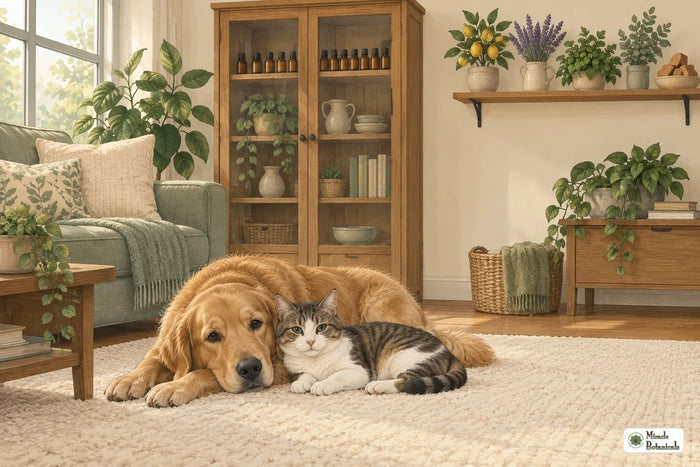
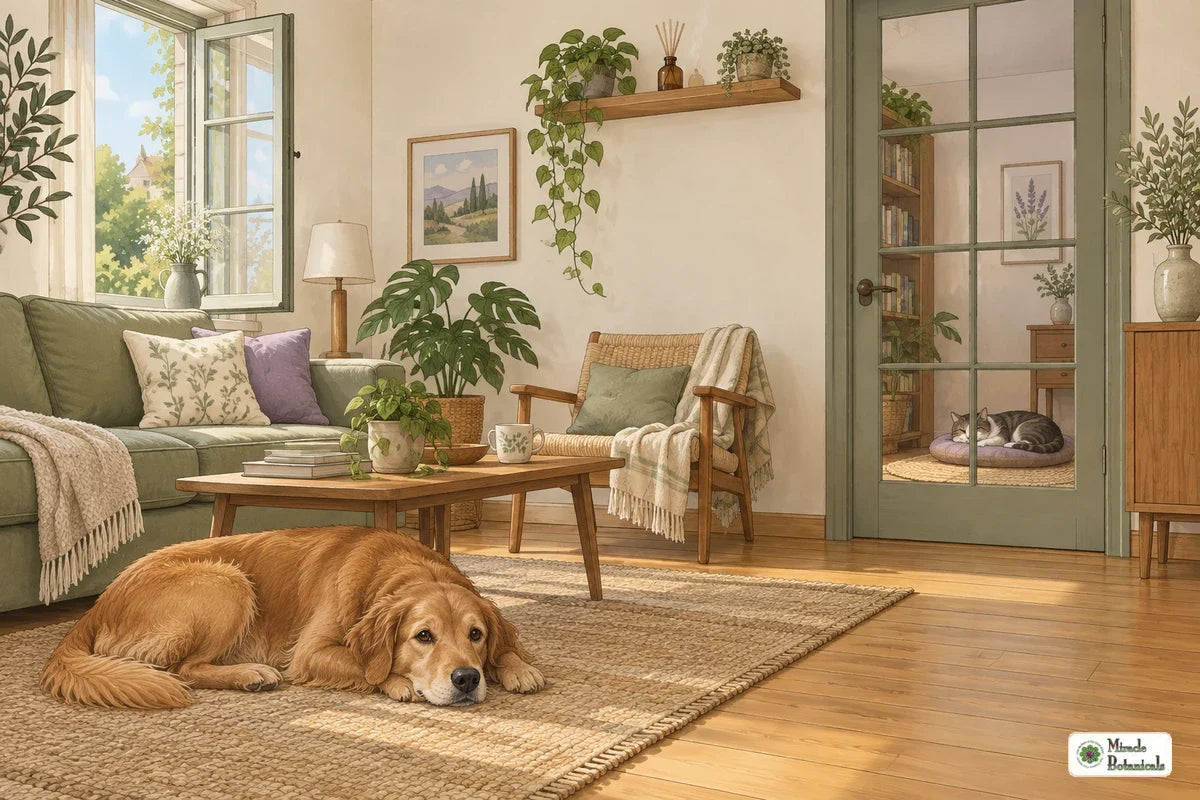
Yes, you can use essential oils around dogs, cats and other pets when the oil is diffused briefly, at 3 drops per 100 mL of water for 30 minutes, the room rule for the species is kept, and nothing goes on skin or fur or into the mouth. The room rule changes by species. A dog shares a session in a room it can leave. A cat shares no session, and the diffuser runs only in a room the cat cannot enter, aired before the cat returns. Birds, rabbits, guinea pigs and other small pets live in a room where no diffuser runs.
Diffusion is the only home route for essential oils around pets, because swallowed or applied oil is where most pet poisonings start. The ASPCA's safest setting for any oil is a short session in an area the pet cannot reach, and pets with breathing problems skip diffused oils altogether. The pet rule is the seventh of the 7 safety rules for skin, diffusers and family, and this page expands it into oils, run times and room layouts for each animal.
Which essential oils are toxic to pets?
The essential oils toxic to pets, as named by the ASPCA Animal Poison Control Center, are 11 oils, which are cinnamon, citrus, clove, eucalyptus, pennyroyal, peppermint, pine, sweet birch, tea tree, wintergreen and ylang ylang, and every one of them harms a pet most when swallowed or put on skin or fur. Each oil on the list carries a constituent that a pet's liver clears slowly or that injures tissue directly.
Wintergreen and sweet birch oils are 96% to 99% methyl salicylate, the aspirin-like compound. Clove bud oil carries eugenol, a phenol. Pennyroyal oil carries pulegone, which caused fatal liver failure in a dog in a 1992 case report by Sudekum, Poppenga, Raju and Braselton in the Journal of the American Veterinary Medical Association.
The table below sorts the 11 listed oils and 5 common unlisted oils into 3 levels for dogs and cats, with the same wording as the pet safety chart.
| Level | What the level means | Dogs | Cats |
|---|---|---|---|
| Room it can leave | Brief diffusion, 3 drops per 100 mL for 30 minutes, door open, pet free to walk out | Lavender, cedarwood atlas, frankincense, Roman chamomile | None |
| Room it cannot enter | Diffusion only in a room the pet cannot enter, aired before the pet returns | Lemon, sweet orange and other citrus, peppermint, eucalyptus, pine, ylang ylang, lemongrass | Lavender, cedarwood atlas, frankincense, Roman chamomile |
| Avoid | No diffusing in the pet's home and no contact with skin or fur | Tea tree, cinnamon, clove, wintergreen, sweet birch, pennyroyal | Every one of the 11 ASPCA-listed oils, plus lemongrass |
The dog levels follow 2 tests. Oils on the ASPCA list, and lemongrass with its sensitising citral, move to a room the dog cannot enter. Oils with a published case of serious harm in pets (tea tree, pennyroyal), 96% to 99% salicylate (wintergreen, sweet birch) or a human skin maximum of 0.5% or lower (cinnamon bark, clove bud) move to avoid. The Latin names, main constituents and reasons for 12 popular oils, one row per oil, are set out in the pet safety chart.
Which essential oils can be used around cats and dogs?
The essential oils used around cats and dogs are 4 oils outside the ASPCA list, which are lavender, cedarwood atlas, frankincense and Roman chamomile, diffused in a room a dog can leave and only in a room a cat cannot enter. The 4 oils are lower risk rather than safe, because no essential oil has a proven safe level for a cat.
Lavender (Lavandula angustifolia) is 25% to 38% linalool and 25% to 45% linalyl acetate, and the ASPCA lists the lavender plant as toxic to cats and dogs when eaten. Cedarwood atlas (Cedrus atlantica) is 60% or more himachalenes. Frankincense (Boswellia carterii) is 30% to 65% alpha-pinene. Roman chamomile (Chamaemelum nobile) is 75% to 85% esters. The Latin name matters, because spike lavender, lavandin and cedarleaf (thuja) carry camphor or thujone that the 4 named oils lack. The oils a dog tolerates, how each one is used and the signs that a dog dislikes a scent are set out in the guide to dogs and essential oils. How bad oils are for pets in general is the next question.
Are essential oils bad for pets?
Yes, essential oils are bad for pets when they are swallowed, applied to skin or fur, or diffused in a closed room, and the harm is greatest in cats, small animals and birds, according to the ASPCA Animal Poison Control Center. Four facts make pets more vulnerable to essential oils than people.
- Liver chemistry. Cats lack the glucuronidation pathway that prepares phenols and terpenes for excretion, because the cat's UGT1A6 gene, the main phenol-clearing enzyme in other mammals, is a non-working pseudogene, according to a 2000 study by Court and Greenblatt in Pharmacogenetics.
- Body weight. A small animal takes a larger dose per kilogram from the same drops.
- Grooming. Cats and dogs lick their coats and paws, so oil that settles on fur is swallowed later.
- No exit. A pet cannot open a window or leave a room with a closed door.
Tea tree oil caused 443 cases of toxicosis in dogs and cats between 2002 and 2012, most from neat application or ingestion, with drooling, weakness and tremors, according to a 2014 review by Khan, McLean and Slater in the Journal of the American Veterinary Medical Association. The dilution limits that make tea tree oil usable for people, and the reasons it stays away from pets, are on the page about tea tree essential oil safety. Diffused oil carries the smallest risk of the 3 routes, and its mist is the next question.
Is essential oil mist safe for dogs?
Yes, essential oil mist is safe for a healthy adult dog when a lower-risk oil runs at 3 drops per 100 mL of water for 30 minutes in a room the dog can leave, and it is not safe for a puppy, an older dog or a dog with breathing problems. An ultrasonic diffuser turns water and oil into a cool mist of fine droplets, and the droplets that settle land on the floor, the furniture and the dog's coat.
A dog licks its coat and paws, so a long day of mist becomes a small oral dose, and a 30-minute session limits that deposit. Flat-faced breeds, such as pugs, French bulldogs and boxers, have narrow airways and stay out of every session. A dog that sneezes, paws at its face or walks out of the room is showing that the scent is too strong. The oils on the ASPCA list, such as lemon, peppermint and eucalyptus, run only in a room the dog cannot enter. How to set up a diffuser so a dog can always leave, and how long to run it in a house with a dog, are set out in the guide to dog-safe diffuser use. Cats need a stricter rule than dogs, for the liver reason above.
Can you use essential oils near cats?
Yes, you can use essential oils near cats only in a room the cat cannot enter, with lavender, cedarwood atlas, frankincense or Roman chamomile, and you avoid the ASPCA-listed oils, such as citrus, peppermint, eucalyptus and tea tree, in a home with a cat. A cat's missing glucuronidation pathway makes the same diffuser session a larger load for a cat than for a dog of the same weight.
A cat grooms several times a day, so oil droplets on its fur reach its mouth. The room rule keeps the cat out during the session and the airing afterwards, with a window open until the scent has faded. Reed diffusers, plug-in oil warmers and liquid potpourri are knocked over or brushed against, and a cat that walks through a spill licks the oil off its paws. Whether a passive diffuser is safer for a cat than an ultrasonic one, and how to scent a house without harming a cat, are set out in the guide to diffusers and cats. Dogs and cats show the same few signs when an oil has reached them.
Safety and precautions for a pet exposed to essential oils
A pet exposed to an essential oil shows 6 common signs, which are drooling, vomiting, unsteady walking, tremors, laboured breathing and pawing at the face or mouth, and the first response is fresh air and a call to a veterinarian or the ASPCA Animal Poison Control Center. The response follows 5 steps.
- Move the pet to fresh air and switch the diffuser off.
- Wash oil from skin or fur with a mild liquid dish soap and lukewarm water, which lifts oil better than water alone.
- Keep the bottle, so the veterinarian knows the oil and its Latin name.
- Call a veterinarian or the ASPCA Animal Poison Control Center at (888) 426-4435, where a consultation fee may apply.
- Leave vomiting to the veterinarian, because an oil brought back up can be breathed into the lungs.
Signs can appear hours after a skin or oral exposure, so a pet that seemed well at first is watched for the rest of the day. Why cats react most, and what a cat owner uses in place of essential oils, are set out in the guide to essential oils for cats.
What diffusing rules lower the risk to pets?
Seven diffusing rules lower the risk to pets, which are choosing a lower-risk oil, adding 3 drops per 100 mL of water, running 30 minutes then pausing, keeping the door open for a dog, closing cats and small pets out, placing the diffuser out of reach, and emptying the tank after use.
- Choose an oil outside the ASPCA list, such as lavender, cedarwood atlas, frankincense or Roman chamomile.
- Add 3 drops per 100 mL of water, the low end of the adult range.
- Run the diffuser for 30 minutes, then switch it off for at least 30 minutes.
- Keep the door open so a dog can leave, and never shut a dog in a diffusing room.
- Close cats, birds and small pets out of the room, and air it before they return.
- Place the diffuser on a stable shelf out of reach, at least 1 m (3 ft) from the pet's bed.
- Empty and wipe the tank after each session, so no scented water stands where a pet can drink it.
A closed bedroom door at night turns a shared room into one the pet cannot leave. The drop counts for larger tanks and rooms, and the run times for each diffuser type, are set out in the guide on how to diffuse essential oils safely.
Which diffusers are safer around pets?
The diffusers safer around pets are ultrasonic units with an interval timer and an automatic shut-off, because they run at a low output and stop on their own, and the riskiest are nebulisers, heat warmers and open reed diffusers. A nebulising diffuser atomises undiluted oil at 5 to 10 times the output of an ultrasonic unit, so it does not run in a home with a cat or a bird. A heat warmer holds hot oil that a pet can knock over. A reed diffuser holds 20 to 30 drops per 100 mL of base in an open bottle that a cat can tip or a dog can chew. What a diffuser puts into indoor air, and the 6 groups who should avoid one indoors, are set out in the guide to diffuser safety.
How do you use essential oils around birds and small pets?
You use essential oils around birds and small pets only in a room they never enter, because birds move air through their lungs in one direction with a set of air sacs and absorb airborne compounds fast, and rabbits, guinea pigs and ferrets combine small airways with a low body weight. A bird's cage stays in a room that no diffuser, scented candle or air freshener reaches, the same rule bird owners keep for the fumes of non-stick pans. An indoor rabbit hutch or guinea pig cage follows the same rule, because a small pet cannot leave its enclosure. The species-by-species rules for parrots, chickens, rabbits and guinea pigs are set out in the guide to birds and small pets.
How do pet rules change a diffuser blend recipe?
Pet rules change a diffuser blend recipe in 3 ways, which are a total of 3 drops per 100 mL of water for the whole blend, a 30-minute session, and the room rule of the blend's strictest oil. A 2-oil blend of lavender and cedarwood atlas runs at 2 drops of lavender and 1 of cedarwood. A blend with 1 ASPCA-listed oil, such as sweet orange, takes that oil's level, which is a room a dog cannot enter, and is avoided in a home with a cat. The 25 recipes for bedrooms, kitchens and living rooms, with the drops of each oil, are in the collection of diffuser blend recipes, and each recipe can be cut to the pet dose on this page before it runs.
Diffuser blends from Miracle Botanicals
Miracle Botanicals sells diffuser blends made from its about 200 third-party GC/MS-tested single essential oils, and every blend label names each oil inside by its Latin name, so a pet owner can match a blend against the 3 levels on this page before it goes into the diffuser. The single oils outside the ASPCA list, such as lavender, cedarwood atlas, frankincense and Roman chamomile, are sold on their own for owners who build a lower-risk blend. The GC/MS report for any batch is available on request. Browse the diffuser blends collection to read the oils in each blend before choosing one for a home with a dog.