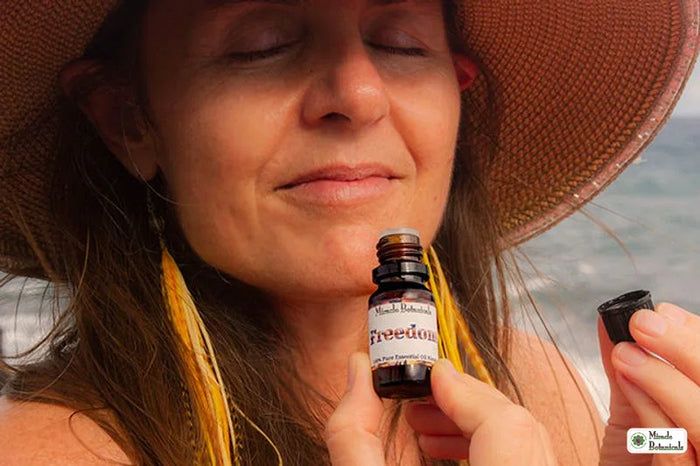



How to use essential oils for sleep comes down to one habit: breathe a scent you find calming during your wind-down hour, through a diffuser in short bursts, a pillow spray, a tissue or a warm bath, then let it fade. Essential oils are a relaxation aid. They don't treat insomnia, and the sleep research is weaker than most labels suggest.
If you'd like to browse by scent while you read, Miracle Botanicals keeps its calming singles and blends together in one collection of essential oils for sleep. Every single oil there has its GC/MS test report on the product page, so you can see what's in the bottle before it goes anywhere near your pillow.
Do essential oils actually help you sleep?
Essential oils may help some people feel calmer at bedtime, and several meta-analyses report better self-rated sleep quality after aromatherapy. Government scientists are more cautious. The NIH's National Center for Complementary and Integrative Health (NCCIH) says that for insomnia, "we don't know whether it's helpful," because little rigorous research exists.
So put a bedtime scent in the same category as dimming the lights or leaving your phone in another room. It's a cheap, pleasant ritual that may make winding down easier, not a fix for a sleep problem, and nobody selling oils should tell you otherwise.
Where do essential oils go at bedtime?
At bedtime, essential oils mostly go into the air or onto fabric, and onto skin only once they're diluted using an essential oil dilution chart and you've learned how to patch test an essential oil. Inhalation methods are the easiest place to start because nothing touches your skin and you can stop the moment a smell bothers you.

| Method | How the scent reaches you | Skin contact | Effort |
|---|---|---|---|
| Diffuser | Mist in the room air | None | Low once it's set up |
| Pillow spray | Fabric near your face | Indirect, through the pillowcase | Low |
| Inhaler stick or tissue | A few close-range breaths | None if kept off skin | Lowest |
| Roller blend | Diluted oil on skin, then breathed in | Yes | Low |
| Bath | Steam and warm water | Yes, whole body | Highest |
Diffuser
A diffuser is the hands-off option. The Tisserand Institute recommends intermittent diffusion, 30-60 minutes on and then 30-60 minutes off, and calls it more effective as well as safer than nonstop running; only a barely noticeable level is fine for longer. In practice, that means switching it on as you start winding down and letting it stop around lights-out. Drop counts depend on the size of the tank, so they live in our guide to how many drops of essential oil in a diffuser.
Pillow spray
A pillow spray puts the scent right where your head lands. Essential oils don't dissolve in water, so a bottle of tap water with a few drops of oil simply separates and sprays out droplets of near-undiluted oil. The workarounds are a hydrosol on its own or a proper solubilizer, and the recipes are in our DIY pillow spray for sleep post.
Inhaler stick or tissue
A personal inhaler (a cotton wick sealed inside a small capped tube) or a scented tissue gives you the most control: a few slow breaths, then it goes away. Put the oil on the tissue rather than your skin, start with a single drop, and leave it on the nightstand or the far corner of the pillow, well away from your eyes. The Tisserand Institute's safety guidelines advise against direct, intensive inhalation for longer than 15-20 minutes, so think of this as a short sniff, not something to hold under your nose all night.
Roller blend
A roller blend is diluted oil in a small glass bottle with a rollerball top, swiped on shortly before bed. Keep it gentle: a 1% blend is 3 drops of essential oil in a 10 ml roller (about 2 teaspoons) filled with carrier oil. Three recipes, and where on the body to apply them, are in our sleep roller blend recipe post.
How long before bed should you use essential oils?
Use essential oils in the stretch just before sleep rather than around the clock. A 2021 meta-analysis of 34 inhalation studies found that scent inhaled one to three times before bed had a larger effect than continuous 24-hour exposure from aroma necklaces, although delivery method and timing were tangled together in that comparison.
The numbers were a Hedges' g of 0.66 for pre-sleep inhalation versus 0.48 for the 24-hour groups. How many times people inhaled before bed (once, twice or three times) made no significant difference. The same review found the effect grew with the total number of sessions, which favors a nightly habit over a one-off experiment.
What the research doesn't give you is a precise countdown. None of the reviews cited here settles on an ideal number of minutes before lights-out, so be suspicious of any exact figure you see online. For diffusers, the on-off cycle above already sets a sensible rhythm. The bath is the one method with real timing data behind it.
Can you use essential oils in a bedtime bath?
Yes, as long as you disperse the oil first. Drops added straight to the tub float on the surface as a film of undiluted oil, and warm water makes it sting. The Tisserand Institute's bath guidance suggests mixing 5-20 drops into 1 tablespoon (about 15 ml) of carrier oil or bath base before it goes into the water.

Kitchen-cupboard dispersants don't work. Milk, Epsom salts, baking soda and cornstarch don't hold essential oil in the water, according to the same Tisserand page, so the oil still ends up floating. A carrier oil keeps the essential oil diluted but floats too and leaves the tub slick, so step out carefully. Only a solubilizer, such as Solubol or polysorbate 20 mixed with the essential oil starting at a 1:1 ratio, actually spreads it through the water. For a sleep bath, stay near the low end of that drop range. A gentle scent is the point.
The warm water may do more for your sleep than the oil does. A 2019 meta-analysis in Sleep Medicine Reviews linked a bath or shower at 104-108.5°F (40-42.5°C), taken 1-2 hours before bedtime, with better self-rated sleep quality, and sessions as short as 10 minutes shortened the time it took to fall asleep. That's a body-heating effect rather than an aromatherapy one, and the authors note the research base is small. It still gives you a sensible order of events: bath first, then the rest of your wind-down.
Which essential oils do people use at bedtime?
Lavender dominates the sleep studies: it appeared in 26 of the 34 studies in that 2021 inhalation review. The Miracle Botanicals sleep collection also includes vetiver, spikenard, Himalayan cedarwood, Hawaiian sandalwood and Cape chamomile, though none of these has a sleep research base close to lavender's. Choose a scent you genuinely enjoy.
For what the lavender trials measured, how much to use and why lavandin isn't a straight swap, see lavender oil for sleep. One finding from the broader review is worth knowing before you shop. Single oils performed at least as well as blends (g = 0.72 versus 0.58), so a five-oil bedtime blend isn't automatically better than one bottle of something you like.
Whichever oil you pick, buy one you can check. We're a small family-run supplier on the Big Island of Hawai'i, and all of our oils are third-party tested for synthetics, pesticides and adulteration.
What does research say about aromatherapy and sleep?
Research says aromatherapy improves self-reported sleep quality on average, but the evidence is low quality. Five systematic reviews published between 2015 and 2025 each found a benefit. The more rigorous ones also found small trials, little or no blinding, results that varied wildly from study to study, and signs that negative trials go unpublished.
That's enough to justify a low-cost, low-risk bedtime ritual and nowhere near enough to replace medical care. Here is what each review pooled and where it falls short.
| Review | What it pooled | Headline result | The catch |
|---|---|---|---|
| Hwang & Shin, 2015, J Altern Complement Med | 12 studies from Korean and nursing databases, 2000-2013 | Aromatherapy improved sleep quality; inhalation beat massage | Narrow, mostly Korean evidence base |
| Lin et al., 2019, Complement Ther Med | 31 randomized controlled trials | Hedges' g 1.10 | Only 4 trials at low risk of bias; I² 91%; signs of publication bias |
| Cheong et al., 2021, Medicine | 34 inhalation studies | Hedges' g 0.65 | I² about 83%; high risk of bias for blinding and allocation |
| Her & Cho, 2021, Complement Ther Med | 30 studies, 2011-2019 | Effect size 0.74 | Largest effects in quasi-experimental (non-randomized) studies |
| Chen et al., 2025, Front Psychiatry | 27 RCTs, 2,072 patients with insomnia alongside another illness | PSQI score down 2.90 points | Only 2 trials reported blinding; I² 97% |
A quick key to the table. A Hedges' g around 0.5 is conventionally read as a moderate effect, and I² above 75% means the individual studies disagreed a lot. The Pittsburgh Sleep Quality Index (PSQI) is a 0-21 questionnaire on which lower scores mean better sleep.
Two problems explain the gap between those positive pooled results and the cautious official line. Blinding is close to impossible, because participants can smell whether they got the real oil, and expectation alone can move a sleep questionnaire. The people studied also often aren't people sleeping at home. In the Cheong review, effects were larger in clinical groups such as cardiac, surgical and psychiatric patients (g = 0.78) than in general groups (g = 0.54).
The reviews don't even agree on which route works best. Hwang and Shin found inhalation beat massage, while Her and Cho found aroma massage studies had the largest effect of any subgroup they analyzed (1.30). With heterogeneity this high, neither finding is settled, and no method has been shown to be clearly better than another.
Who should be careful with bedtime aromatherapy?
Pregnant people, babies and young children, people with asthma and anyone with reactive skin need extra care. Bedtime raises the stakes slightly, because you spend hours in a small, closed room and you're asleep if a scent starts to bother you. Talk to your doctor, midwife or pediatrician before using essential oils in any of these situations.
Pregnancy changes which oils are suitable and how much to use, so check the list of essential oils to avoid during pregnancy before you diffuse or bathe with anything. Children's rules change by age, and some popular oils aren't suitable for young kids at all; see essential oils safe for kids by age before scenting a nursery or a child's room. Keep bottles where young children can't reach them, as the Tisserand Institute advises.
Asthma needs a conversation with your doctor first. The Tisserand Institute says an essential oil triggering an asthma attack has never been formally recorded, but it acknowledges anecdotal reports. If you get the go-ahead, a tissue you can move away is easier to control than a diffuser, and a cough or wheeze is your cue to stop.
Skin and eyes are the last check. Never put undiluted oil on your skin before bed, and keep it away from your eyes; the Tisserand Institute warns that undiluted oil dripped into the eye can cause a chemical burn. NAHA's safety statements make the skin point too, noting that some oils can irritate or sensitize skin unless properly diluted in a carrier.
When is poor sleep a reason to see a doctor?
See a doctor if trouble sleeping happens three or more nights a week and has lasted more than three months, which is how the NHLBI describes chronic insomnia. Go sooner if poor sleep is hurting your work, mood or safety. A bedtime scent can't address the cause, and better-proven treatments exist.
The best-proven one isn't a pill. In 2021, the American Academy of Sleep Medicine's behavioral treatment guideline gave its only strong recommendation to cognitive behavioral therapy for insomnia (CBT-I), a structured program that typically runs four to eight sessions. Loud snoring, gasping or pauses in breathing that a partner notices are another reason to book an appointment, since they can point to sleep apnea. Essential oils can still sit alongside any of this as part of your wind-down, as long as your doctor knows what you're using.
What's the simplest way to start tonight?
Pick one oil you like and one inhalation method, such as a diffuser cycle or a tissue by the bed, and use it at the same point in your wind-down nightly for two weeks before judging it. For the most-studied option, start with lavender. Still sleeping badly after that? Call your doctor rather than buying a stronger blend.
This article is educational and isn't medical advice. Check with your doctor, midwife or pediatrician before using essential oils if you're pregnant, caring for a young child, taking medication or managing a health condition.