
Table of Contents
- Why Jasmine Cannot Be Steam Distilled
- The Problem With Solvent-Extracted Absolutes
- What Is Supercritical CO2 Extraction?
- Why Jasmine CO2 Smells More Alive
- Why Whole-Plant Chemistry Matters
- Jasmine CO2 vs Jasmine Absolute
- Why We Blend Jasmine CO2 in Meadowfoam
- Jasmine Through History, Ritual & Traditional Medicine
- A More Living Expression of the Flower
- FAQs
Jasmine CO2 vs Jasmine Absolute: Why This Extraction Method Matters
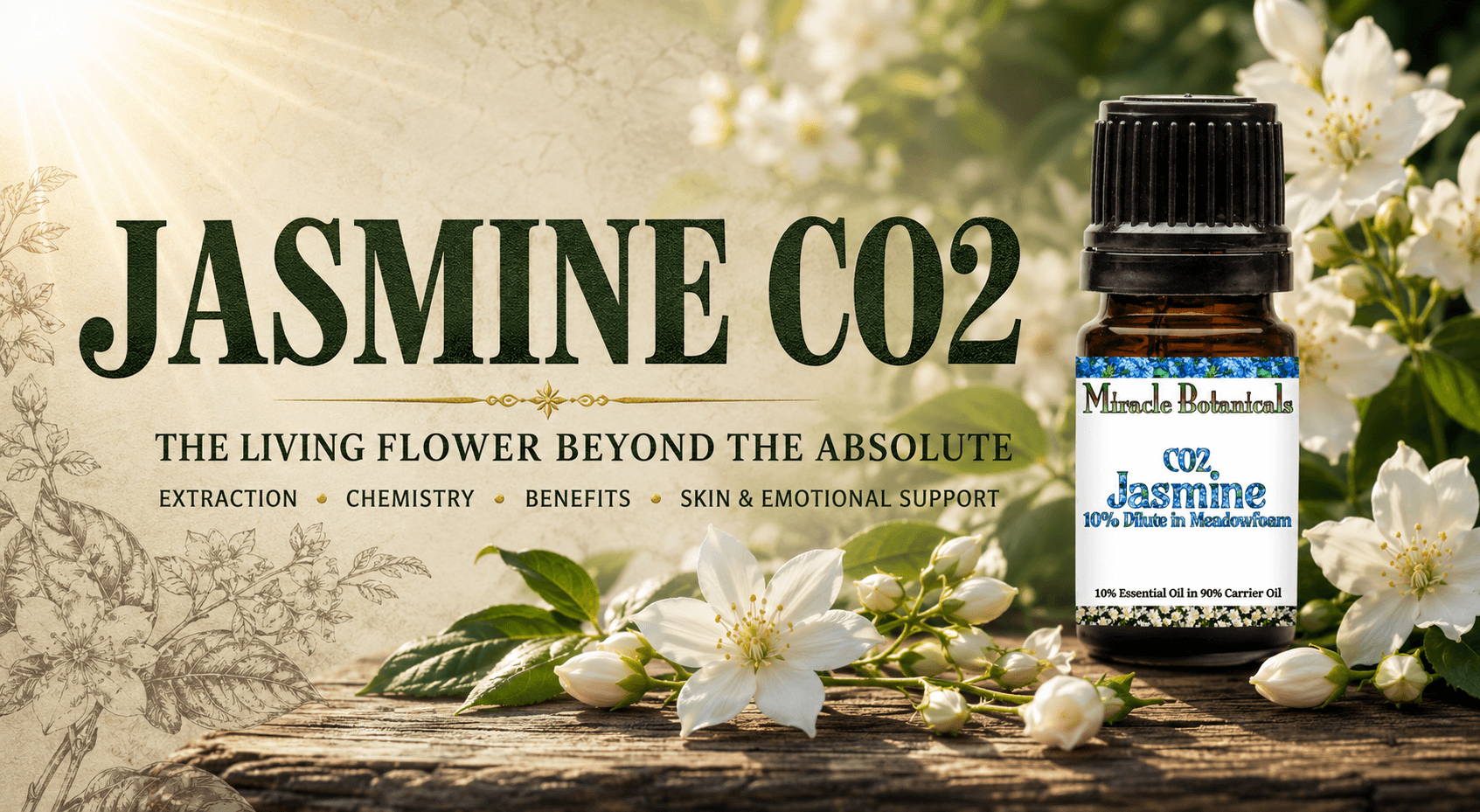
There are few aromatic materials in the botanical world as revered as Jasmine. Rich, narcotic, floral, sensual, and emotionally expansive, jasmine has captivated herbalists, perfumers, physicians, and spiritual practitioners for centuries. Yet most people have never experienced jasmine in one of its most complete and biologically intact forms: Jasmine CO2 extract.
Most jasmine products sold in perfumery and aromatherapy are jasmine absolutes extracted using chemical solvents. While jasmine absolute can smell beautiful, the extraction process itself fundamentally changes the chemistry and energetic integrity of the plant material.
Jasmine CO2 is different.
Our Jasmine Essential Oil Blend features 10% Jasminum grandiflorum CO2 extract pre-diluted in 90% Meadowfoam Seed Oil (Limnanthes alba), creating a ready-to-use botanical oil that preserves the flower’s aromatic complexity while remaining gentle enough for direct skin application.
This is not merely a perfume ingredient. It is a highly sophisticated botanical extract produced through one of the most advanced extraction methods available in aromatic medicine.
Why Jasmine Cannot Be Steam Distilled
Unlike lavender, peppermint, or eucalyptus, jasmine flowers are far too delicate to tolerate traditional steam distillation.
The aromatic molecules within jasmine blossoms are highly sensitive to heat. Many of the flower’s most nuanced compounds degrade rapidly when exposed to elevated temperatures, which is why true jasmine essential oil obtained through steam distillation is extraordinarily rare and generally considered impractical on a commercial scale.
Historically, perfumers turned to solvent extraction instead.
This created jasmine absolute — a concentrated aromatic material extracted using hydrocarbons such as hexane. The solvent dissolves aromatic compounds from the flowers, producing a wax-like concrete that is later processed into an absolute using alcohol.
While effective from a fragrance perspective, this method has several drawbacks from a clinical herbalist and therapeutic standpoint.
The Problem With Solvent-Extracted Absolutes
Jasmine absolute smells intensely floral because solvent extraction is excellent at capturing volatile aromatic molecules. However, the process itself can alter or flatten certain aspects of the plant’s chemistry.
From a therapeutic perspective, several concerns arise:
✧ Residual solvent traces may remain in the final product
✧ Heat exposure during processing can damage delicate aromatic constituents
✧ The extract tends to emphasize fragrance over full-spectrum botanical integrity
✧ Certain waxes, pigments, and heavier plant compounds are removed or altered
✧ The aroma can become sharper, heavier, or more perfume-like compared to the living flower
For perfumery alone, this may not matter.
But for topical application, emotional aromatherapy, botanical skin care, and energetic plant medicine, extraction method matters tremendously.
This is where supercritical CO2 extraction becomes extraordinary.
What Is Supercritical CO2 Extraction?
CO2 extraction uses carbon dioxide under carefully controlled pressure and temperature conditions to pull aromatic compounds directly from the plant material.
When CO2 reaches a “supercritical” state, it behaves simultaneously like both a liquid and a gas. In this state, it becomes an incredibly efficient natural solvent capable of extracting delicate aromatic compounds without harsh chemicals or damaging heat.
One of the most remarkable aspects of this process is temperature control.
CO2 becomes supercritical at approximately 33°C (91°F), allowing extraction to occur at far lower temperatures than steam distillation. This preserves delicate floral compounds that would otherwise degrade.
Once pressure is released, the CO2 simply evaporates away completely.
No solvent residue remains. No harsh petrochemicals are required.
The resulting extract is astonishingly close to the aroma and chemistry of the living flower itself.
Why Jasmine CO2 Smells More Alive
Many people who smell Jasmine CO2 for the first time immediately notice the difference.
Rather than smelling aggressively perfumed or overly powdery, Jasmine CO2 often feels softer, greener, creamier, and more dimensional. It carries subtle fruity notes, warm floral undertones, faint indolic depth, and even traces of the humid living flower itself.
Clinical herbalists and natural perfumers often describe CO2 extracts as more “whole.”
That word matters.
Because aromatic medicine is not merely about isolated fragrance molecules — it is about the synergy of the entire phytochemical matrix working together.
Jasmine CO2 contains a broader spectrum of naturally occurring compounds, including heavier aromatic constituents often lost during steam distillation or altered during solvent extraction.
This creates a fuller sensory and therapeutic experience.
Why Whole-Plant Chemistry Matters
When it comes to working with plants, extraction method directly influences therapeutic outcome.
Plants are biochemical symphonies.
When extraction damages or selectively removes compounds, the energetic and physiological behavior of the final medicine changes.
Jasmine naturally contains complex aromatic constituents including:
Benzyl acetate
Benzyl benzoate
Indole
Linalool
Farnesene
Phytol
Jasmonates
Various sesquiterpenes and aromatic esters
Many of these compounds contribute not only to aroma, but to nervous system effects, emotional response, anti-inflammatory activity, and skin compatibility.
Jasmine’s naturally occurring indoles, for example, are part of what gives the flower its deeply sensual, almost animalic undertone. In low concentrations, indoles are psychologically grounding and emotionally activating — one reason jasmine is considered such a profound aphrodisiac.
Meanwhile, linalool contributes calming nervous system effects, while aromatic esters create emotionally softening and mood-lifting properties.
The more intact the phytochemistry remains, the more complete the therapeutic action becomes.
Jasmine CO2 vs Jasmine Absolute
| Feature | Jasmine CO2 | Typical Jasmine Absolute |
|---|---|---|
| Extraction Method | Supercritical CO2 | Solvent extraction |
| Solvents Used | None | Usually hexane/alcohol |
| Heat Exposure | Extremely low | Moderate |
| Residual Solvent Risk | None | Possible trace residues |
| Aroma Profile | Full-spectrum, creamy, alive | Stronger, sharper, perfume-heavy |
| Botanical Integrity | Highly preserved | Partially altered |
| Skin Compatibility | Excellent when diluted | Can be more sensitizing |
| Therapeutic Depth | Broad-spectrum | Primarily aromatic/perfumery |
| Energetic Quality | Whole-plant expression | More fragrance-oriented |
| Texture | Thick, waxy, resinous | Thick but smoother |
| Shelf Stability | Excellent when diluted in Meadowfoam | Moderate |
Why We Blend Jasmine CO2 in Meadowfoam
Pure Jasmine CO2 extract naturally becomes thick, waxy, and highly concentrated.
To make the oil easier to use directly on the skin, our Jasmine Essential Oil Blend is diluted to 10% in cold-pressed Meadowfoam Seed Oil.
This pairing is intentional and clinically intelligent.
Meadowfoam Seed Oil possesses an unusually stable fatty acid profile rich in long-chain fatty acids that resist oxidation remarkably well. Unlike many carrier oils, Meadowfoam helps stabilize delicate aromatic compounds while simultaneously creating a luxurious, silky texture on the skin.
It absorbs beautifully while leaving behind a soft, luminous finish.
Together, Jasmine CO2 and Meadowfoam create an oil that functions simultaneously as:
✧ A natural perfume oil
✧ A botanical facial oil
✧ A nervous system support oil
✧ A sensual body oil
✧ A ritual and meditation oil
Jasmine Through History, Ritual & Traditional Medicine
Jasmine has been treasured for thousands of years across India, Persia, Egypt, China, and the Mediterranean world — not only for its intoxicating aroma, but for its deep association with love, spirituality, beauty, emotional healing, and the unseen dimensions of human experience.
Across cultures, jasmine became more than a fragrant flower.
It became medicine. It became ritual. It became symbol.
Few plants have carried such a universal connection to sensuality, devotion, emotional restoration, and the subtle realms of the heart.
Jasmine in India & Ayurvedic Tradition
In India, Jasminum grandiflorum has long been woven into devotional ceremonies, temple offerings, wedding garlands, and sacred anointing rituals. Jasmine flowers are traditionally offered to deities such as Lakshmi, goddess of beauty, abundance, and divine femininity, and Krishna, whose stories are deeply intertwined with flowers, fragrance, love, and devotional ecstasy.
The aroma of jasmine has traditionally been associated with calming the mind, healing the heart, and elevating consciousness during prayer, meditation, and sacred ceremony.
Within Ayurvedic traditions, jasmine was viewed as more than a beautiful fragrance. It was often considered cooling, moistening, and emotionally balancing — particularly for helping soothe excess Pitta energy associated with heat, irritability, inflammation, overexertion, and emotional intensity.
Rather than simply quieting the mind, jasmine was traditionally used to restore harmony between emotional and physical states.
The flowers were infused into hair oils, skin preparations, perfumes, aphrodisiac formulations, and ceremonial adornments. Jasmine also became associated with supporting ojas — the subtle reserve of vitality, resilience, radiance, and life force believed in Ayurveda to sustain emotional stability and overall well-being.
Jasmine Across Ancient Cultures
Across the Middle East and North Africa, jasmine became a symbol of sensuality, hospitality, and paradise itself. The flower frequently appeared in poetry, perfumery, and traditional medicine systems as an emblem of sacred beauty and emotional intoxication.
In Chinese herbal and aromatic traditions, jasmine flowers were valued for their uplifting and harmonizing effects on mood and spirit. Jasmine tea eventually became one of the most beloved aromatic rituals in the world, pairing floral aromatics with calming effects on the nervous system and digestive support.
Because jasmine blossoms release much of their aroma after sunset, many cultures began associating the flower with mystery, dreams, romance, and the hidden emotional landscape of the human experience.
Jasmine as Nervous System Medicine
“Jasmine helps restore confidence, optimism and emotional warmth.”
— Gabriel Mojay
Jasmine possesses one of the most fascinating psycho-emotional profiles in aromatherapy...
It is simultaneously relaxing and stimulating.
Unlike sedative oils that dull the senses, jasmine often creates emotional brightness while calming internal tension. Many herbalists use jasmine during periods of emotional numbness, grief, exhaustion, low libido, heartbreak, or creative stagnation.
It encourages embodiment.
Presence.
Warmth.
Connection to pleasure and beauty.
This unusual duality may partially explain jasmine's longstanding reputation as both an antidepressant and aphrodisiac in traditional aromatic medicine systems.
Mythologically, jasmine has often been associated with the moon, femininity, love magic, and nocturnal beauty — a flower existing somewhere between medicine and mystery.
Even today, jasmine remains one of the most emotionally evocative botanical extracts in the world:
a flower associated simultaneously with softness, passion, devotion, comfort, sensuality, and transcendence.
Jasmine CO2 Essential Oil - 10% Dilute in Meadowfoam (10% Pure Jasminum Grandiflorum Preblended in 90% Limnanthes Alba)
$34.97
Botanical Name: 10% Pure Jasminum Grandiflorum Preblended in 90% Limnanthes Alba Plant Part And Method Of Extraction: Jasminum Grandiflorum is CO2 Extracted from Jasmine Flowers, Meadowfoam Oil is cold pressed from seeds of Meadowfoam Country of Origin: India (Jasmine) and USA… read more

A More Living Expression of the Flower
Jasmine CO2 represents a new generation of aromatic extraction — one that prioritizes preservation rather than force.
Rather than aggressively stripping fragrance molecules from the flower, CO2 extraction gently carries the plant’s chemistry into an aromatic oil that feels startlingly close to the living blossom itself.
For those seeking more than perfume —
for those seeking whole-plant aromatics, botanical skin care, nervous system support, sensual ritual, and true aromatic medicine —
Jasmine CO2 stands in a category almost entirely its own.
Sweet, floral, warm, rich, and astonishingly alive.
FAQs
What is the difference between Jasmine CO2 and Jasmine Absolute?
Jasmine Absolute is traditionally extracted using solvents, while Jasmine CO2 is extracted using pressurized carbon dioxide. Many people find Jasmine CO2 retains a fuller, fresher aroma that feels closer to the living flower while preserving more of the plant's delicate aromatic compounds.
What has Jasmine traditionally been used for?
Throughout history Jasmine has been associated with love, beauty, devotion, emotional comfort, sensuality, and spiritual ceremony. It has been woven into wedding traditions, temple offerings, perfumery, and wellness practices across India, Persia, Egypt, and beyond.
Can Jasmine be used in skincare?
Jasmine is often included in facial oils, perfumes, and body products because of its luxurious aroma and its reputation for supporting healthy-looking, radiant skin. Because it is highly concentrated, it should always be diluted appropriately before topical use.