
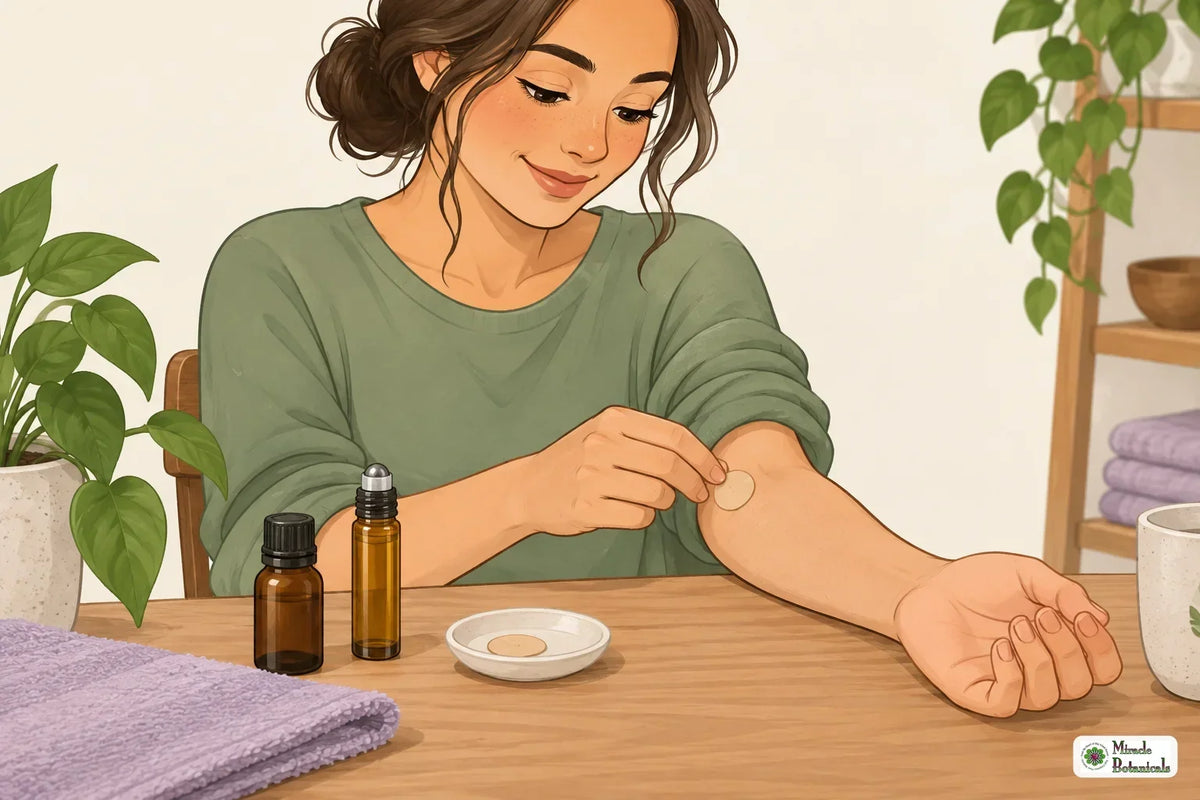

An essential oil patch test means putting a little diluted oil, mixed to a strength from the essential oil dilution chart, on a quarter-sized spot of your inner forearm twice a day for 7-10 days and watching for redness, itching or swelling.
Most quick guides stop at 24 or 48 hours. That catches fast irritation but can miss an allergic reaction, which often takes a day or more to show. The routine below follows the American Academy of Dermatology's home test for new skin products.
This guide is educational, not medical advice. If you have eczema or another skin condition, or have reacted to a skin product before, talk to your doctor or a board-certified dermatologist before using essential oils on your skin.
Who should patch test an essential oil?
Anyone with sensitive skin, eczema, known allergies or a past skin reaction gets the most from a patch test, and NAHA (the National Association for Holistic Aromatherapy) advises a skin patch test whenever sensitivity is suspected. For everyone else, it's a sensible habit with a new oil, especially one with a reputation for irritating skin.
The Tisserand Institute is more skeptical about testing itself. Its page on skin irritation and allergy says that, in general, it doesn't recommend patch testing. For high-risk people (a past topical allergic reaction, or multiple chemical sensitivity) it recommends dose escalation instead: start around 1% and raise the strength in 0.5% steps.
The routine below fits both views. It starts at 1%, Tisserand's first rung, and watches that rung for a week or more before you climb.
How do you patch test an essential oil, step by step?
Dilute the oil to 1% (3 drops in 10 ml of carrier oil), apply it to a quarter-sized spot on the inside of your forearm twice a day for 7-10 days, and stop at the first sign of a reaction. If you've already mixed a blend, test that exact blend instead.
- Pick one oil. Test one new oil or one finished blend at a time, so a reaction points to a single cause. New to oils? Our gentle essential oils for beginners are a reasonable place to start.
- Mix a 1% test blend. Add 3 drops of essential oil to 10 ml (about 2 teaspoons) of a carrier your skin already tolerates, such as apricot kernel or argan. At the Tisserand standard of 30 drops per ml, that's 3 drops in 300, or 1%. Already made a blend at another strength? Test that blend as it is.
- Choose the spot. Use intact skin on the underside of your forearm or the bend of your elbow, where the AAD says product won't be rubbed or washed away. Skip broken, sunburned or inflamed skin, which NAHA says absorbs more oil and is more likely to become sensitized.
- Apply a thin layer to a quarter-sized area (about 1 inch across), roughly the amount you'd use in real life, and leave it uncovered. Plain carrier on the other forearm makes a handy control.
- Repeat twice a day for 7-10 days. That's the AAD schedule. It mirrors the repeated open application test (ROAT) that Hannuksela and Salo described in 1986: twice-daily application to the inner forearm for 7 days.
- Check the spot 10-15 minutes after the first application, then morning and evening. The Tisserand Institute notes a skin reaction can start within 5 or 10 minutes.
- Read the result. Redness, itching, burning or bumps mean stop now. A calm patch after day 10 means you can use that oil at 1% or lower; a stronger blend later counts as a new test.
How long should you wait after a patch test?
Wait the full 7-10 days of twice-daily application before calling a patch test clean. A single 24- or 48-hour check catches quick irritation, but allergic contact dermatitis usually appears 24-72 hours after contact, according to DermNet, so a reaction can surface after a short test has already been called a pass.

Repetition matters as much as the clock. You'll wear a body oil or roller blend again and again, and the AAD's window checks how skin copes with a product used that way.
Keep watching for 3 days after the last application, too. Because allergic contact dermatitis can lag that long, a reaction that turns up on day 12 still counts.
What are the signs of an essential oil skin reaction?
Redness, itching, burning or stinging, pain, raised bumps or hives, and small blisters at the test spot are the usual signs. Stronger reactions add swelling or dry, cracked skin. According to the Tisserand Institute, allergic reactions sometimes spread to parts of the body the oil never touched, so check beyond the patch.

The AAD's contact dermatitis guide adds that an intense itch, burning or pain can come before any rash shows. Count that feeling as a positive result.
Irritation and allergy call for different next steps:
| Irritation (irritant contact dermatitis) | Allergic reaction (allergic contact dermatitis) | |
|---|---|---|
| When it shows | Within minutes; can be almost instant | Usually 24-72 hours after contact |
| Irritation (irritant contact dermatitis) | Allergic reaction (allergic contact dermatitis) | |
| How long it lasts | Tends to resolve within a few hours once the oil is off | Can persist for days or even weeks |
| On first use? | Can happen the first time | Often doesn't happen the first time an oil is used |
| Will a weaker dilution help next time? | Usually prevents a repeat | May not prevent a repeat |
Sources: Tisserand Institute, DermNet, NAHA.
What should you do if an essential oil irritates your skin?
Stop applying the oil, then wash the area gently with unscented soap and water for at least 10 minutes, as the Tisserand Institute advises. Let the skin air-dry out of direct sunlight. NAHA suggests applying a little vegetable oil or cream to the area, and the AAD recommends a cool compress or petroleum jelly for relief.
Don't rub in a different essential oil to calm the spot; that's another exposure on inflamed skin. Note the oil, its dilution and what happened. The Tisserand Institute's first-aid guidance lists a simple barrier cream or a mild corticosteroid cream as the normal medical approach, so ask a doctor or pharmacist before using one.
See a dermatologist if the reaction is severe, blisters, spreads, or doesn't settle with a cool compress or petroleum jelly. If you can't pin down the cause, the AAD notes a board-certified dermatologist can arrange proper patch testing.
When is a reaction an emergency?
Call 911 right away for swelling of the lips, tongue or throat, or any trouble breathing. These are signs of anaphylaxis, which the Tisserand Institute describes as very rare with essential oils. If oil has been swallowed or splashed into an eye, call Poison Control at 1-800-222-1222.
What is essential oil sensitization?
Sensitization is an acquired allergic skin reaction (allergic contact dermatitis) that develops after one or more exposures to an oil. Once it develops, it tends to be permanent and can be triggered by low concentrations. It differs from irritation, a direct, non-allergic reaction that appears quickly and fades once the oil is off.
According to NAHA, the first exposure primes the immune system with little or no visible effect, and a later exposure to the same or a chemically similar material triggers the reaction. The Tisserand Institute says that priming usually lasts for life, though some allergies fade after 10 or 20 years.
Contact allergy to essential oils is well documented: a 2016 review by de Groot and Schmidt links close to 80 oils to it, mostly after use of pure oils or highly concentrated products.
The age of the bottle matters too. NAHA lists oxidized pine-family and citrus oils as dermal sensitizers. Linalool, a major component of lavender, is a weak allergen when fresh, yet in a 2012 multicenter study of 2,900 dermatitis patients, 6.9% reacted to its air-oxidized form (Bråred Christensson et al., Contact Dermatitis). Storage deserves its own guide; for now, keep caps tight and bottles away from heat and light.
A patch test is also only as useful as the bottle: an oil cut with synthetics or a cheaper species isn't the oil you think you're testing. Miracle Botanicals has every oil third-party tested for synthetics, pesticides and adulteration and posts a GC/MS report on the product page of every single essential oil. For the full buying checklist, see how to tell if an essential oil is pure.
Does a clean patch test mean you'll never react to that oil?
No. A clean patch test shows that your skin tolerated that blend at that strength over 7-10 days. It can't rule out sensitization later, because allergy builds through repeated exposure. DermNet notes that people may be in contact with an allergen for years before becoming sensitized, and NAHA calls sensitization partly unpredictable.
Habits that keep the risk down afterward:
- Use the lowest dilution that works. The Tisserand Institute says dilution and risk are directly linked. Tempted to skip the carrier? Read about applying essential oils neat first.
- Rotate your oils. NAHA advises against applying the same essential oil every day for long stretches.
- Re-test when something changes, such as a higher strength, a new supplier or a bottle that's been open a long time.
A forearm test also has blind spots. Done indoors, it can't show phototoxicity, which needs UV light, so check the list of phototoxic essential oils before using cold-pressed citrus on sun-exposed skin. Children need their own dilution rules; see essential oils safe for kids by age before testing anything on a child.
The one thing to remember: a calm patch after 7-10 days of twice-daily use is a green light for that oil at that strength, not for every oil or every strength. Change either one and the test starts over.