

Carrier oil shelf life runs from about 12 to 36 months for an unopened bottle, according to supplier technical data sheets, and it shortens once air gets in. Fatty acids set the pace. Polyunsaturated oils such as rosehip and kukui turn rancid far sooner than macadamia, meadowfoam or castor, and every figure below is sourced.
A carrier oil is a non-volatile plant oil pressed or extracted from seeds, nuts, kernels or fruit, used to dilute essential oils before they go on skin (the essential oil dilution chart has the drops per ml). If you haven't chosen one yet, start with the best carrier oil for essential oils.
How long does each carrier oil last?
Unopened, most carrier oils last 12 to 36 months from the date they were made. Castor, meadowfoam and macadamia sit at the long end, with 36-month supplier ratings. Rosehip and sea buckthorn seed oil are rated for 24 months, while kukui, rich in fragile polyunsaturated fats, is better measured in months than years.
| Oil | Dominant fatty acid type | Shelf life (months) | Source |
|---|---|---|---|
| Castor | Hydroxylated monounsaturated (ricinoleic acid, 86-89%) | 36 unopened, sealed and out of light | Lotioncrafter spec; Jolayemi 2022 |
| Meadowfoam seed | Long-chain monounsaturated (about 95% C20-C22) | 36 unopened; 12 once opened | Lotioncrafter spec, product page; Elementis |
| Macadamia nut | Monounsaturated (oleic 50-70%, palmitoleic 14-27%) | 12 to 36 unopened, depending on supplier | MakingCosmetics 2024 (12); Lotioncrafter (36) |
| Argan, virgin | Monounsaturated-led (oleic 43-55%, linoleic 28-37%) | 36 unopened under argon; about 6 at 77°F (25°C) by cosmetic-industry limits | Lotioncrafter spec; Gharby 2014 |
| Apricot kernel | Oleic and linoleic | 24-36 unopened; recheck quality after 12 | Biocham TDS; MakingCosmetics |
| Rosehip seed | Polyunsaturated (linoleic 40-50%, alpha-linolenic 28-35%) | 24 from manufacture (cold-pressed oil); refrigerate once opened | Lotioncrafter spec, product page |
| Sea buckthorn seed | Polyunsaturated (linoleic 39%, alpha-linolenic 26%) | 24 from manufacture (cold-pressed oil) | Lotioncrafter spec; Miracle Botanicals product page |
| Oil | Dominant fatty acid type | Shelf life (months) | Source |
| Kukui nut | Polyunsaturated (linoleate 43%, linolenate 33%) | No supplier figure; stable 3-5 under nitrogen in one study | Ako et al. 1993 |
Two caveats before you use these numbers. Supplier ratings count from the date of manufacture and assume a sealed container, often one blanketed with argon or nitrogen at the warehouse. Your bottle's clock started before it reached your shelf, so check for a batch or best-by date.
The same oil can also get very different ratings. A supplier gives unopened virgin argan oil 36 months, yet a one-year study by Gharby and colleagues in the Journal of Cosmetic Science (2014) found cosmetic argan oil kept at 77°F (25°C), away from sunlight, still met the Moroccan standard at 12 months but shouldn't be stored past 6 months to meet industrial standards. For a bottle you open every day, plan around the shorter figure. (For which one suits your face, see rosehip oil vs argan oil.)
Macadamia shows a similar spread: 12 months on one 2024 spec sheet, 36 on another. Our Hawaiian macadamia nut oil is expeller pressed on the Big Island, and macadamia's fatty acids are mostly monounsaturated, the slow-oxidizing kind.
Why do some carrier oils go rancid faster than others?
Carrier oils go rancid at different speeds because of their fatty acids. Each carbon-carbon double bond gives oxygen a place to attack, so polyunsaturated fats (two or three double bonds) oxidize much faster than monounsaturated fats (one). Saturated fats have none. Natural antioxidants such as tocopherols slow the reaction.
The differences are large. Fatemi and Hammond, writing in Lipids in 1980, measured relative oxidation rates of about 1: 10: 22 for the methyl esters of oleic, linoleic and linolenic acid in mixtures. Going from one double bond to two multiplied the rate about tenfold, and a third roughly doubled it again.
That ratio is why rosehip and kukui, both heavy in three-double-bond linolenic acid, sit at the bottom of the table. Two oils do better than their unsaturation suggests. Meadowfoam's long-chain fatty acids carry their double bonds in unusual positions (delta-5 and delta-13), and the oil contains natural tocopherols. In its supplier's oxidative stability test at 266°F (130°C), meadowfoam lasted an average of 15 hours, against under 2 hours for safflower and sunflower oil. Castor's ricinoleic acid has a single double bond plus a hydroxyl group.
Iodine value, the shortcut on a spec sheet
Iodine value, printed on many technical data sheets, measures how many double bonds an oil contains. Oils above 130 are classed as drying oils: exposed to air, they oxidize and cross-link into a film. Rosehip's spec range is 165-195 and sea buckthorn seed's is 140-180. Meadowfoam tests at about 94. If you see a number above 130, plan on refrigerating that oil once opened.
How can you tell if a carrier oil has gone rancid?
Smell it. A rancid carrier oil smells stale, sharp or paint-like instead of mild and nutty, and that change is the most reliable test you can do at home. Supporting signs are a tacky film where oil has dried, a change in color, and haze that stays after the bottle warms to room temperature. You don't need to taste it.

Oxidation first forms peroxides, which then split into volatile aldehydes and ketones, the compounds your nose reads as rancid. Sniff every new bottle on the day you open it so you know its normal. Some oils smell strong even when fresh, neem being the obvious example.
Tackiness shows up first on the bottle neck or dropper, where a thin film meets air, and high-iodine oils such as rosehip are the usual culprits. Sticky oil inside the bottle means oxidation is well advanced.
Cloudiness needs context. Some oils are hazy from the start: unfiltered moringa is sold as "cloudy and semi-opaque," and black seed as "slightly cloudy." For a clear oil that turns cloudy at room temperature and smells off, discard it. Color is the weakest clue, because natural oils vary in color from lot to lot.
Tasting adds nothing that smell hasn't already told you, and many cosmetic carriers are labeled for external use only. A rancid oil has no place in a skin blend. Even a fresh carrier can't vouch for every essential oil you mix into it, so check new blends first with how to patch test an essential oil.
What peroxide value means
Peroxide value is the lab measure of early oxidation, in milliequivalents of oxygen per kilogram (meq O2/kg). Supplier specs for fresh oil cap it at 8 for rosehip and 15 for macadamia. Ako and colleagues reported that kukui oil normally leaves the factory at about 2, and that batches are sometimes rejected after rising to 10 or more. You can't run this test at home, which is why smell does the job.
Should you refrigerate carrier oils?
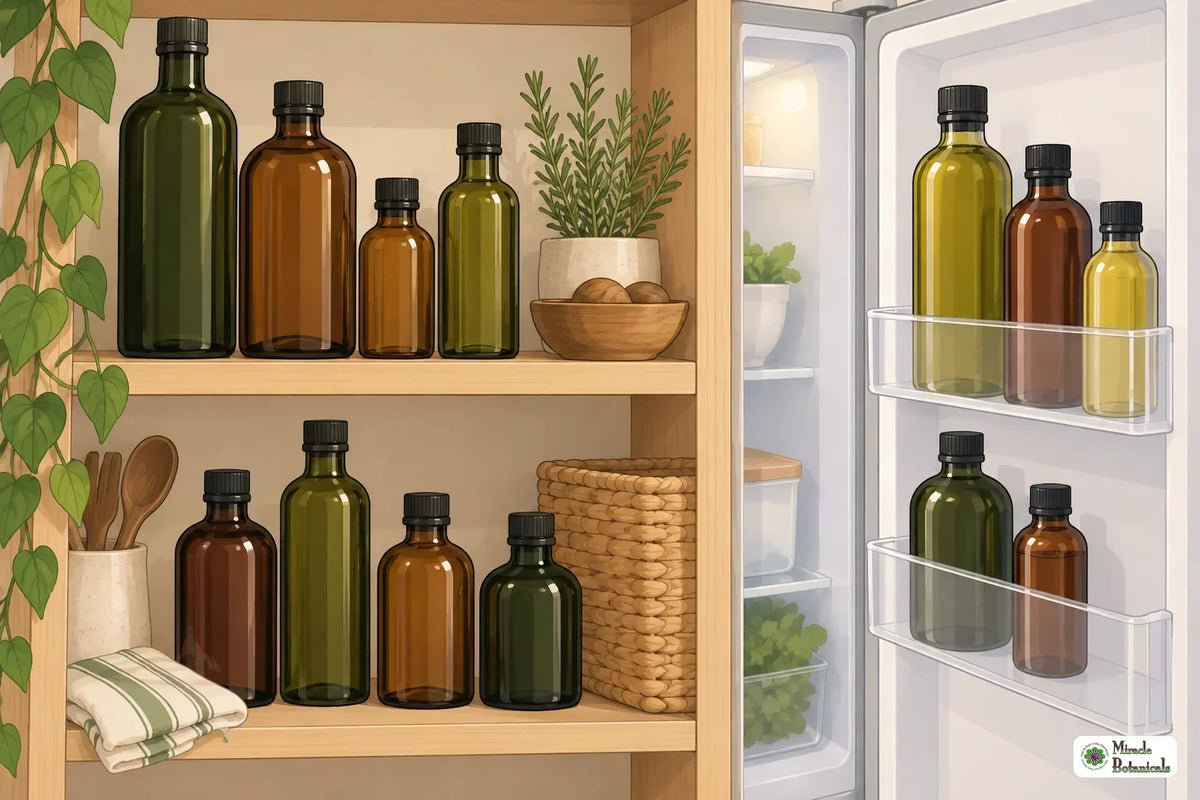
Refrigerate polyunsaturated carrier oils once they're open. Rosehip, sea buckthorn seed and kukui are the clearest cases, and one supplier also recommends the fridge for long-term argan storage. Oils led by monounsaturated or hydroxylated fatty acids, castor among them, keep well in a cool, dark cupboard within their suppliers' storage ranges.
Heat matters most. In the Gharby study, argan oil stored at 104°F (40°C) lost quality rapidly; at 77°F (25°C) it held up for months. A kitchen shelf near a stove or a sunny bathroom windowsill works against you.
Suppliers specify 59-86°F (15-30°C) for sealed castor, 50-77°F (10-25°C) for meadowfoam, and at or below 72°F (22°C) for macadamia. Our kukui product page advises refrigerating kukui after opening, then letting it come back to room temperature before use.
Why refrigerated oil turns cloudy
Cold can make some oils hazy or grainy as their higher-melting fats crystallize. A formulation supplier notes that tamanu "may naturally separate or solidify at cold temperatures." Meadowfoam resists this: its spec sheet records a cold test of more than 48 hours at 45°F (7°C). Haze that clears once the oil reaches room temperature is a temperature effect, not spoilage.
Does vitamin E extend carrier oil shelf life?
Vitamin E (tocopherol) can extend carrier oil shelf life somewhat, but it slows oxidation rather than stopping it, and it only works when added to fresh oil. It won't rescue an oil that already smells off. It also isn't a preservative, so it does nothing against mold or bacteria.
Most carrier oils already contain tocopherols, and more isn't automatically better. A 2006 review by Kamal-Eldin in the European Journal of Lipid Science and Technology found tocopherols work well at low concentrations but gradually lose efficacy as their concentration rises, an effect sometimes called pro-oxidant. The review notes that natural tocopherol levels in vegetable oils seem close to the optimum already.
Timing matters too: one supplier notes that antioxidants must go into oils while fresh, before oxidation has started. A formulation supplier's vitamin E listing adds that it "will not provide preservation properties" to a finished product. For a home bottle of rosehip, the fridge does more than an additive.
How should you store carrier oils so they last?
Keep carrier oils in dark glass with the cap screwed tight, somewhere cool and out of sunlight, and buy a size you'll finish within the oil's window. Oxygen and light start rancidity and warmth accelerates it, so anything that limits them buys time. Write the opening date on the label.

Air in the bottle counts. Suppliers refill the headspace of opened containers with argon or nitrogen; at home, decanting a large bottle into smaller full ones leaves less oxygen above the oil.
Storage decides how long an oil stays good, but it can't fix what was in the bottle on day one. Miracle Botanicals is a small family-run business on the Big Island whose oils are third-party tested for synthetics, pesticides and adulteration. Essential oils oxidize too, though their shelf life follows different rules and is a separate topic.
One rule covers most cases: the more polyunsaturated the oil, the shorter its life and the sooner it belongs in the fridge once opened. When the label date and your nose disagree, believe your nose.