
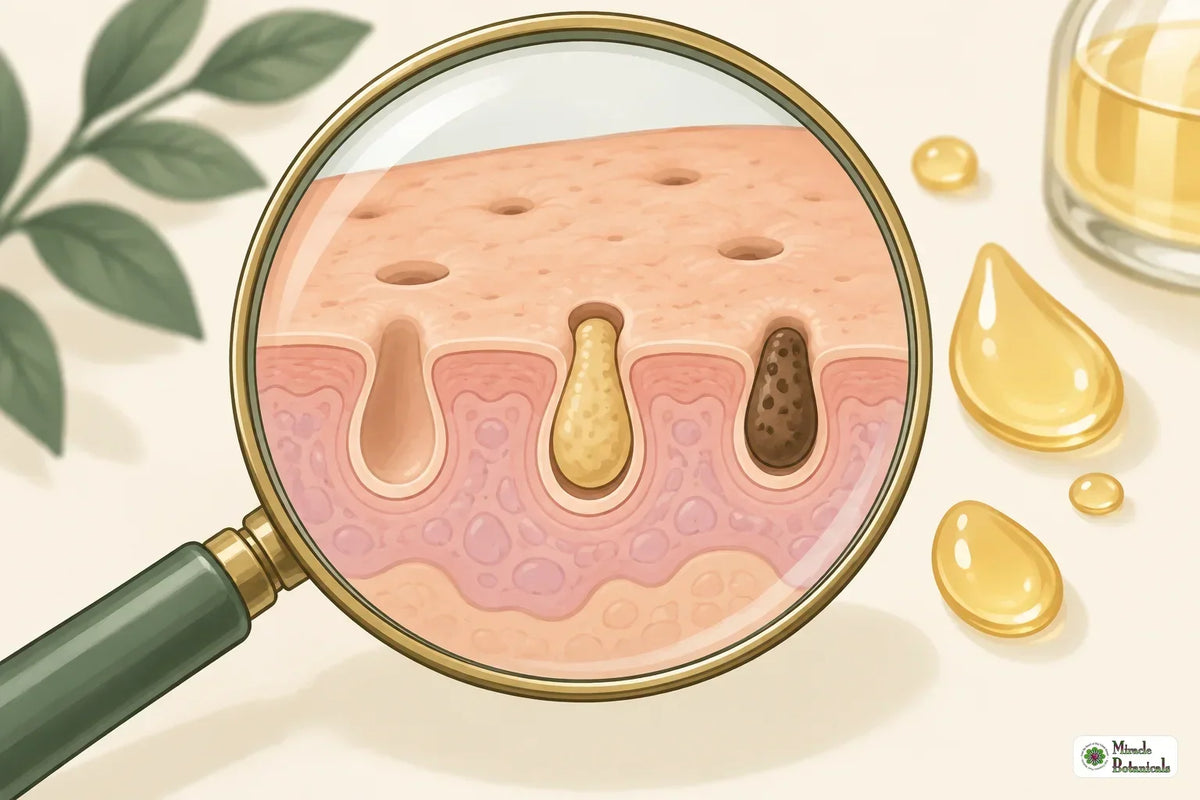

A comedogenic rating is a 0-5 score for how much an ingredient plugged hair follicles in a rabbit-ear test, with 0 meaning no significant plugging. Of the 14 carrier oils Miracle Botanicals stocks, only three have a published comedogenic rating: castor oil (1), squalane (1) and apricot kernel oil (2). The rest have none.
Those three numbers come from one 1989 study and carry less weight than most charts imply. If you're still choosing a base oil by texture or skin type, start with the best carrier oil for essential oils. For how many drops go into that carrier before it touches your skin, use the essential oil dilution chart.
What is a comedogenic rating?
A comedogenic rating is a grade from 0 to 5 that records how strongly a substance caused follicular keratosis (a buildup of skin cells that plugs the pore) when it was spread on the inner ear of albino rabbits for two weeks. Low grades meant little or no plugging. Grades 4 and 5 counted as a clear positive.

Albert Kligman and Otto Mills described "acne cosmetica" in 1972 in Archives of Dermatology, a low-grade, persistent acne in adult women that they tied to cosmetics. Dermatologist James Fulton then used the rabbit ear, a model in use since the mid-1950s, to screen ingredients and finished products (Fulton, Pay and Fulton, 1984).
The oil grades here come from Fulton's 1989 paper in the Journal of the Society of Cosmetic Chemists. Three albino rabbits each get 1 ml of test material on one inner ear, five days a week for two weeks, with the other ear left as a control. The grade comes from the measured width of six follicles.
| Grade | Follicle width in the rabbit ear | Fulton's reading |
|---|---|---|
| 0 | 0.009 in (about 0.23 mm) or less | No significant increase in follicular keratosis |
| 1 | 0.010-0.014 in | Not significant |
| 2 | 0.015-0.019 in | Moderate increase, borderline |
| 3 | 0.020-0.025 in | Borderline |
| 4 | 0.025-0.029 in | Extensive increase, positive |
| 5 | 0.030 in (about 0.76 mm) or more | Large comedones throughout the ear, positive |
Grade 5 was benchmarked against isopropyl myristate, a cosmetic emollient Fulton used as his "positive" control. Irritancy got its own 0-5 scale, from no irritation up to dead, peeling skin. An oil can grade 0 for pores and still redden skin, which is why how to patch test an essential oil applies to every new blend.
What does a comedogenic rating of 0 mean?
A comedogenic rating of 0 means the ingredient caused no significant increase in follicle plugging in the rabbit ear, at the concentration and in the base Fulton tested it in. It doesn't mean the oil can't clog anyone's pores. Fulton grouped 0 with 1: he wrote that a grade of 0 to 1 is "not considered significant."
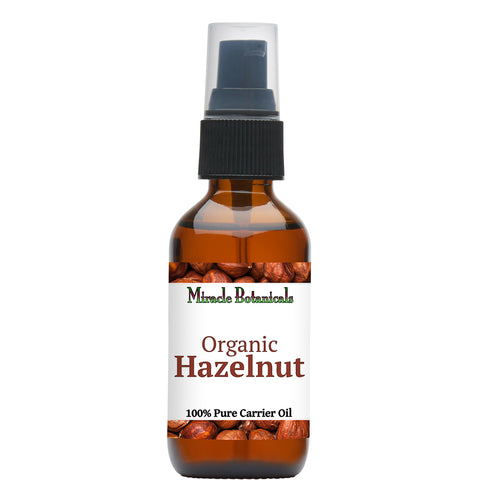
"Non-comedogenic" on a bottle is the marketing version of a low grade. No carrier oil on our shelf can claim it on test data, including virgin organic hazelnut oil, which we couldn't find in any published comedogenicity table.
Ranking a 0 oil above a 1 oil also splits a difference the researcher who ran the test didn't recognize. A 2 isn't "slightly comedogenic" in any measured sense either. Fulton called 2 and 3 borderline, and only 4 and 5 counted as a reproducible positive.
Which stocked carrier oils have a published comedogenic rating?
Three do. In Fulton's 1989 table, castor oil and squalane each graded 1 and apricot kernel oil graded 2, all with an irritancy grade of 0. The other eleven oils in our range have no rating in the published rabbit-ear or human-assay papers we checked, so they're marked "none found" below rather than given a borrowed number.
| Oil | Rating (0-5) | Source of rating | Notes |
|---|---|---|---|
| Castor oil (Ricinus communis) | 1 | Fulton 1989, Table I | Irritancy 0. Ours is cold-pressed in India. Thick and sticky, which makes it hard to use as a blend's only base. |
| Squalane, plant-derived | 1 | Fulton 1989, Table I | Irritancy 0. Fulton didn't name his squalane's source; ours is derived from olives or sugarcane. A refined hydrocarbon, not a pressed oil, but it dilutes essential oils the same way. |
| Apricot kernel oil (Prunus armeniaca) | 2 (refined sample: 1) | Fulton 1989, Table I | Irritancy 0. Borderline on Fulton's reading. Ours is virgin and cold-pressed (Turkey), so the 2 is the closer match, not the refined 1. |
| Argan oil (Argania spinosa) | None found | n/a | Cold-pressed, Morocco. Medium texture. |
| Hazelnut oil (Corylus avellana) | None found | n/a | Virgin, cold-pressed, France. The product page describes its consistency as thick. |
| Oil | Rating (0-5) | Source of rating | Notes |
| Rosehip seed oil, CO2-extracted (Rosa canina) | None found | n/a | Germany. 51.7% linoleic acid per the product page. |
| Tamanu oil (Calophyllum inophyllum) | None found | n/a | Cold-pressed and unfiltered, Vietnam. Small fat granules that melt on contact with skin. |
| Kukui nut oil (Aleurites moluccana) | None found | n/a | Cold-pressed in Hawai'i. |
| Macadamia nut oil (Macadamia integrifolia) | None found | n/a | Expeller-pressed on the Big Island. |
| Meadowfoam seed oil (Limnanthes alba) | None found | n/a | Cold-pressed, USA. Thick. |
| Moringa seed oil (Moringa oleifera) | None found | n/a | Cold-pressed, India. Cloudy. |
| Black seed oil (Nigella sativa) | None found | n/a | Cold-pressed, Turkey. Thin for a carrier. |
| Neem seed oil (Azadirachta indica) | None found | n/a | Cold-pressed, India. Thick, dark green, strong smell. |
| Sea buckthorn seed CO2 total extract (Hippophae rhamnoides) | None found | n/a | Germany. 39.0% linoleic acid per the product page. |
"None found" isn't code for safe or risky. It means nobody has published a test for that oil, so any number you see for it elsewhere has no assay behind it that we could trace. Torn between two unrated face oils? Rosehip oil vs argan oil compares them.
The notes above come from our product pages. We're a family-run supplier on the Big Island of Hawai'i, and every oil is third-party tested for synthetics, pesticides and adulteration. That confirms what's in the bottle, not how your pores will respond.
Are comedogenic ratings reliable?
Comedogenic ratings are a rough screening signal, not a forecast for your skin. The animal model overreacts, the tests graded single ingredients rather than finished blends, and one ingredient can score differently from another supplier or in another base. Use the scale to flag strong offenders at 4 or 5, not to rank oils scoring 0 to 2.
The rabbit ear is more sensitive than your face
Fulton named the model's "extreme sensitivity" as its main drawback. The rabbit's inner ear reacts within two weeks; by his estimate, human skin can take six months. Mills and Kligman later built a human test, applying substances under occlusion for a month to the upper backs of young Black men with large follicles. They concluded the rabbit model is more sensitive than human skin (Archives of Dermatology, 1982).
A single ingredient isn't a finished blend
Draelos and DiNardo tested finished cosmetics on six people with large pores who form comedones easily, patching the upper back three times a week for four weeks and counting microcomedones with glue-strip (cyanoacrylate) biopsies. Their 2006 conclusion in the Journal of the American Academy of Dermatology: finished products made with comedogenic ingredients are not necessarily comedogenic. Six people is a small sample, but it broke the assumption that an ingredient's grade carries straight through to the product.
Concentration and base change the score
Fulton tested ingredients at 10% in propylene glycol unless otherwise indicated, and the oil rows don't say how each oil was run. In a facial oil, the carrier is nearly the whole bottle. The base matters too. Retested in sunflower oil instead of a volatile solvent, palmitic acid went from 0 to 2 and lauric acid from 3 to 4.
Your pores aren't a rabbit's
Both human assays had to hand-pick volunteers who form comedones readily, which tells you plenty of people don't. Mills and Kligman judged substances weakly comedogenic in rabbits probably safe for people, with one possible exception: acne-prone skin.
Fulton's own table hedges, and charts copy it loosely
The oils section of Fulton's table carries a footnote: results depend on the source of the raw material. Mineral oil is listed as 0-2, refined sesame oil graded 1 against 3 for the standard sample, and refined avocado oil 2 against 3. Online charts round these figures and extend them to untested oils. One widely shared retailer chart gives argan oil a 0 without citing any study, though argan isn't in Fulton's table.
What is the best carrier oil for acne-prone skin?
On published data, squalane is the most practical low-rated choice we stock. It graded 1, which Fulton counted as not significant, and it's light enough to use as a whole base. Castor oil also graded 1 but is too heavy to use alone. No carrier oil treats or clears acne, and none is guaranteed to suit every skin.

Apricot kernel oil, at 2, sits in Fulton's borderline band. That doesn't rule it out; it's just the one rated oil here that calls for extra care if you clog easily.
For the eleven unrated oils, your own skin is the only assay available. Copy the human studies: one new oil at a time, on one area, for about four weeks before you judge it, because comedones build slowly. Keep the rest of your routine unchanged so a breakout has one suspect. And dilute: the Tisserand Institute's safety guidelines say not to put essential oils on skin undiluted.
The American Academy of Dermatology suggests "non-comedogenic" or "won't clog pores" sunscreen for people with acne, and a board-certified dermatologist if breakouts continue (AAD, acne tips). Persistent or painful acne needs that appointment, not a new carrier oil.
How should you use a comedogenic chart?
Use a comedogenic chart as a filter, not a ranking. Treat a 4 or 5 as a reason to skip an ingredient, ignore the gaps between 0, 1 and 2, and ask any chart where its number came from. If your pores are the worry, start with squalane and let a four-week trial on your own skin outvote the table.