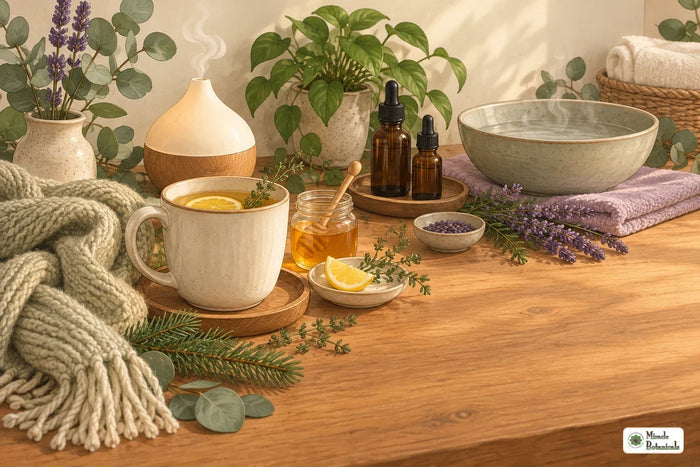



Essential oils for colds are aromatic plant oils used by inhalation to make the 7 to 10 days of a common cold more comfortable. The 12 oils on this page are ranked by the constituent that does the work, which is 1,8-cineole in eucalyptus, ravintsara and rosemary, and menthol in peppermint. No essential oil shortens a cold. The safest methods are a diffuser at 3 to 5 drops per 100 mL of water and a 2% to 3% chest rub for adults, which is 12 to 18 drops in 30 mL of carrier oil. The sections below list the 12 oils with Latin names and constituent ranges, name the best oil by age, match oils to 6 symptoms, give a 3-oil blend and set the safety limits. The supplementary part answers whether essential oils can shorten a cold and how to use them through cold season.
Which 12 essential oils help with a cold?
The 12 essential oils that help with a cold are eucalyptus radiata, eucalyptus globulus, ravintsara, rosemary cineole, peppermint, tea tree, thyme linalool, lemon, balsam fir, black spruce, lavender and frankincense, ranked by their content of 1,8-cineole and menthol, the 2 constituents with published evidence for nasal comfort. A common cold is a viral infection of the nose and throat caused by more than 200 viruses, most often rhinoviruses, according to the Centers for Disease Control and Prevention.
The list below gives each oil with its Latin name, main constituent and the cold use it suits.
- Eucalyptus radiata (Eucalyptus radiata) is a leaf oil with 60% to 75% 1,8-cineole. Eucalyptus radiata is the first choice for an adult's diffuser during a head cold.
- Eucalyptus globulus (Eucalyptus globulus) is a leaf oil with 65% to 85% 1,8-cineole. Eucalyptus globulus suits steam inhalation and chest rubs for adults, and its limits are set out in the eucalyptus globulus oil profile.
- Ravintsara (Cinnamomum camphora CT 1,8-cineole) is a leaf oil from Madagascar with 50% to 65% 1,8-cineole. The label must read Cinnamomum camphora, because Ravensara aromatica is a different tree whose leaf oil can carry estragole, a compound Tisserand and Young restrict.
- Rosemary cineole (Salvia rosmarinus CT 1,8-cineole) is a leaf oil with 38% to 55% 1,8-cineole. Rosemary cineole suits daytime diffusing, because its aroma is alerting rather than sedating.
- Peppermint (Mentha × piperita) is a leaf oil with 30% to 55% menthol. Peppermint raises the sensation of cool airflow in the nose within seconds.
- Tea tree (Melaleuca alternifolia) is a leaf oil with 35% to 48% terpinen-4-ol. Tea tree is used in cold-season surface sprays, because terpinen-4-ol is the constituent tested against bacteria in the laboratory.
- Thyme linalool (Thymus vulgaris CT linalool) is a flowering-herb oil with 60% to 80% linalool. Thyme linalool is the mild chemotype, chosen over thyme thymol, whose dermal maximum is 1.3%.
- Lemon (Citrus limon) is a cold-pressed peel oil with 56% to 78% limonene. Lemon freshens a sickroom in a diffuser and is phototoxic on skin above 2%.
- Balsam fir (Abies balsamea) is a needle oil with about 30% beta-pinene and 8% to 16% bornyl acetate. Balsam fir is the conifer oil most diffused for children over 2.
- Black spruce (Picea mariana) is a needle oil with 25% to 37% bornyl acetate. Black spruce suits a bedroom diffuser when a cold brings fatigue.
- Lavender (Lavandula angustifolia) is a flower oil with 25% to 38% linalool and 25% to 45% linalyl acetate. Lavender is the oil for the sleep side of a cold.
- Frankincense (Boswellia carterii) is a resin oil with 30% to 65% alpha-pinene. Frankincense slows the breath and rounds off the sharp scent of eucalyptus.
The first 5 oils share 1,8-cineole or menthol and do the nasal work, and the other 7 support cleaning, rest and scent.
What is the best essential oil for colds?
The best essential oil for colds in adults is eucalyptus radiata, because it carries 60% to 75% 1,8-cineole, the one constituent with controlled-trial evidence for nasal comfort, in a softer aroma than eucalyptus globulus. For children under 10 the best oil is balsam fir in a diffuser, because fir carries almost no cineole or menthol.
1,8-cineole has 2 placebo-controlled trials behind it, both using oral pharmaceutical capsules rather than inhaled oil. Cineole at 200 mg 3 times daily for 7 days reduced symptom scores in 152 patients with acute rhinosinusitis, according to a 2004 trial by Kehrl, Sonnemann and Dethlefsen in the Laryngoscope. Cineole at the same dose for 10 days reduced cough frequency in 242 patients with acute bronchitis, according to a 2013 trial by Fischer and Dethlefsen in the journal Cough.
Menthol raises the sensation of nasal airflow by acting on cold receptors in the nose, without widening the nasal passage on measurement, according to reviews by Ronald Eccles of the Common Cold Centre at Cardiff University. Peppermint is therefore the second choice for adults and is not used near the face of children under 3. The 10 oils that open a blocked nose, ranked by cineole content, are in the list of 10 essential oils for congestion.
Which essential oils match each cold symptom?
Essential oils match 6 cold symptoms, which are a blocked nose, a runny nose, a cough, a sore throat, body aches and broken sleep, with 1,8-cineole oils for the nose and chest, lavender for sleep, and conifer oils for aches. The table below matches each symptom to its 2 best oils, the constituent behind the choice and the method that fits.
| Cold symptom | Oils most used | Constituent behind the use | Method and amount |
|---|---|---|---|
| Blocked nose | Eucalyptus radiata, peppermint | 1,8-cineole, menthol | Diffuser, 3 to 5 drops per 100 mL, 30 to 60 minutes |
| Runny nose | Eucalyptus globulus, ravintsara | 1,8-cineole | Steam inhalation, 2 to 3 drops, 5 to 10 minutes, adults only |
| Chesty cough | Eucalyptus globulus, thyme linalool | 1,8-cineole, linalool | Chest rub, 3% for adults, 18 drops per 30 mL |
| Sore throat | Thyme linalool, lavender | Linalool | Diffuser in a humid room, 3 drops per 100 mL |
| Body aches | Black spruce, balsam fir | Bornyl acetate, beta-pinene | Bath, 5 drops dispersed in 15 mL carrier or bath oil |
| Broken sleep | Lavender, frankincense | Linalool, linalyl acetate, alpha-pinene | Diffuser, 3 drops per 100 mL, 30 minutes before bed |
Sleep is the symptom with the clearest evidence for an essential oil. Lavender inhalation for 5 nights improved self-rated sleep quality in 79 college students with sleep complaints, according to a 2015 trial by Lillehei, Halcón, Savik and Reis in the Journal of Alternative and Complementary Medicine. The steps for a bedtime routine are on the page about lavender oil sleep routine. A cold with 3 or more of these symptoms calls for a blend.
How do you make an essential oil blend for a cold?
To make an essential oil blend for a cold, combine 3 oils in a 5 mL bottle at a ratio of 3 parts eucalyptus radiata, 2 parts lavender and 1 part lemon, which is 30, 20 and 10 drops, then diffuse the stock blend or dilute it for skin. The 6 steps below make the blend and the 2 products from it.
- Drop 30 drops of eucalyptus radiata into an empty 5 mL amber glass bottle.
- Add 20 drops of lavender and 10 drops of lemon, for 60 drops or 3 mL of stock blend.
- Cap the bottle, roll it between the palms for 30 seconds and label it with the oils, the date and "undiluted".
- Diffuse 4 drops of the stock blend per 100 mL of water for 30 to 60 minutes, then pause for at least as long.
- Dilute 18 drops of the stock blend in 30 mL (1 oz) of jojoba or fractionated coconut oil for a 3% adult chest rub.
- Apply the chest rub to the upper chest and back twice a day for up to 5 days, below the collarbone and away from the face.
Swapping eucalyptus radiata for black spruce makes a version for a room shared with children aged 2 to 10, and 7 more recipes for a stuffy nose, a cough and a sore throat are on the page of diffuser blends for colds and congestion.
Are essential oils for colds safe for children and in pregnancy?
Yes, essential oils for colds are safe for adults and for children over 10 when diffused for 30 to 60 minutes or diluted to 3% or less, and the limits tighten for younger children, pregnancy and pets. Four groups need specific rules.
Safety and precautions for cold oils
- Children under 10. Eucalyptus, ravintsara and rosemary cineole are not applied to or near the face of children under 10, and peppermint is not applied to or near the face of children under 3, according to Tisserand and Young's Essential Oil Safety (2014), because 1,8-cineole and menthol can slow breathing in young children. A child over 2 can share a room with a diffuser running balsam fir or lavender at 2 to 3 drops per 100 mL, with the door open. Topical blends for children aged 2 to 6 stay at or below 1%, which is 6 drops in 30 mL. The oils and dilutions for each age are on the page about kids' dilution and age limits.
- Pregnancy. Eucalyptus radiata, lavender, lemon and frankincense at 1% or in a diffuser are the oils most midwives and aromatherapists accept after the first trimester. Peppermint and rosemary are kept to the diffuser in pregnancy.
- Steam inhalation. Steam with 2 to 3 drops of oil is for adults only, for 5 to 10 minutes with eyes closed. Scalds from tipped bowls of steaming water are a documented injury in children with colds, according to a 2012 report by Baartmans and colleagues in the British Journal of General Practice.
- Pets. Cats lack the liver pathway that clears terpenes and phenols, so eucalyptus, peppermint, tea tree and lemon are not diffused in a room a cat cannot leave, according to the ASPCA Animal Poison Control Center.
A cold with a fever above 39 °C (102 °F), symptoms beyond 10 days, or breathing difficulty is a reason to see a doctor.
Which pure, tested oils and which collection should you shop for a cold?
The oils worth buying for a cold are the 5 cineole and menthol oils, which are eucalyptus radiata, eucalyptus globulus, ravintsara, rosemary cineole and peppermint, plus lavender, bought from a seller who publishes a GC/MS report for each batch. Three checks separate a pure cold oil from a stretched one.
- Which bottle names the species and the chemotype, such as Eucalyptus radiata or Salvia rosmarinus CT 1,8-cineole, rather than "eucalyptus" or "rosemary" alone?
- Which report shows 1,8-cineole inside the published range for that species, which is 60% to 75% for radiata and 65% to 85% for globulus?
- Which bottle gives the country of origin and the distillation date, so that the 2 to 3 year shelf life of a cineole oil can be counted?
Eucalyptus is one of the most adulterated oils on the market, because added 1,8-cineole is cheap and raises the percentage on paper. A report with cineole alone and no minor constituents such as alpha-terpineol or limonene is a sign of a stretched oil, and how to check a GC/MS report for these red flags is explained on its own page.
Can essential oils shorten a cold?
No, essential oils cannot shorten a cold, because no published trial shows that inhaling or applying an essential oil reduces the 7 to 10 day course of a cold virus. The 2 cineole trials used 600 mg a day of a purified constituent by mouth and measured symptom scores, not cold duration. There is no published evidence that diffused eucalyptus, tea tree or any other oil lowers the viral load in the nose of a person with a cold.
The laboratory results for eucalyptus and tea tree vapours against influenza particles come from test chambers, not from people.
How do you use essential oils for cold season?
You use essential oils for cold season by diffusing a cineole oil for 30 minutes in the morning, keeping lavender for sleep at night, and pairing both with the 3 habits that have evidence, which are hand washing, 7 or more hours of sleep and vaccination. Adults who slept less than 6 hours a night were 4.2 times more likely to develop a cold after exposure to a rhinovirus than adults who slept 7 hours or more, in a 2015 study of 164 adults by Prather, Janicki-Deverts, Hall and Cohen in the journal Sleep.
Tea tree or lemon at 10 to 20 drops per 250 mL of water makes a surface spray for doorknobs and desks, and hand washing with soap for 20 seconds, as the Centers for Disease Control and Prevention advise, removes more virus than any spray. The full set of cold season oils, with the oils for headaches and for congestion, is grouped on the guide to essential oils for head and respiratory health.
Essential oils for colds from Miracle Botanicals
Miracle Botanicals sells about 200 single essential oils, each one steam-distilled, cold-pressed or CO2-extracted and tested by a third-party laboratory with GC/MS. Every product page names the Latin name, the plant part, the country of origin and the extraction method, and the GC/MS report for the batch is available on request. Eucalyptus radiata, eucalyptus globulus, ravintsara, rosemary cineole, peppermint, tea tree and the conifer oils named on this page are grouped in the essential oils for congestion collection, where each oil can be compared by species, chemotype and origin. Miracle Botanicals is based in Hawaii.