

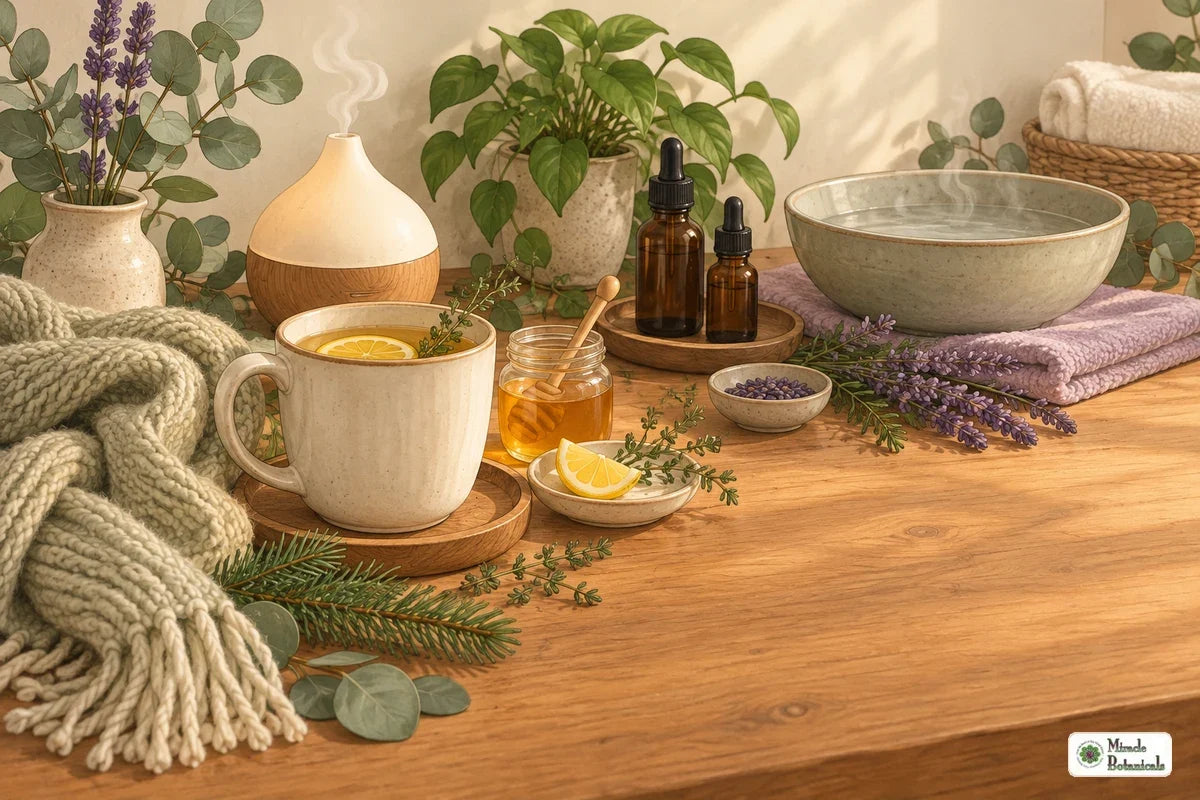

Essential oils for cough are aromatic plant oils used in a chest rub or a diffuser to make the up to 3 weeks of an acute cough more comfortable. The 8 oils on this page run from eucalyptus globulus to black spruce, ranked by their 1,8-cineole and menthol content. The best oil for a wet cough in adults is eucalyptus globulus at 3% in a chest rub, which is 18 drops in 30 mL of carrier oil, and the best oil for a dry cough is lavender in a diffuser at 3 drops per 100 mL. The sections below list the 8 oils with their constituent ranges, name the best oil by cough type, pair cough oils with cold oils, give 2 blends for wet and dry coughs, and set the rules for children. The supplementary part answers whether essential oils can stop a cough and when a cough needs a doctor.
Which 8 essential oils ease a cough?
The 8 essential oils that ease a cough are eucalyptus globulus, eucalyptus radiata, cajeput, peppermint, thyme linalool, lavender, frankincense and black spruce, ranked by their content of 1,8-cineole and menthol, the 2 constituents with trial evidence for cough comfort. An acute cough after a cold lasts up to 3 weeks, according to the American College of Chest Physicians, and the oils make those weeks easier rather than shorter. The first 4 oils suit a wet, chesty cough, and the last 4 suit a dry, tickly one.
The list below gives each oil with its Latin name, main constituent and the cough it suits.
- Eucalyptus globulus (Eucalyptus globulus) is a leaf oil with 65% to 85% 1,8-cineole. Eucalyptus globulus is the first choice for an adult chest rub during a wet cough, and its full constituent list and limits are in the profile of eucalyptus globulus constituents.
- Eucalyptus radiata (Eucalyptus radiata) is a leaf oil with 60% to 75% 1,8-cineole. Eucalyptus radiata is the softer eucalyptus for an adult's bedtime diffuser.
- Cajeput (Melaleuca cajuputi) is a leaf oil with 40% to 70% 1,8-cineole. Cajeput gives a chest rub a lighter, fruitier scent than eucalyptus.
- Peppermint (Mentha × piperita) is a leaf oil with 30% to 55% menthol. Peppermint cools the throat sensation and is used at 1 drop per 100 mL in a diffuser, never near the face of a child under 3.
- Thyme linalool (Thymus vulgaris CT linalool) is a flowering-herb oil with 60% to 80% linalool. Thyme linalool is the mild thyme chemotype used for a sore, coughed-raw throat in a diffuser.
- Lavender (Lavandula angustifolia) is a flower oil with 25% to 38% linalool and 25% to 45% linalyl acetate. Lavender is the first choice for a dry night cough that breaks sleep.
- Frankincense (Boswellia carterii) is a resin oil with 30% to 65% alpha-pinene. Frankincense slows the breath during a dry, irritable cough.
- Black spruce (Picea mariana) is a needle oil with 25% to 37% bornyl acetate. Black spruce is the conifer oil for a dry-cough diffuser in a room shared with children over 2.
The 4 cineole and menthol oils carry the published evidence, and the 4 soothing oils rest on traditional aromatherapy practice. Which of the 8 is best depends on whether the cough is wet or dry.
What is the best essential oil for cough?
The best essential oil for a wet cough in adults is eucalyptus globulus, because it carries 65% to 85% 1,8-cineole, the constituent that reduced cough frequency in a 242-patient trial, and the best essential oil for a dry cough is lavender, because a dry cough needs rest rather than cineole. A wet cough brings up mucus, and a dry cough does not.
1,8-cineole at 200 mg 3 times daily for 10 days reduced cough frequency in 242 patients with acute bronchitis, according to a 2013 placebo-controlled trial by Fischer and Dethlefsen in the journal Cough. The trial used oral pharmaceutical capsules, so it shows what the constituent does at a measured dose, not what a chest rub or diffuser delivers.
Inhaled menthol reduced the cough reflex response to citric acid in healthy volunteers, according to a 1994 study by Morice, Marshall, Higgins and Grattan in Thorax. Menthol is therefore the second choice for a tickly adult cough, and its age limits, dermal maximum of 5.4% and chemotype notes are on the peppermint oil profile. Most coughs arrive with a cold, which brings in the oils of the next section.
Which essential oils help with a cold and cough together?
The essential oils that help with a cold and cough together are eucalyptus radiata for the nose and chest, lavender for sleep and thyme linalool for the throat, used as 3 drops, 2 drops and 1 drop in a 100 mL diffuser. A cold adds a blocked nose, a sore throat and poor sleep to the cough, and no single oil covers all 4 symptoms.
The table below matches the 4 symptoms of a cold with cough to the oil, the constituent and the method.
| Symptom | Oil | Constituent | Method and amount |
|---|---|---|---|
| Chesty cough | Eucalyptus globulus | 1,8-cineole | Chest rub, 3% for adults, 18 drops per 30 mL |
| Blocked nose | Eucalyptus radiata | 1,8-cineole | Diffuser, 3 drops per 100 mL, 30 to 60 minutes |
| Sore throat | Thyme linalool | Linalool | Diffuser in a humid room, 2 drops per 100 mL |
| Broken sleep | Lavender | Linalool, linalyl acetate | Diffuser, 3 drops per 100 mL, 30 minutes before bed |
The 12 oils for a cold, including ravintsara, rosemary cineole and the conifer oils, with the blend for a full head cold, are on the page about essential oils for colds. A cough on its own, without the cold, calls for the 2 blends in the next section.
How do you make an essential oil blend for cough?
To make an essential oil blend for cough, mix 3 drops of eucalyptus globulus, 2 drops of thyme linalool and 1 drop of peppermint for a diffuser, or scale the same 3:2:1 ratio to 18 drops in 30 mL of carrier oil for a 3% adult chest rub. The blend is written for a wet cough in adults. The 5 steps below make the chest rub.
- Pour 30 mL (1 oz) of jojoba or fractionated coconut oil into an amber glass bottle.
- Add 9 drops of eucalyptus globulus, 6 drops of thyme linalool and 3 drops of peppermint, for 18 drops and a 3% dilution.
- Cap and roll the bottle between the palms for 30 seconds.
- Massage 5 to 6 drops of the rub into the upper chest and upper back, below the collarbone and away from the face, twice a day for up to 5 days.
- Label the bottle with the 3 oils, the dilution and the date.
A 3% dilution is a short-term level for adults, and 2% is the everyday level. The percentages for every body area and bottle size are in the dilution chart by body area. A dry cough needs a different set of oils, which follows.
How do you make an essential oil blend for dry cough?
To make an essential oil blend for dry cough, mix 3 drops of lavender, 2 drops of frankincense and 1 drop of black spruce in a 100 mL diffuser and run it in a humid room for 30 minutes before sleep. A dry cough is an irritated airway without mucus, so the blend leaves out cineole and menthol, which traditional aromatherapy practice reserves for wet coughs.
Humidity does half the work for a dry cough, and a humidifier in the bedroom adds more moisture than a diffuser. The same 6 drops scaled to 12 drops in 30 mL of carrier oil make a 2% rub for the throat and upper chest. Five more recipes, including diffuser blends for a cough and sore throat, with drop counts for 100 mL and 300 mL diffusers, are on the diffuser blend page. Every blend above is written for adults, and the rules for children follow.
Which essential oils are safe for kids' cough?
The essential oils that are safe for kids' cough are lavender, black spruce and frankincense in a diffuser for children over 2, with eucalyptus and cajeput added only after age 10 and peppermint only after age 3, according to Tisserand and Young's Essential Oil Safety (2014). The age rules exist because 1,8-cineole and menthol can slow breathing in young children. Three age bands set the limits.
Safety and precautions for cough oils
- Children under 2. No essential oil goes on the skin of a child under 2. A diffuser with 1 to 2 drops of lavender per 100 mL runs for 15 minutes with the door open, and never in the room of a baby under 6 months.
- Children aged 2 to 10. Lavender, black spruce, frankincense and balsam fir run in a diffuser at 2 to 3 drops per 100 mL for 30 minutes. A chest rub for a child aged 2 to 6 stays at or below 1%, which is 6 drops of lavender in 30 mL, and no cineole or menthol oil is applied to or near the face.
- Children over 10. Eucalyptus radiata and cajeput join the diffuser at 3 drops per 100 mL, and a 2% chest rub, which is 12 drops in 30 mL, goes on the chest and back.
A rub of camphor, menthol and eucalyptus oil was rated better than petrolatum and no rub at all for night cough and sleep in 138 children aged 2 to 11, according to a 2010 trial by Paul, Beiler, King, Clapp, Vallati and Berlin in Pediatrics, and the same trial recorded skin and nose irritation in some children. The rub was a regulated product at fixed low percentages, and the Tisserand and Young limits for pure cineole and menthol oils are stricter than its label. Honey outperformed dextromethorphan and no remedy at all for night cough in 105 children aged 2 to 18, according to a 2007 trial by Paul and colleagues in the Archives of Pediatrics and Adolescent Medicine, and honey is never given under 12 months because of infant botulism. The oils, dilutions and methods for each age are set out on the page about essential oils for children by age. These limits assume a pure oil, and the next question is how to be sure of that.
Which pure, tested oils and which collection should you shop for cough?
The oils worth buying for cough are eucalyptus globulus, eucalyptus radiata, cajeput and peppermint for a wet cough and lavender, frankincense and black spruce for a dry cough, bought from a seller who publishes a GC/MS report for each batch. A cough oil earns its place by its constituent percentage, so the report decides the purchase. Two checks separate a pure cough oil from a stretched one.
- Which bottle names the species and chemotype, such as Eucalyptus globulus or Thymus vulgaris CT linalool, rather than "eucalyptus" or "thyme" alone?
- Which report shows the main constituent inside its published range, which is 65% to 85% cineole for globulus and 60% to 80% linalool for thyme linalool?
Thyme is the oil in this list most often sold without a chemotype, and a thymol-type thyme at the same drop count irritates skin above 1.3%. The 9 checks that work and the 3 myths that do not are on the page about how to tell if an essential oil is pure. The last 2 sections answer the question most people ask at night and the question that decides when oils are the wrong tool.
Can essential oils stop a cough?
No, essential oils cannot stop a cough, because a cough is a reflex that clears the airway and no published trial shows that an inhaled or applied essential oil ends it. The cineole trial reduced how often 242 patients coughed with 600 mg a day of a purified constituent by mouth, and the menthol study reduced how easily healthy volunteers coughed when challenged with citric acid, for minutes rather than days.
There is no published evidence that a chest rub or diffuser changes the length of a post-viral cough, which runs 3 to 8 weeks on its own. An essential oil for cough is a comfort measure, in the same class as honey, a warm drink and a humid room.
When should a cough be seen by a doctor?
A cough should be seen by a doctor when it lasts more than 3 weeks, brings up blood, comes with a fever above 39 °C (102 °F) or with breathing difficulty, wheeze or a whooping sound, or occurs in a baby under 3 months, according to American Academy of Pediatrics and NHS guidance. Five signs settle the decision.
- A cough that lasts more than 3 weeks in an adult or more than 4 weeks in a child.
- Blood in the mucus, or mucus that turns rust-coloured or green with fever.
- A fever above 39 °C (102 °F), or any fever in a baby under 3 months.
- Breathing that is fast, laboured or wheezing, or a barking cough with difficulty breathing in.
- A whooping sound on the in-breath after a coughing fit.
The complete set of cough comfort oils, with the oils for headaches, colds and congestion, is grouped on the guide to essential oils for head and respiratory health.
Essential oils for cough from Miracle Botanicals
Miracle Botanicals sells about 200 single essential oils, each one steam-distilled, cold-pressed or CO2-extracted and tested by a third-party laboratory with GC/MS. Every product page names the Latin name, the plant part, the country of origin and the extraction method, and the GC/MS report for the batch is available on request. Eucalyptus globulus, eucalyptus radiata, cajeput, peppermint and the conifer oils named on this page are grouped in the congestion essential oils collection, where each oil can be compared by species, chemotype and origin. Miracle Botanicals is based in Hawaii.