
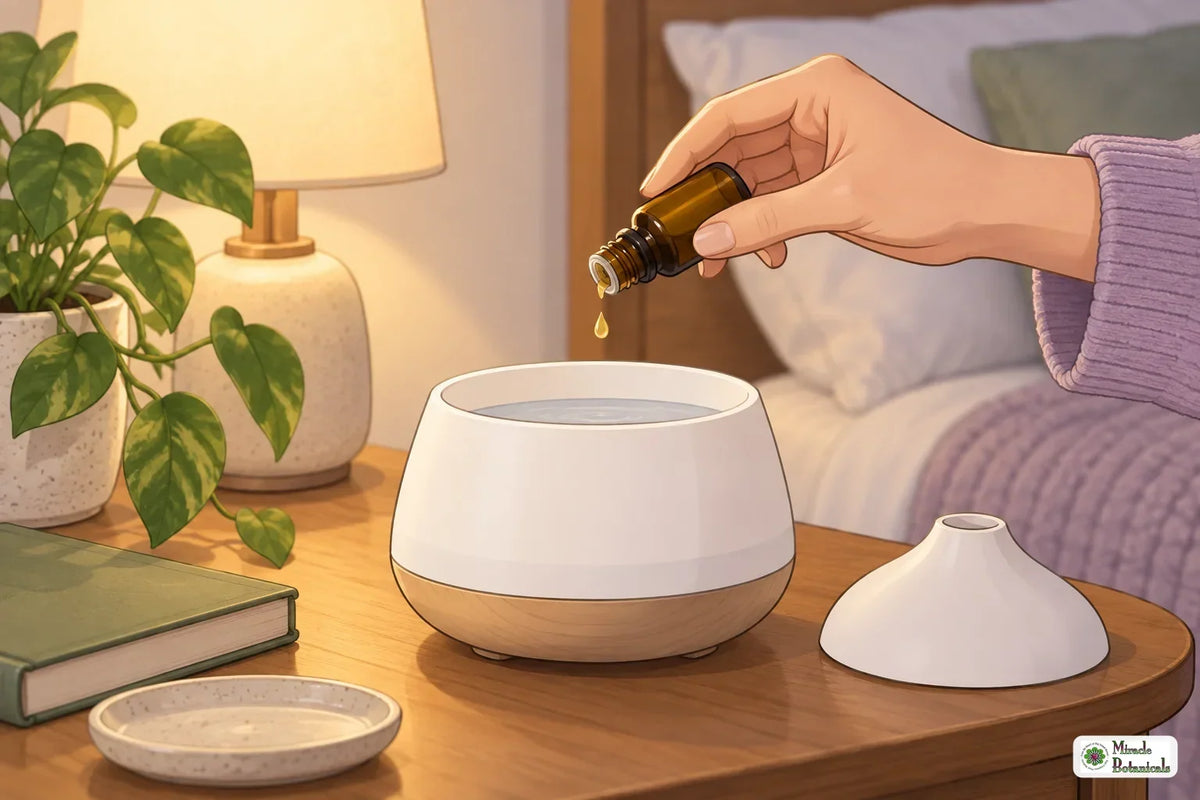

Start with 2-3 drops of essential oil per 100 ml (about 3.4 fl oz) of water, the amount InnoGear's manual gives for its 100 ml ultrasonic diffuser, and scale with tank size from there. Run the diffuser for 30-60 minutes, then leave it off for 30-60 minutes, which is the cycle the Tisserand Institute recommends.
There's no official answer to how many drops of essential oil in a diffuser is right. The Tisserand Institute's diffusion guidelines deal with timing and NAHA's guidance on inhalation deals with ventilation, but neither sets a drops-per-ml figure. So the numbers here come from manufacturer instructions, scaled with plain arithmetic and labelled that way. For how diffusing compares with pillow sprays and roller blends, see our guide on how to use essential oils for sleep.
Diffusing keeps oil off your skin. If a bedtime oil later ends up in a massage blend, work out the amount with the essential oil dilution chart and read how to patch test an essential oil before it touches your arm.
How many drops should you put in a 100 ml diffuser?
Two to three drops is a sensible start for a full 100 ml tank. That's the printed instruction for InnoGear's AD291D model, which says to adjust for scent strength. Using the Tisserand standard of 30 drops = 1 ml, 3 drops is 0.1 ml of oil, or about 0.1% of the water by volume.
Manufacturer numbers vary more than you'd expect. One ceramic diffuser's manual suggests 10-15 drops per fill for a room of about 500 sq ft, and 20-25 for larger spaces. That's roughly five times InnoGear's figure, and neither manual explains its reasoning. With no independent standard to settle the gap, start low. You can always add a drop next time. You can't take one out.
The oil itself changes the answer too. Take Sweet Marjoram essential oil: its product page describes the aroma as "strong, sweet, camphorous, herbal" and lists terpinen-4-ol (23.34%), gamma-terpinene (11.90%) and linalool (10.56%) as its main constituents. For an oil sold as strong, 2 drops in 100 ml is enough for a first night. The same page links to the oil's GC/MS test report, so you can check that composition yourself.
How many drops for a 200, 300 or 500 ml diffuser?
Keep the ratio at 2-3 drops per 100 ml of water, so the count rises with the tank: 4-6 drops for 200 ml, 6-9 for 300 ml and 10-15 for 500 ml. These figures are scaled from InnoGear's 100 ml instruction. No larger-tank manufacturer printed them, so treat them as a starting range, not a rule.

| Water in the tank | Low start (2 drops per 100 ml) | Upper start (3 drops per 100 ml) | Oil volume (30 drops = 1 ml) |
|---|---|---|---|
| 100 ml (3.4 fl oz) | 2 drops | 3 drops | 0.07-0.1 ml |
| 200 ml (6.8 fl oz) | 4 drops | 6 drops | 0.13-0.2 ml |
| 300 ml (10.1 fl oz) | 6 drops | 9 drops | 0.2-0.3 ml |
| 500 ml (16.9 fl oz) | 10 drops | 15 drops | 0.33-0.5 ml |
Source: 100 ml row from the InnoGear AD291D manual. The 200-500 ml rows are proportional arithmetic, not a manufacturer recommendation.
Count by the water you actually pour, not the size printed on the box. Half-fill a 300 ml diffuser and you're back to 3-4 drops. A bigger tank mostly buys a longer run before it empties, which matters for the timing rules below.
Waterless nebulizing diffusers don't fit this table at all, because they atomize undiluted oil, so follow that device's own manual.
Adjusting for room size
No published formula converts square feet into drops. The ceramic-diffuser manual mentioned above pairs 10-15 drops with a room of about 500 sq ft, while a 12 x 12 ft bedroom is 144 sq ft, under a third of that floor area. So in a small bedroom with the door closed, use the low column. Move toward the upper column in a larger room or an open-plan space, and only if you can't smell anything from across the room.
How long should you run a diffuser at a time?
Run it for 30-60 minutes, then turn it off for 30-60 minutes. The Tisserand Institute's guidelines call this intermittent diffusing more effective, and safer, than continuous use, because the body (the nervous system in particular) gets used to a scent after about that long. Running a diffuser nonstop, the Institute says, doesn't increase the benefit.
Research points the same way. In a study of 100 healthy spa workers in Taipei, Chuang and colleagues (European Journal of Preventive Cardiology, 2014) measured heart rate and blood pressure during two hours of exposure to oil vapor from an ultrasonic atomizer. Between 15 and 60 minutes, higher VOC levels went with lower readings. From 75 to 120 minutes, they went with higher ones. These were people at work, not sleepers at home, so read it as support for a time limit rather than proof of harm.
Watch the word "intermittent" on your diffuser's button, though. Built-in intermittent modes cycle in seconds. One ceramic model mists for 30 seconds and pauses for 30 seconds over 7.5 hours, and InnoGear's intermittent mode stretches a 100 ml fill across 6-8 hours. That's a thinner stream of vapor spread over a long night, not the 30-60 minute rest the Tisserand Institute describes. A one-hour timer, or switching off by hand, gets you much closer.
Is it safe to diffuse essential oils overnight?
Running a diffuser at normal strength all night isn't the conservative choice. The better pattern is to diffuse for up to an hour before bed and switch off when you lie down. The one exception the Tisserand Institute makes is a level so low the oil is barely noticeable, which it says is fine for any length of time.

The reason is the risk profile of inhaled oils. NAHA's safety page cites Tisserand and Balacs (Essential Oil Safety, 1995), who name prolonged exposure, perhaps an hour or more, to relatively high vapor levels as the main inhalation risk, with headaches, vertigo, nausea and lethargy as the result. Asleep, you won't notice those early signs, and you can't reach the switch.
Habituation works against you at night as well. A scent that seems to have "gone" after half an hour usually means your nose has adjusted, not that the room is empty. Don't top up the tank.
If you still want a trace of scent after lights out, use the low column of the table and let the timer end the session, rather than running a full tank on continuous mode.
Does a diffuser change the air in your bedroom?
Yes, measurably, and how much depends on the oil, the water and how well the room is ventilated. A University of Toronto chamber study in Indoor Air (Schwartz-Narbonne, Du and Siegel, 2021) found that an ultrasonic diffuser released both volatile organic compounds (VOCs) and fine particles. Lemon oil alone gave off 2.6 mg of d-limonene in 15 minutes.
Water type matters more than most people realize. In the same study, filling the diffuser with tap water instead of deionized water raised PM1 particle emissions about fivefold with eucalyptus oil. Distilled water is the easy fix, even though many manuals, InnoGear's included, accept tap water.
Ventilation is the other lever. NAHA describes inhalation as a very low-risk route for most people and still advises good ventilation, so leave the door ajar or crack a window rather than sealing a small room. The American Lung Association takes a firmer line: it doesn't recommend adding anything, essential oils included, to the air you breathe. That's worth weighing if anyone in your home has a lung condition.
Who should check with a doctor before using a diffuser?
Anyone with asthma or another lung condition, anyone pregnant, and anyone diffusing near a baby or young child should get personal advice first. These are the groups authorities single out. France's health safety agency, ANSES, advises against essential oil use by people with respiratory conditions, asthma in particular, and by pregnant women.
For asthma, the evidence is thin rather than reassuring. An AAAAI expert answer by physicians at Massachusetts General Hospital notes that no published studies have looked specifically at diffused oils and asthma, but diffusing releases terpenes and other VOCs linked to breathing symptoms. Their advice is caution, and stopping at the first cough or chest tightness is sensible.
During pregnancy, which oils to leave out (and whether to diffuse at all) is covered in essential oils to avoid during pregnancy. For a nursery or a child's bedroom, age matters more than drop count, so check essential oils safe for kids by age first. Pets have their own sensitivities, which this guide doesn't cover.
This article is educational and isn't medical advice. If you're pregnant, have a lung or heart condition, or are setting up a diffuser for a child, talk to your doctor, midwife or pediatrician before you begin.
What's the simplest bedtime routine to follow?
Fill the tank with distilled water, add 2 drops per 100 ml, and switch the diffuser on while you get ready for bed. Turn it off when you lie down or after an hour at most, keep a door slightly open, and add one more drop next time only if the scent was too faint.
If you keep one number in mind, make it the hour: the Tisserand Institute's guidance and the spa-worker study both point to it, whatever the drop count. Pick an oil whose makeup you can check for yourself. Miracle Botanicals publishes a GC/MS test report for every single essential oil on its product pages.