

Essential oils are diluted for skin by mixing a counted number of drops into a measured volume of carrier oil, at a percentage set by the body area. The face takes 0.5% to 1%, which is 3 to 6 drops per 30 mL (1 oz) of carrier oil, and the body takes 2% to 3%, which is 12 to 18 drops per 30 mL, according to Tisserand and Young's Essential Oil Safety (2014) and the National Association for Holistic Aromatherapy. The sections below give the method in 5 steps, the percentage for 9 body areas, the difference between 1% and 2%, and the drop maths for 4 bottle sizes. The supplementary part answers why the percentage changes across the body, who needs a lower dilution, and which essential oils carry their own skin maximum.
How do you dilute essential oils for skin?
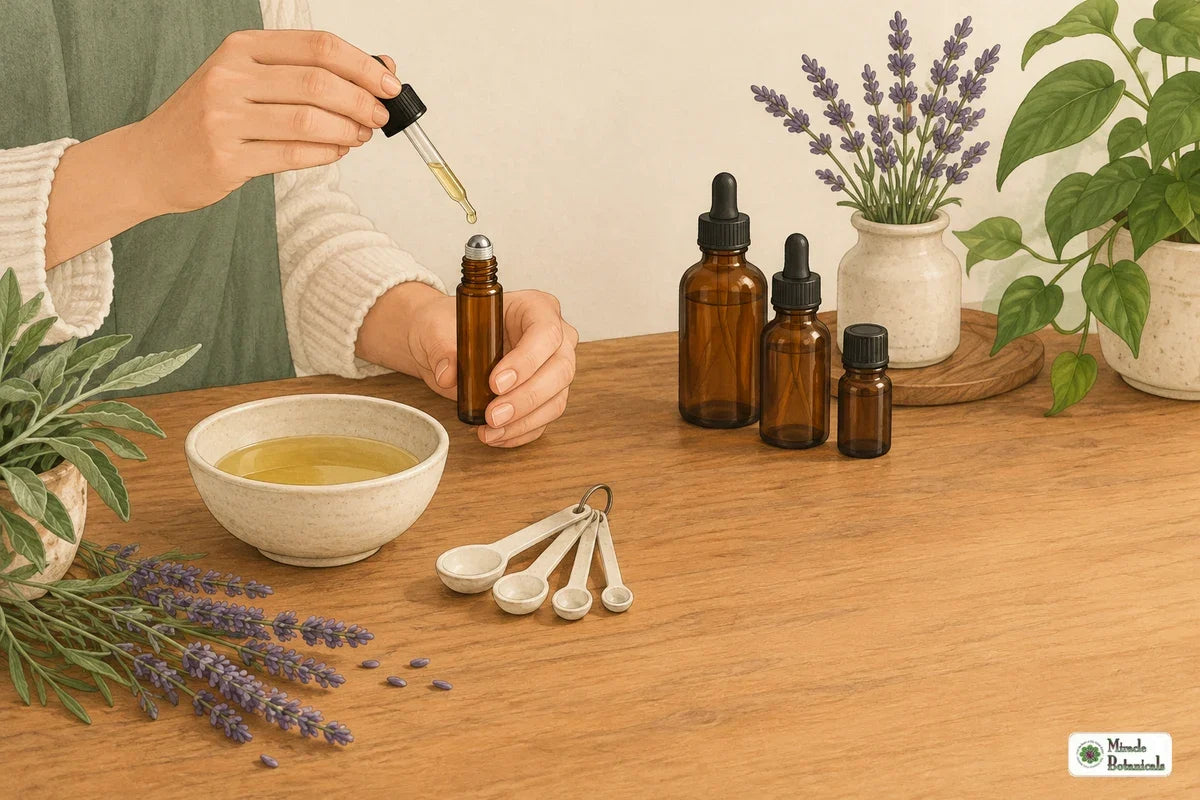
You dilute essential oils for skin by adding 3 to 18 drops of essential oil to 30 mL (1 oz) of carrier oil, which gives a 0.5% to 3% dilution, with the percentage chosen by body area. The method has 5 steps and takes about 5 minutes. A carrier oil is a fatty vegetable oil, such as jojoba, sweet almond or fractionated coconut oil, that spreads the essential oil across the skin and slows its absorption. The drop count follows the NAHA convention of 20 drops per mL.
Diluting an essential oil for skin takes 5 steps.
- Choose the body area, because the area sets the percentage, with 0.5% to 1% for the face and 2% to 3% for the body.
- Measure the carrier oil into a glass bottle, such as 10 mL for a roller or 30 mL (1 oz) for a body oil.
- Count the essential oil drops with the orifice reducer held vertical, at 2 drops per 10 mL for 1% and 12 drops per 30 mL for 2%.
- Cap the bottle and roll it between the palms for 30 seconds, so the essential oil disperses through the carrier oil.
- Patch test the blend on the inner forearm and wait 24 hours before applying it to a larger area.
Essential oils do not dissolve in water, so water, aloe gel and witch hazel are not carriers, and a blend made with them separates into undiluted drops. The fatty acid profile, absorption speed and shelf life of each base are compared in the guide to carrier oils for dilution. The first body area to settle, because it has the lowest percentage, is the face.
What dilution of essential oil is used for the face?
The dilution of essential oil used for the face is 0.5% to 1%, which is 3 to 6 drops per 30 mL (1 oz) of carrier oil or 1 to 2 drops per 10 mL, according to Tisserand and Young (2014) and NAHA guidance. Facial skin is thinner than body skin, sits close to the eyes and is exposed to sunlight every day. The epidermis of the eyelids is about 0.05 mm thick, against about 1.5 mm on the palms and soles. A 1% facial blend is the ceiling for daily use, and 0.5% is the starting point for a first blend or for reactive skin.
The face has 3 zones with different needs. The eye area takes no essential oil, because the orbital skin is the thinnest on the body and the eye itself is damaged by essential oil contact. The forehead, cheeks and chin take 0.5% to 1% in a carrier oil matched to the skin type, such as jojoba for combination skin or rosehip seed oil for dry skin. The lips take no essential oil, because lip skin lacks the oil glands that protect the rest of the face. Which base suits oily, dry, combination and mature skin is set out in the guide to the best carrier oil for facial skin type.
Phototoxic citrus oils have a facial limit below 1%. Cold-pressed bergamot is capped at 0.4% and cold-pressed lime at 0.7% on any skin that will see sunlight within 12 to 18 hours, so a 1% facial blend of either oil exceeds its own maximum. The body, which is covered by clothing for most of the day, takes a higher percentage.
What dilution of essential oil is used for the body?
The dilution of essential oil used for the body is 2% to 3%, which is 12 to 18 drops per 30 mL (1 oz) of carrier oil, with 2% as the everyday default, according to the 1% to 3% adult range in Tisserand and Young (2014) and NAHA guidance. Each body area has its own percentage within the range, because skin thickness and absorption rate differ across the body.
The table below gives the percentage, the drop count per 30 mL of carrier oil and the reason for 9 body areas.
| Body area | Dilution | Drops per 30 mL (1 oz) | Reason for the percentage |
|---|---|---|---|
| Face (forehead, cheeks, chin) | 0.5% to 1% | 3 to 6 | Thin skin, daily sun exposure, close to the eyes |
| Eye area, lips, inside the nose | 0% | 0 | Mucous membrane or the thinnest skin on the body |
| Neck and chest | 1% | 6 | Thin skin that shows sun damage and sensitisation early |
| Scalp | 1% to 2% | 6 to 12 | Dense hair follicles absorb 3.5 times more than the forearm |
| Underarms | 1% | 6 | Shaved skin, sweat glands and frequent friction |
| Arms, legs, back and torso | 2% to 3% | 12 to 18 | The reference skin for the adult range |
| Hands and wrists | 2% | 12 | Frequent washing removes the blend within hours |
| Feet and soles | 3% | 18 | Thickest epidermis, lowest absorption, short-term local use |
| Genital skin and broken skin | 0% | 0 | Highest absorption and no protective barrier |
The forearm, which most skin absorption studies use as the reference area, sits in the middle of the range. The 3% figure for the soles and for sore muscles is a short-term local dilution, used for a few days on one area, not a daily full-body percentage. Some references allow up to 5% on a small area for a few days, a figure labelled as an upper limit rather than a default. Choosing between the two most used percentages, 1% and 2%, is the next question.
What is the difference between a 1 percent and a 2 percent dilution?
The difference between a 1 percent and a 2 percent dilution is 6 drops per 30 mL (1 oz) of carrier oil, with 1% at 6 drops and 2% at 12 drops, and the two percentages serve different skin areas and users. A 1% dilution is the facial, daily-use and sensitive-skin percentage. A 2% dilution is the adult body, massage and skin-care percentage.
The table below compares the two dilutions on the 5 attributes that decide the choice.
| Attribute | 1% dilution | 2% dilution |
|---|---|---|
| Drops per 10 mL roller | 2 | 4 |
| Drops per 30 mL (1 oz) bottle | 6 | 12 |
| Body area | Face, neck, underarms, scalp | Arms, legs, back, torso, hands |
| Users | Children 2 to 6, adults over 65, pregnancy after the first trimester, sensitive skin | Healthy adults 15 and over |
| Frequency | Daily, long-term | Daily for skin care, 1 to 3 times a week for massage |
Doubling the percentage does not double the scent or the effect on skin, because the carrier oil already spreads a 1% blend across the whole application area. A 2% blend applied to the face carries twice the risk of sensitisation for no added benefit, which is why the facial ceiling stays at 1%. Sensitisation is an allergic reaction that develops after repeated contact with an essential oil, often after weeks of daily use at too high a percentage or with no carrier at all. The reactions that follow undiluted or over-concentrated use are described in the guide to what happens without a carrier. Once the percentage is chosen, the remaining step is the arithmetic of drops to millilitres.
How much essential oil goes in carrier oil?
The amount of essential oil that goes in carrier oil is 2 drops per 10 mL for each 1% of dilution, which is 6 drops per 30 mL (1 oz) at 1%, 12 drops at 2% and 18 drops at 3%, at the convention of 20 drops per mL. The formula is carrier volume in mL, multiplied by 20 drops, multiplied by the percentage. A 30 mL bottle at 2% is 30 × 20 × 0.02, which is 12 drops. The same formula scales to any bottle size.
The table below gives the drop counts for 4 dilutions in the 4 bottle sizes most used for skin blends.
| Dilution | 5 mL | 10 mL roller | 30 mL (1 oz) | 100 mL (3.4 oz) |
|---|---|---|---|---|
| 0.5% | 0.5 (use 1 drop in 10 mL instead) | 1 | 3 | 10 |
| 1% | 1 | 2 | 6 | 20 |
| 2% | 2 | 4 | 12 | 40 |
| 3% | 3 | 6 | 18 | 60 |
A drop is not a fixed unit. Thick oils, such as vetiver, sandalwood and myrrh, give larger drops, and thin oils, such as lemon and eucalyptus, give smaller drops, so a counted drop ranges from about 0.03 mL to 0.07 mL. The 20 drops per mL convention sits in the middle of that range, so with thick oils the real percentage comes out higher than the drop count suggests. The full method for filling a 10 mL roller, from choosing the carrier to labelling the lid, is in the guide to roller bottle steps. The remaining sections answer why the percentage moves across the body, who needs a lower figure, and which oils have a limit of their own.
How do dilution percentages change for the face, body and sensitive areas?
Dilution percentages change for the face, body and sensitive areas because skin thickness and absorption rate vary across the body by a factor of up to 300, from the soles to the scrotum. The classic measurement is a 1967 study by Feldmann and Maibach in the Journal of Investigative Dermatology, which applied radiolabelled hydrocortisone to 13 body sites on male volunteers. Taking the forearm as 1, the scrotum absorbed 42 times as much, the forehead 6 times, the scalp 3.5 times, the palm 0.83 times and the sole 0.14 times. Essential oil constituents are smaller and more lipophilic than hydrocortisone, so the ratios are not exact for essential oils, but the ranking of body sites holds.
Three groups of body areas follow from the ranking. Sensitive areas are the genital skin, the eye area, the lips, the inside of the nose, the underarms and any broken skin, and these take 0% to 1%. Thin areas are the face, neck and chest, and these take 0.5% to 1%. Thick areas are the arms, legs, back, torso, hands and feet, and these take 2% to 3%. Mucous membranes, such as the inside of the mouth, nose and genitals, have no stratum corneum and absorb essential oils almost at once, which is why a hydrosol rather than an essential oil blend is used on them. The percentage changes again for 5 groups of users, whatever the body area.
Who needs a lower skin dilution?
Five groups of people need a lower skin dilution than the adult range, which are children aged 2 to 12, babies under 2, adults over 65, people who are pregnant and people with sensitive or allergy-prone skin. Each group has a percentage set by Tisserand and Young (2014) and the National Association for Holistic Aromatherapy.
The table below gives the percentage and the drop count per 30 mL for each group.
| User group | Dilution | Drops per 30 mL (1 oz) | Note |
|---|---|---|---|
| Babies under 2 years | 0% | 0 | Hydrosols or plain carrier oil only |
| Children 2 to 12 years | 0.5% to 1% | 3 to 6 | Peppermint not near the face under 3; 1,8-cineole oils not near the face under 10 |
| Adults over 65 | 1% | 6 | Thinner, drier skin and slower clearance |
| Pregnancy after the first trimester | 1% | 6 | Most oils avoided in the first trimester as a precaution |
| Sensitive or allergy-prone skin | 0.5% to 1% | 3 to 6 | Patch test every new oil for 24 hours |
The children's figures are the consensus value. Tisserand and Young's own age bands run higher, at 1% to 2% for ages 2 to 6 and 1.5% to 3% for ages 6 to 15, and these are labelled as the upper limit for a trained practitioner rather than the home default. Which oils suit each age, and which are kept away from children altogether, such as wintergreen and birch, are listed in the guide to essential oils for kids by age. A small group of essential oils stays below the body percentage for every user, because the oil itself sets the limit.
Which essential oils have their own skin maximum?
Eleven common essential oils have their own skin maximum below the 2% to 3% body range, which are bergamot, lime, lemon, bitter orange and grapefruit among the phototoxic oils, and cinnamon bark, clove bud, lemongrass, oregano, thyme and ylang ylang among the irritant oils. The maximums come from Tisserand and Young (2014), who drew the phototoxic figures from the International Fragrance Association standards. An oil's maximum overrides the body-area percentage whenever the maximum is lower.
The phototoxic group contains cold-pressed citrus oils that hold furanocoumarins, compounds that cause burns and dark patches when the skin is exposed to sunlight or a tanning bed within 12 to 18 hours of application. The maximums are 0.4% for bergamot, 0.7% for expressed lime, 2% for expressed lemon, 1.25% for bitter orange and 4% for grapefruit. Steam-distilled lime and lemon, and bergamot sold as FCF, are free of furanocoumarins and follow the ordinary body percentage. The full list of oils, their maximums and the waiting times are on the page about phototoxic essential oils.
The irritant group contains oils high in phenols and aldehydes. Cinnamon bark is capped at 0.07%, clove bud at 0.5%, lemongrass at 0.7%, ylang ylang at 0.8%, oregano at 1.1% and thyme of the thymol chemotype at 1.3%. A 0.07% dilution of cinnamon bark is about 1 drop in 70 mL of carrier oil, which is why cinnamon bark is diffused rather than applied to skin at home. These maximums, the ratios for every carrier volume, and the choice of carrier oil for each skin type are brought together in the parent guide to diluting essential oils, which holds the full dilution chart for the whole site.
Carrier oil blends from Miracle Botanicals
Miracle Botanicals sells single carrier oils and ready-made carrier oil blend formulas for the face, body, scalp and massage, each one cold-pressed or fractionated and sold with its botanical name and origin. A carrier oil blend formula gives a base matched to a skin type, so the only step left is counting the essential oil drops for the body area. Browse the carrier oil blend formulas to pick a base for a 1% facial blend or a 2% body oil, and pair it with any of the about 200 GC/MS-tested single essential oils in the store.