

An essential oil blend is a mix of 2 or more essential oils, made undiluted as a stock and then diluted in a carrier oil, water or alcohol for one use. To make one, you pick a top, a middle and a base note oil, mix them at a starting ratio of 30/50/20, which is 3, 5 and 2 drops in a 10-drop trial, and rest the stock for 24 to 48 hours. The ratio is a perfumery convention, and the dilution is the safety rule, so a 2% body oil takes 12 drops of stock in 30 mL (1 oz) of carrier oil at 20 drops per mL. The sections below give 7 blending steps, define the 3 notes, set the ratio by use, count the drops, dilute for 9 uses, test the blend and set the safety limits. The supplementary part answers when a finished blend is worth buying, which oils pair well, how to store a blend and where blending sits in the use of pure oils.
How do you blend essential oils together?
To blend essential oils together, you pick 1 top, 1 middle and 1 base note oil for one purpose, mix them in drops at a starting ratio of 30/50/20, rest the stock for 24 to 48 hours, and then dilute it for its use.
An essential oil blend is a mix of 2 or more essential oils made for one scent and one use. A blend is mixed undiluted as a stock, and the stock is diluted afterwards in a carrier oil, water or alcohol. The working size of a first stock blend is 5 mL, which is 100 drops at 20 drops per mL. The 7 steps below take about 20 minutes, plus the rest.
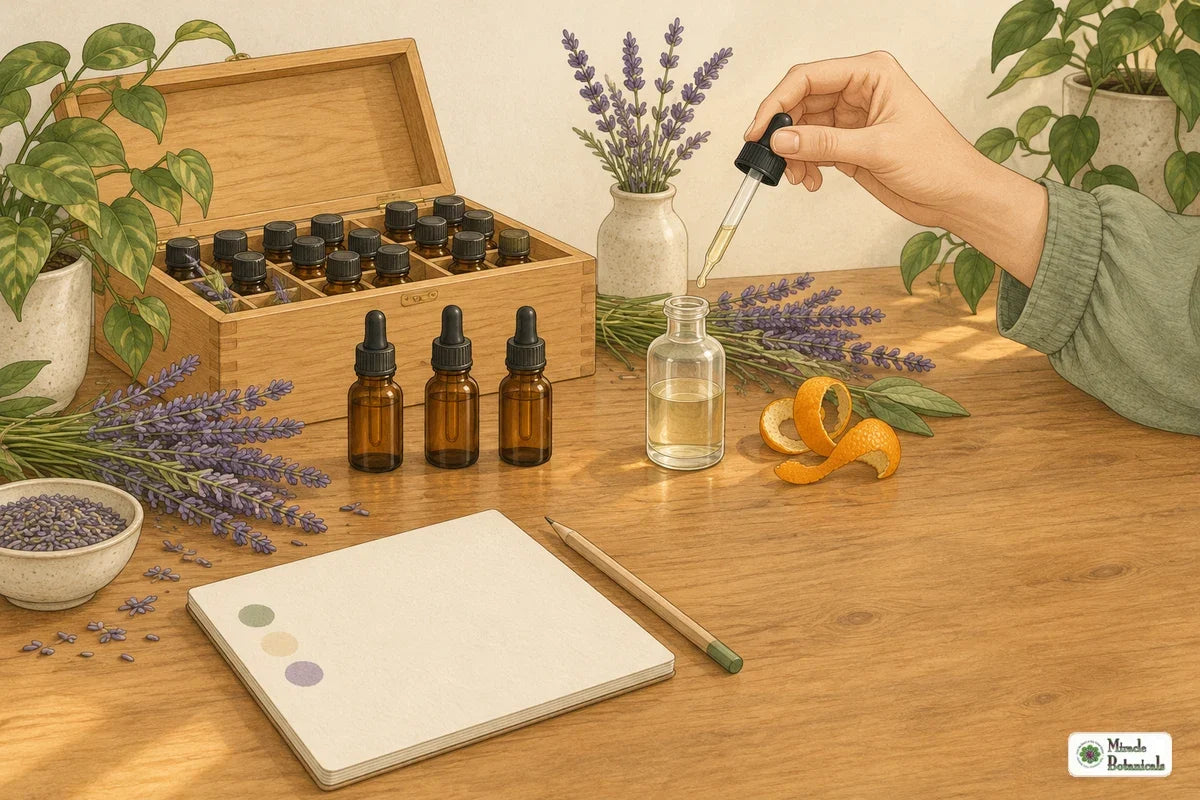
- Choose the purpose and the method, such as a diffuser blend for the evening or a 2% body oil, because the method sets the final dilution.
- Pick 3 oils, one from each note, such as bergamot as the top note, lavender as the middle note and cedarwood atlas as the base note.
- Smell the 3 oils together on paper scent strips held in a fan, and swap any oil that clashes.
- Mix a 10-drop trial of 3 drops top, 5 drops middle and 2 drops base in a small glass vial.
- Record every drop in a notebook, and adjust the trial 1 drop at a time until no single oil dominates.
- Scale the trial to a 5 mL stock of 30, 50 and 20 drops in an amber glass bottle, and label it with the oils, the date and "undiluted".
- Rest the stock for 24 to 48 hours, then dilute it for its use and patch test any skin product for 24 hours.
A skin product in step 7 needs a carrier oil, and jojoba and fractionated coconut keep longest, as the guide on how to choose a carrier oil explains. The 3 notes in step 2 are the core of blending, and the next section defines them.
What are top, middle and base notes?
Top, middle and base notes are the 3 classes of essential oils by evaporation speed, with top notes fading from a scent strip in under 2 hours, middle notes in 2 to 6 hours, and base notes lasting from 6 hours to several days.
A note is the place an oil takes in a scent over time. William Poucher, a British perfume chemist, ranked about 330 perfume materials from 1 to 100 by how long each lasted on a smelling strip, in a 1955 paper in the Journal of the Society of Cosmetic Chemists, with top notes at 1 to 14, middle notes at 15 to 60 and base notes at 61 to 100. The note follows the size of the molecule. Top notes are rich in monoterpenes such as limonene, at 136 g/mol. Middle notes are rich in monoterpene alcohols and esters such as linalool, at 154 g/mol, and linalyl acetate, at 196 g/mol. Base notes are rich in sesquiterpene alcohols such as santalol, at 220 g/mol, which evaporate slowly. The table below sets out the 3 notes by time on a strip, chemistry, example oils and role.
| Note | Time on a scent strip | Main chemistry | Example oils (Latin name of the first) | Role in a blend |
|---|---|---|---|---|
| Top | Under 2 hours | Monoterpenes, such as limonene and alpha-pinene | Bergamot (Citrus bergamia), lemon, sweet orange, peppermint, eucalyptus radiata | First impression; lifts the blend |
| Middle | 2 to 6 hours | Monoterpene alcohols and esters, such as linalool, linalyl acetate and geraniol | Lavender (Lavandula angustifolia), geranium, Roman chamomile, clary sage, rosemary | Heart; carries the character |
| Base | 6 hours to several days | Sesquiterpenes and sesquiterpene alcohols, such as santalol, patchoulol and khusimol | Vetiver (Chrysopogon zizanioides), patchouli, Hawaiian sandalwood, cedarwood atlas | Fixes and holds the scent |
A note is a convention, not a fixed value, and some oils span 2 notes, such as ylang ylang from middle to base and frankincense from top to base. Vetiver is the classic base note and holds a scent on a strip for more than 48 hours, as the profile of the vetiver base note sets out. The notes name the parts of a blend, and the ratio sets how much of each goes in.
What is a good ratio for an essential oil blend?
A good starting ratio for an essential oil blend is 30% top note, 50% middle note and 20% base note, which is 3, 5 and 2 drops in a 10-drop trial, and the ratio is a perfumery convention rather than a measured rule.
There is no published evidence that one ratio smells better or works better than another, and the 30/50/20 split is a teaching starting point that gives a balanced scent from 3 oils. The ratio shifts with 2 things, which are the use of the blend and the odour strength of each oil. The table below gives a starting ratio for 5 common uses, each one a convention.
| Use | Starting ratio, top/middle/base | Reason |
|---|---|---|
| Roller or body oil | 30/50/20 | A balanced scent over 2 to 6 hours on skin |
| Diffuser blend | 40/40/20 | Top notes carry in the air during a 30 to 60 minute session |
| Sleep or calming blend | 20/60/20 | A lavender or chamomile middle note leads |
| Natural perfume | 20/50/30 | More base note for 6 hours or more on skin |
| Room or linen spray | 50/30/20 | Fresh top notes for a short burst |
Odour strength overrides the ratio. A strong oil such as vetiver, patchouli, clove bud or Roman chamomile can take over a blend at 1 drop in 10, and a light oil such as sweet orange or lemon needs more drops to be noticed. Aromatherapy teaching scores this strength as a blending factor, and each common oil is scored on the blending factor chart. A ratio in percentages turns into drops at the next step.
How many drops of essential oil go in a blend?
The drops of essential oil in a blend depend on the bottle size and the dilution, at the convention of 20 drops per mL, so a 2% blend takes 4 drops in a 10 mL roller and 12 drops in 30 mL (1 oz) of carrier oil.
The formula is drops = mL × 20 × percentage, so a 1% blend in 30 mL is 30 × 20 × 0.01, which is 6 drops. A 5 mL undiluted stock holds 100 drops, which at 30/50/20 is 30 drops of the top note, 50 of the middle and 20 of the base. A drop is a convention rather than a unit, and a drop from an orifice reducer ranges from about 0.03 mL to 0.06 mL with the reducer and the thickness of the oil, so vetiver and sandalwood give larger drops than lemon or lavender. The chart of 6 dilutions across 6 bottle sizes, from 0.25% to 5%, is in the dilution ratio chart.
How do you dilute a blend for each use?
You dilute a blend for each use by its medium and skin area, at 0.5% to 1% for the face, 1% to 3% for the body, 3 to 5 drops per 100 mL for a diffuser and 10 to 20 drops per 250 mL for a spray.
The table below gives the amount and the drops of stock blend for 9 uses.
| Use | Dilution or amount | Drops of stock blend | Base |
|---|---|---|---|
| Face oil or serum | 0.5% to 1% | 1 to 2 in 10 mL; 3 to 6 in 30 mL | Jojoba or rosehip seed oil |
| Body or massage oil | 2% (range 1% to 3%) | 4 in 10 mL; 12 in 30 mL | Sweet almond, fractionated coconut or jojoba oil |
| Roller bottle | 1% to 2% | 2 to 4 in 10 mL | Fractionated coconut or jojoba oil |
| Short-term local use, adults | 3% | 6 in 10 mL; 18 in 30 mL | Any carrier oil, for a few days |
| Children aged 2 to 6 | Up to 1% | Up to 2 in 10 mL; up to 6 in 30 mL | Fractionated coconut or sunflower oil |
| Bath | Per bath | 5 to 10 | 15 mL of carrier oil or a solubiliser, never straight into the water |
| Diffuser | Per 100 mL of water | 3 to 5 | Water; 30 to 60 minutes, then a pause |
| Inhaler stick | Per wick | 10 to 15 | Cotton wick, no carrier |
| Room or linen spray | Per 250 mL of water | 10 to 20 | 30 mL of high-proof alcohol or a solubiliser |
The skin rows give the consensus ranges from Tisserand and Young's Essential Oil Safety (2014) and the National Association for Holistic Aromatherapy, and an oil with its own lower maximum, such as ylang ylang at 0.8%, overrides its row. Tank sizes and room sizes for a diffuser blend are on the page about drops per diffuser tank.
How do you test an essential oil blend before using it?
You test an essential oil blend before using it in 3 stages, which are a scent-strip test of the oils, a rest of the stock for 24 to 48 hours, and a 24-hour patch test of the diluted product on the inner forearm.
A scent strip is a narrow strip of unscented blotter paper dipped about 1 cm into an oil. Smelling the strips of a planned blend together at 0, 15 and 60 minutes previews its top, middle and base before a drop is mixed. A blend rests because its scent changes in the first days, as the oils mix and the sharpest top notes soften. Aromatherapy practice rests a diffuser or skin blend for 24 to 48 hours, and perfumers rest a perfume for 2 to 6 weeks before judging it. The diluted product then goes on a 2 cm square of the inner forearm, and wider use waits 24 hours with no redness or itching. How to read a red patch, an itch or no reaction is set out on the page about how to patch test a blend. A blend that passes all 3 stages still has to sit inside the safety limits.
Are homemade essential oil blends safe?
Yes, homemade essential oil blends are safe when the stock is diluted for its use, each oil stays under its own skin maximum, and oils that are phototoxic or unsafe for children or pets are left out where they do not belong.
A blend is only as safe as its riskiest oil at its share of the finished product. That share is the oil's part of the blend times the dilution, so bergamot at 30% of a blend diluted to 2% sits at 0.6% of the body oil. Cold-pressed bergamot is phototoxic above 0.4% on skin that meets sunlight within 12 to 18 hours, so the 30/50/20 example is made at 1%, which puts bergamot at 0.3%, or with bergamot FCF, which carries no phototoxic limit. The cold-pressed oils and their sun limits are listed on the page about phototoxic citrus oils.
Safety and precautions for blends
Six rules keep a homemade blend inside the safety limits.
- Skin maximums. Cinnamon bark at 0.07%, clove bud at 0.5%, lemongrass at 0.7%, ylang ylang at 0.8%, oregano at 1.1% and thyme thymol at 1.3% each have a maximum skin dilution in Tisserand and Young (2014), and the maximum applies to the oil's share of the product. Clove bud at 1 drop in a 10-drop blend diluted to 3% sits at 0.3%, under its 0.5% limit.
- Children. Blends for children aged 2 to 6 stay at or below 1%, peppermint stays away from the face of children under 3, and 1,8-cineole-rich oils such as eucalyptus and rosemary cineole stay away from the face of children under 10.
- Pregnancy. A blend used after the first trimester stays at 1%, and wintergreen, pennyroyal, sage, wormwood and camphor-rich oils are left out throughout pregnancy.
- Pets. Tea tree, peppermint, eucalyptus, cinnamon, clove, pine, ylang ylang and citrus oils are hazardous to cats, according to the ASPCA Animal Poison Control Center, so a blend that holds them is diffused only in a room a cat can leave.
- Containers. Stock blends go in amber or cobalt glass with glass pipettes, because limonene softens polystyrene and some other plastics.
- Oxidation. Citrus, pine and tea tree oils oxidise fastest, and oxidised oils sensitise skin that tolerated the fresh oil, so a stock with citrus is kept cool and closed and used within 1 to 2 years.
Each oil's maximum and the lower percentages for thin skin are listed on the page about skin limits by body area. A blend is never swallowed, and a child who swallows one needs a call to Poison Control (1-800-222-1222 in the United States).
Which finished blends are worth buying instead of mixing yourself?
Finished blends are worth buying instead of mixing yourself when the blend holds costly oils such as rose otto, neroli or sandalwood, when the same scent is needed batch after batch, or when 3 to 5 full bottles would cost more than one finished blend.
Mixing at home makes sense when the oils are already on the shelf and the blend is for one use. Four questions separate a well-made finished blend from a vague one.
- Which label lists every oil in the blend by its Latin name, rather than "proprietary blend"?
- Which label states whether the blend is undiluted or already in a carrier oil, and at what percentage?
- Which seller shows a GC/MS report for the finished blend or for each single oil in it?
- Which label gives the blending or bottling date, so the shelf life of its citrus oils can be counted?
A GC/MS report for a blend shows the constituents of every oil in it side by side, and how to check a GC/MS report for peaks and red flags is explained on its own page. The remaining 3 sections answer which oils pair well, how to store a blend and where blending sits in the use of pure oils.
Which essential oils blend well together?
Essential oils blend well together when they share a scent family or sit next to each other on the perfumer's fragrance wheel, such as citrus with floral, floral with woody, and woody with resinous or spicy oils.
Essential oils fall into 8 scent families, which are citrus, floral, herbaceous, minty, woody, resinous, spicy and coniferous. Five pairings work for most first blends.
- Lavender and cedarwood atlas, for a soft woody floral.
- Bergamot and frankincense, for a bright resinous blend.
- Sweet orange and clove bud, for a warm spice blend at 1 drop of clove in 10.
- Ylang ylang and sandalwood, for a deep floral base.
- Peppermint and eucalyptus radiata, for a cooling herbal blend for adults.
Twelve combinations with their drop counts are on the page of combinations that smell good.
How do you store a homemade blend?
You store a homemade blend in amber or cobalt glass, capped, below 25 °C (77 °F) and out of light, and an undiluted stock keeps as long as its shortest-lived oil, which is 1 to 2 years for a blend with citrus.
A diluted blend keeps as long as its carrier oil, which is 6 to 12 months for most blends, so the shorter shelf life sets the date on the label. A stock that smells flat, sour or like turpentine has oxidised and is discarded. The storage rules for single oils apply to blends, as the page on how to store essential oils sets out.
Where does blending sit in using pure essential oils?
Blending is the step after choosing, testing and diluting single oils, because a blend is only as pure as the single oils that go into it and only as safe as the dilution it ends in.
A blend of 3 oils with GC/MS reports, mixed at 30/50/20 and diluted so each oil stays under its own skin maximum, keeps every rule of the root guide intact. Choosing single oils, checking their purity and diluting them are set out in the root guide on how to use pure essential oils safely, the starting point for every blend.
Essential oil blends from Miracle Botanicals
Miracle Botanicals sells about 200 single essential oils, each tested by a third-party laboratory with GC/MS, and a range of 100% pure essential oil blends made from them. Every single-oil product page names the Latin name, the plant part, the country of origin and the extraction method. Finished blends such as Sleepy, Peace Potion and Earth are grouped in the essential oil blends collection, and glass bottles and 3 mL pipettes for home blending are sold beside them. Miracle Botanicals is based in Hawaii.