


Lavender oil for sleep has more research behind it than most aromatherapy uses, though the effect is modest. Small controlled trials of inhaled lavender essential oil found better self-rated sleep quality and, in one sleep-lab study, more deep sleep, with a dose as small as two drops. Treat it as a relaxation aid, not an insomnia treatment.
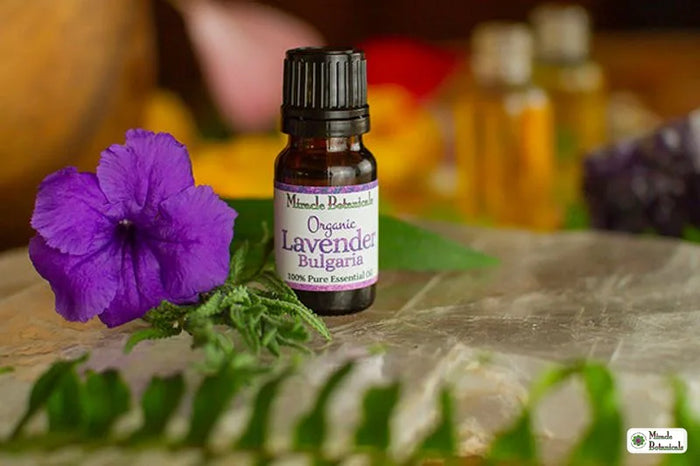
For the wider picture of diffusing, sprays, rollers and baths, start with our guide on how to use essential oils for sleep. This page sticks to the evidence and the practical details for true lavender, Lavandula angustifolia, the species in Miracle Botanicals' organic Bulgarian lavender essential oil.
Does lavender oil help you sleep?
Yes, modestly, and mainly for how well people feel they slept. A 2026 meta-analysis of 11 randomized trials with 628 adults found a moderate pooled improvement in sleep quality, and its authors still asked for higher-quality trials. No study has shown that lavender resolves a sleep disorder, and it doesn't replace medical care.
Most lavender trials score sleep with questionnaires such as the Pittsburgh Sleep Quality Index (PSQI), which asks how long you took to fall asleep, how often you woke and how you'd rate your sleep. That's a real outcome, but it isn't the same as sleeping longer. So expect a calmer wind-down, not an extra hour of sleep.
What did the main lavender sleep studies find?
The trials found small gains in specific groups of people. Goel's 2005 sleep-lab study recorded more deep sleep in 31 young adults, Lillehei's 2015 trial found better sleep quality in 79 students, and Karadag's 2017 trial reported better sleep scores in 60 coronary intensive care patients. Reviews rate the evidence as promising but limited by small, varied studies.

| Study | Design | Participants | Method | Finding | Limitation |
|---|---|---|---|---|---|
| Goel, Kim and Lao, 2005, Chronobiology International | Controlled crossover, sleep lab | 31 healthy adults, 18-30 | Lavender vs distilled water, 2 minutes of every 10 from 23:10 to 23:40 | More slow-wave sleep; more vigor next morning; other stage effects differed by sex | One night per condition |
| Study | Design | Participants | Method | Finding | Limitation |
| Lillehei et al., 2015, J Altern Complement Med | Randomized controlled trial | 79 students with sleep issues | Patch with 55 microliters of lavender oil worn 5 nights, plus sleep hygiene; control: blank patch plus sleep hygiene | Better PSQI scores, lasting to 2-week follow-up; more waking refreshed | Sleep quantity (Fitbit, diary) didn't differ |
| Karadag et al., 2017, Nursing in Critical Care | Randomized controlled trial | 60 coronary ICU patients | Inhaled 2% lavender oil over 15 days; control: no inhalation | Sleep and anxiety scores improved more than controls | No placebo scent; hospital setting |
| Fismer and Pilkington, 2012, Eur J Integr Med | Systematic review | 8 studies (4 randomized) | Lavender aroma only | "Small to moderate benefit" | Small, weak studies |
| Ostovar et al., 2025, Experimental Gerontology | Meta-analysis | 10 trials, adults over 60 | All inhalation | Pooled SMD -1.20 | Heterogeneity I² 87.5%; called preliminary |
| Shen, Zhang and Zhu, 2026, Holistic Nursing Practice | Meta-analysis | 11 RCTs, 628 adults | Lavender essential oil | Pooled SMD -0.56 | Needs higher-quality trials |
Objective results are mixed: Goel's sleep recordings showed more deep sleep, while Lillehei's trackers found no change in how long people slept. And none of the three trial abstracts reports the oil's linalool or camphor content, so you can't tell how closely the tested oil matches yours.
What is linalool, and why does it matter for sleep?
Linalool is a monoterpene alcohol that, together with its ester linalyl acetate, makes up the bulk of true lavender oil. It's one of the compounds researchers have tested to explain lavender's calming effect. In mice, linalool's scent reduced anxiety-like behavior only in animals that could smell, which points to the nose as part of the mechanism.
In that study (Harada et al., Frontiers in Behavioral Neuroscience, 2018), the effect also vanished when mice got flumazenil, a drug that blocks the benzodiazepine site on GABA-A receptors, the brain's main inhibitory system. It's an animal result about anxiety, not a human sleep finding.
The European Pharmacopoeia accepts lavender oil with 20-45% linalool and 25-47% linalyl acetate, and ISO 3515 sets narrower bands for each growing region (Crișan et al., Plants, 2023). Miracle Botanicals publishes a GC/MS report for every single essential oil, and the organic Bulgarian lavender page lists linalool at 31.56% and linalyl acetate at 29.25%.
How many drops of lavender oil should you use for sleep?
One or two drops is enough for inhalation. The patch in the Lillehei trial held 55 microliters of lavender oil, about 2 drops on the Tisserand standard of 30 drops per ml. Put the drops on a tissue or a personal inhaler on your nightstand, close enough to smell without pressing it to your face.

Pick the method first, then the amount:
- Tissue or personal inhaler: 1-2 drops.
- Diffuser: the amount depends on tank size; see how many drops of essential oil in a diffuser.
- Massage or roller on the skin: dilute first, using the essential oil dilution chart. At 1%, that's 3 drops of lavender in 10 ml (about 2 teaspoons) of carrier oil. Before the first use, learn how to patch test an essential oil.
- Pillow spray: lavender oil won't mix into plain water; see DIY pillow spray for sleep.
Keep close-up sniffing short. The Tisserand Institute's guidelines advise against direct, intensive inhalation for longer than 15-20 minutes, so set the tissue aside as you settle. More drops won't help you match the trial results either, since none of the studies tested whether a stronger scent works better.
When should you use lavender oil before bed?
No study in the table compared one timing with another, so the evidence only shows what worked inside each protocol. Goel's team released lavender scent for 2 minutes of every 10 between 23:10 and 23:40, and Lillehei's participants wore their patch through the night for five nights in a row.
For a home routine, the Lillehei result is the more useful one. Lavender plus sleep hygiene beat sleep hygiene alone, and both groups improved. That suggests using lavender at the same point each night as one step in a steady wind-down, rather than as a rescue at 2 a.m.
Should you choose lavender or lavandin for sleep?
Choose true lavender. The sleep reviews cited here were built around lavender oil, and lavandin (Lavandula x intermedia), a hybrid of true lavender and spike lavender, is chemically different. Lavandin and spike lavender oils carry more than 6% camphor, while ISO 3515 caps Bulgarian lavender at under 0.6%. That gap makes camphor a handy purity check.
Price drives the swap. Crișan and colleagues report that true lavender oil sells for three to five times the price of lavandin, and that lavandin and spike lavender are used to adulterate it.
Two checks help. The label should name Lavandula angustifolia, and the GC/MS report should show camphor in fractions of a percent. For the full set of checks, see how to tell if an essential oil is pure. Lavandin isn't a bad oil, just a different one, and an honest bottle sells it under its own name.
Is oral lavender (Silexan) the same as inhaling lavender oil?
No. Silexan is a specific lavender oil preparation taken as an 80 mg daily capsule in clinical trials, mostly by people with anxiety symptoms. Its sleep results come from swallowing a manufactured product, not breathing in essential oil, so they don't apply to the bottle on your nightstand. They're also no reason to swallow lavender essential oil.
In a 2015 trial, Kasper and colleagues gave Silexan or placebo to 170 outpatients with anxiety-related restlessness and disturbed sleep for 10 weeks; anxiety scores fell 12.0 points on Silexan versus 9.3 on placebo. A 2019 reanalysis of a 212-patient trial found 98.4% of Silexan's effect on sleep ran through its effect on anxiety. People slept better because they were less anxious, not because the capsule sedated them.
Nobody has compared the two routes directly: a 2018 JBI systematic review found no such studies. Whether essential oils can be taken by mouth at all is a separate safety question outside this article.
Who should be careful with lavender oil at bedtime?
Pregnant people, young children and anyone with reactive skin need extra care, and sleep trouble that keeps going belongs with a doctor. Lavender oil is a concentrated plant extract. Oil that has oxidized from age, heat or light is more likely to cause skin sensitization, an allergic reaction that tends to be permanent once it develops.
During pregnancy, read essential oils to avoid during pregnancy and check with your midwife or doctor before using any oil. For children, age limits and doses are in which essential oils are safe for kids by age; ask your pediatrician first.
Talk to your doctor before relying on lavender if poor sleep has lasted for weeks, if you snore loudly or wake up gasping, or if you're sleepy during the day despite a full night in bed. Those can signal a sleep disorder that needs proper assessment. Keep the bottle capped, cool and dark to slow oxidation.
What's a sensible way to start with lavender tonight?
Start with 1-2 drops of true lavender on a tissue each night as part of your wind-down, and give it five nights, the length of the Lillehei trial, before you decide. Check first that the label says Lavandula angustifolia. If it doesn't help, you've lost a couple of drops and learned something about your own sleep.