


No, it is not safe to diffuse essential oils all night, because an 8-hour session runs 8 to 16 times past the 30 to 60 minute limit in Tisserand and Young's Essential Oil Safety (2014). The safe pattern is 3 to 4 drops per 100 mL of water for 30 to 60 minutes before bed, stopped at lights out by hand or by an auto-off timer. The later sections answer whether intermittent diffusing changes the risk and what changes for children and pets.
Is it safe to diffuse essential oils all night?
No, it is not safe to diffuse essential oils all night, because Tisserand and Young (2014) set diffusion at 30 to 60 minutes on with a pause of at least as long, and an 8-hour session runs 8 to 16 times past that limit.
Three facts make the night the hardest time to diffuse. The nose stops registering a scent after 15 to 20 minutes, so the scent fades while the concentration in the air keeps rising. A closed bedroom holds the mist near the bed for hours. A sleeping person does not notice a headache, nausea or a dry throat until waking.
There is no published study of all-night diffusion in a home bedroom. In 100 spa workers exposed to bergamot essential oil vapour, exposure under 1 hour lowered blood pressure and heart rate, and exposure over 1 hour raised both, according to a 2014 study by Chuang, Chen, Liu, Chuang and Lin in a European cardiology journal. What diffused oils do to indoor air and the lungs is set out in the guide to diffuser safety.
Can you diffuse essential oils while sleeping?
No, you cannot safely diffuse essential oils through the night while sleeping, and an auto-off timer set to 30 or 60 minutes covers the one exception, which is a healthy adult who falls asleep before the bedtime session ends.
The diffuser starts 30 to 60 minutes before bed and stops at lights out, and the timer is the backstop for the nights when sleep comes first. The exception closes for 4 sleepers, who are a child, a pet, a pregnant woman and anyone with asthma. Scent that lasts into the night comes from 1 or 2 sprays on the pillow edge left to dry for 10 minutes, and the ratios are in the pillow spray recipe.
How do you set up an essential oil diffuser in the bedroom?
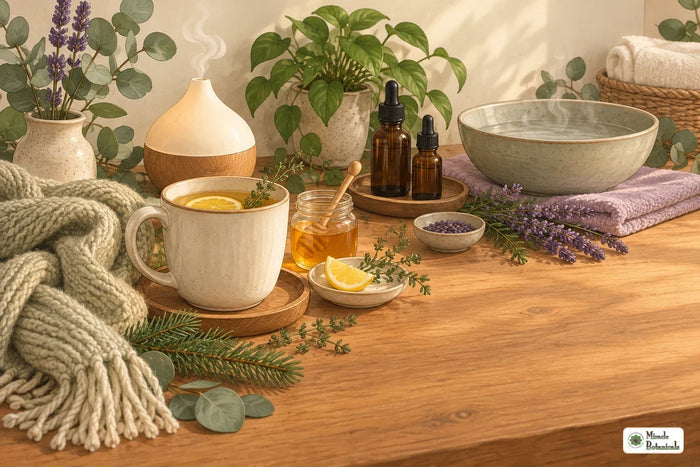
You set up an essential oil diffuser in the bedroom with a 100 mL tank, 3 to 4 drops of essential oil, a place at least 1 m (3 ft) from the bed, the door ajar and a countdown timer set to 30 or 60 minutes.
Setting up a bedroom diffuser takes 4 steps.
- Place the diffuser at least 1 m (3 ft) from the pillow, with the mist outlet pointed away from the bed.
- Add 3 to 4 drops of essential oil to 100 mL of room-temperature water.
- Set the countdown timer to 30 or 60 minutes and leave the door ajar.
- Empty and wipe the tank after the session.
A 500 mL tank runs 10 to 12 hours on one fill, which makes an all-night session possible, so that size belongs in a living room. A 100 mL tank runs 2 to 3 hours before the waterless shut-off stops the mist, which caps a forgotten session.
How do diffuser timers and intermittent mode work at night?
Diffuser timers work at night in 2 ways, which are a countdown that switches the mist off after a set time and an intermittent mode that pulses the mist on and off, and only a 30 or 60 minute countdown keeps a bedroom session inside the limit.
The table below compares 5 common settings by the mist time each delivers over an 8-hour night.
| Setting | What it does | Mist time over an 8-hour night | Bedroom use |
|---|---|---|---|
| Continuous, no timer | Runs until the tank is empty | 2 to 3 hours in a 100 mL tank; the full 8 hours in a 500 mL tank | Not used at night |
| Countdown, 30 or 60 minutes | Switches the mist off after the set time | 30 to 60 minutes | The bedroom setting |
| Countdown, 2 to 6 hours | Switches the mist off after the set time | 2 to 6 hours | Not used at night |
| Intermittent mode, about 30 seconds on and 30 seconds off | Pulses the mist until the tank empties or a countdown ends | About 4 hours with no countdown | Only inside a 30 or 60 minute countdown |
| Interval cycle, 10 minutes on and 20 minutes off | Repeats the cycle until the tank is empty | About 2 hours 40 minutes | Not used at night |
The countdown sets the length of the session, and the intermittent mode halves the output inside it, so a 60-minute countdown in intermittent mode delivers about 30 minutes of mist.
Which essential oils suit a sleep diffuser?
Six essential oils suit a sleep diffuser, which are lavender, Roman chamomile, bergamot, sweet orange, cedarwood atlas and vetiver, at 3 to 4 drops in total per 100 mL for a session that ends at lights out.
Lavender (Lavandula angustifolia) has the most evidence. Lavender inhalation for 5 nights improved self-rated sleep quality in 79 college students with sleep complaints, according to a 2015 trial by Lillehei, Halcón, Savik and Reis in the Journal of Alternative and Complementary Medicine. The trial delivered lavender by an inhalation patch rather than a diffuser. There is no published trial showing that an all-night diffuser improves sleep more than a bedtime session. Peppermint, rosemary cineole and eucalyptus stay out of the bedtime diffuser, because aromatherapy practice uses their menthol and 1,8-cineole in the morning. The 10 sleep oils are compared on the page of sleep oils ranked by research.
Does intermittent diffusing change the risk?
Yes, intermittent diffusing lowers the risk, because a pause of 30 to 60 minutes lets a ventilated room clear and lets the nose register the scent again, and the lower risk does not make an all-night session safe.
An intermittent mode left on for 8 hours still delivers about 4 hours of mist, and a cycle of 10 minutes on and 20 minutes off delivers about 2 hours 40 minutes, which is 3 to 8 times a 30 to 60 minute session. Intermittent use is the rule Tisserand and Young (2014) set for every session, so the rule is the baseline for diffusing, not an extension that covers the night. The people in the bedroom matter more than the timer.
Is it safe to diffuse essential oils overnight in a child's room?
No, it is not safe to diffuse essential oils overnight in a child's room, and a child from 2 to 6 years gets 2 to 3 drops per 100 mL for 15 to 30 minutes, with the session ending before sleep.
The diffuser sits at least 2 m (6 ft) from the child's bed. Peppermint is not diffused near a child under 3, and 1,8-cineole-rich oils, such as eucalyptus and rosemary cineole, are not diffused near a child under 10, according to Tisserand and Young (2014). No diffuser runs in a room with a baby under 6 months in practice, and the settings for older babies are on the page about diffusing near babies.
Is it safe to diffuse essential oils overnight with pets in the bedroom?
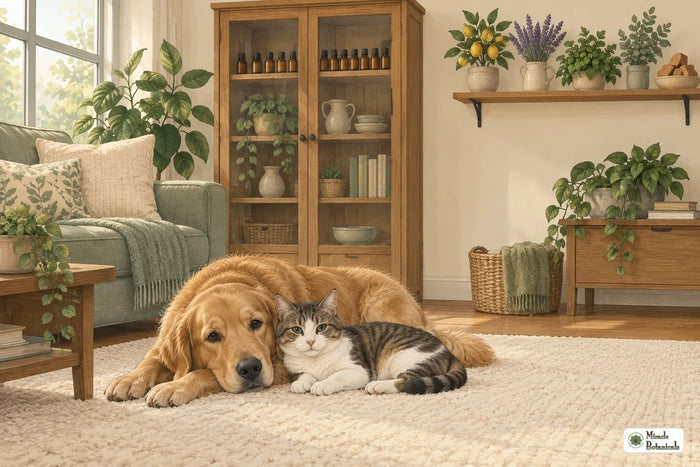
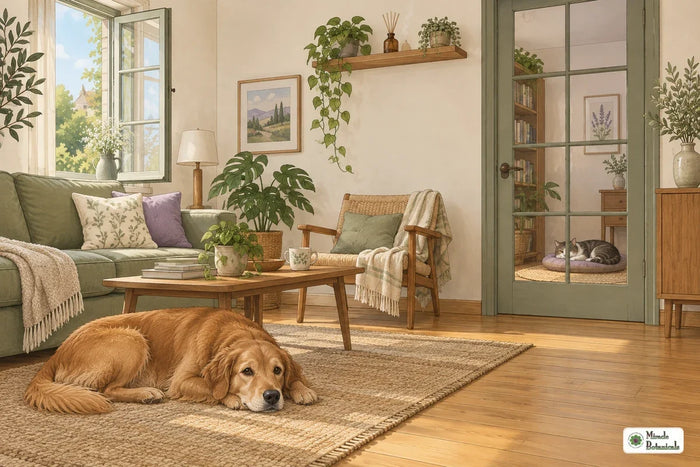
No, it is not safe to diffuse essential oils overnight with a cat or a bird in the bedroom, and a dog shares only a bedtime session, with the door open so the dog can leave.
Cats lack the liver enzyme pathway (glucuronidation) that clears phenols and terpenes, so tea tree, peppermint, eucalyptus, cinnamon, clove, pine, ylang ylang and citrus oils, bergamot and sweet orange included, are hazardous to cats, according to the ASPCA Animal Poison Control Center. Birds react to any aerosol. The room layouts for each animal are set out in the guide to pet-safe diffusing.
Where does overnight diffusing sit in the diffusing rules?
Overnight diffusing sits under the intermittent rule that covers every diffuser session, which is 3 to 5 drops per 100 mL for 30 to 60 minutes, then a pause of at least as long, and the bedroom adds one rule, which is off at lights out. The drop counts for every tank and room size are set out in the diffusing drops guide.
Essential oils for sleep from Miracle Botanicals
Miracle Botanicals sells about 200 single essential oils, each one tested by a third-party laboratory with GC/MS and labelled with its Latin name, plant part, origin and extraction method, so a bedtime diffuser holds true lavender (Lavandula angustifolia) rather than lavandin or a fragrance oil. The essential oils for sleep collection groups the oils most often diffused before bed, such as lavender, Roman chamomile, cedarwood atlas and vetiver, in one place, with the GC/MS report for each batch available on request. Miracle Botanicals is based in Hawaii and sells the single oils for the 3 to 4 drop bedtime session described above.