
Essential oil quality is the degree to which a pure oil matches the best chemical profile of its species and stays fresh until it is used, and 10 signs show that quality before you buy. The signs cover the plant, the batch and the bottle, from the Latin name to the batch GC/MS report and the price. You can check 8 of the 10 signs before you pay, and the other 2, the distillation date and the report, often need a request to the seller. The supplementary part answers which signs show only after the bottle arrives and where quality sits in a buyer's checklist.
What are the 10 signs of a high-quality essential oil?
The 10 signs of a high-quality essential oil are a Latin name with the plant part, a chemotype, an origin, a fitting extraction method, a dated batch number, a batch GC/MS report, a stated strength, dark glass, a sealed orifice-reducer cap and a price that fits the plant. Essential oil quality is the degree to which a pure oil matches the best chemical profile of its species and stays fresh until use. Quality sits on top of purity, so a pure oil can still be old, under-distilled or the wrong chemotype. The main measure of essential oil quality is the constituent profile on the batch GC/MS (gas chromatography and mass spectrometry) report. Signs 1 to 4 describe the plant, signs 5 to 7 the batch, and signs 8 to 10 the bottle and the price.
1. Does the label give the Latin name and the plant part?
Yes, the label of a high-quality essential oil gives the Latin binomial and the plant part, because 1 species can yield up to 3 different oils, as the bitter orange tree (Citrus aurantium) does. Its flowers give neroli, its leaves and twigs give petitgrain, and its peel gives bitter orange oil. Only the cold-pressed peel oil is phototoxic, with a 1.25% skin maximum under Tisserand and Young (2014).
2. Does the label name the chemotype?
Yes, the label of a high-quality essential oil names the chemotype whenever the species has more than one, as rosemary does with its 3 chemotypes, cineole, camphor and verbenone. A chemotype is a chemical race within one species, and the chemotype sets the main constituent. Thyme ct. thymol carries a 1.3% skin maximum, while thyme ct. linalool is a mild, alcohol-rich oil from the same species. The species that vary this way are listed on the page about essential oil chemotypes.
3. Does the label state the country of origin?
Yes, the label of a high-quality essential oil states the country of origin, because for some oils the origin names a different species, as it does for the 3 sandalwoods. Indian sandalwood is Santalum album, with 41% to 55% (Z)-alpha-santalol under ISO 3518. Hawaiian sandalwood is Santalum paniculatum, with 40% or more. Australian sandalwood is Santalum spicatum, with 15% to 25%. A label that reads only "imported" states no origin.
4. Does the label state an extraction method that fits the plant?
Yes, the label of a high-quality essential oil states an extraction method that fits the plant, such as steam distillation for lavender, cold pressing for lemon peel and CO2 extraction for ginger. Cold-pressed lime is phototoxic, with a 0.7% skin maximum, and steam-distilled lime is not. Jasmine yields only an absolute or a CO2 extract, so a "steam-distilled jasmine essential oil" is mislabelled. The plants each method suits are compared on the page about essential oil extraction methods.
5. Does the bottle carry a batch number and a distillation date?
Yes, the bottle of a high-quality essential oil carries a batch number and a distillation or bottling date, because the number ties the bottle to 1 test report and the date shows the shelf life left. Cold-pressed citrus oils keep 1 to 2 years from distillation, so a sweet orange oil distilled 15 months before sale has 9 months or less of unopened life left. The ranges for 30 named oils are in the essential oil shelf life chart.
6. Is there a GC/MS report for the batch on sale?
Yes, a high-quality essential oil has a GC/MS report for the batch on sale, from a named laboratory, with the main constituents inside the ISO or reference range for the species. Quality shows in where the values fall, since an edge value can mean a poor harvest, an old oil or a blend. Tea tree oil carries 30% to 48% terpinen-4-ol under ISO 4730, and a fresh batch shows p-cymene low in its 0.5% to 8% range, because p-cymene rises with age. The peaks to read first are explained on the page about GC/MS report percentages.
7. Does the label state the strength of the oil?
Yes, the label of a high-quality essential oil states its strength, either undiluted or as a percentage in a named carrier, such as "rose otto, 10% in jojoba". Rare oils, such as rose otto, neroli and melissa, are often sold diluted, and a stated dilution is an honest product. A dilution sold without its percentage is adulterated, because the carrier is undeclared. A 1% blend in 30 mL (1 oz) takes 6 drops of an undiluted oil or 60 drops of a 10% dilution.
8. Is the oil sold in amber or cobalt glass?
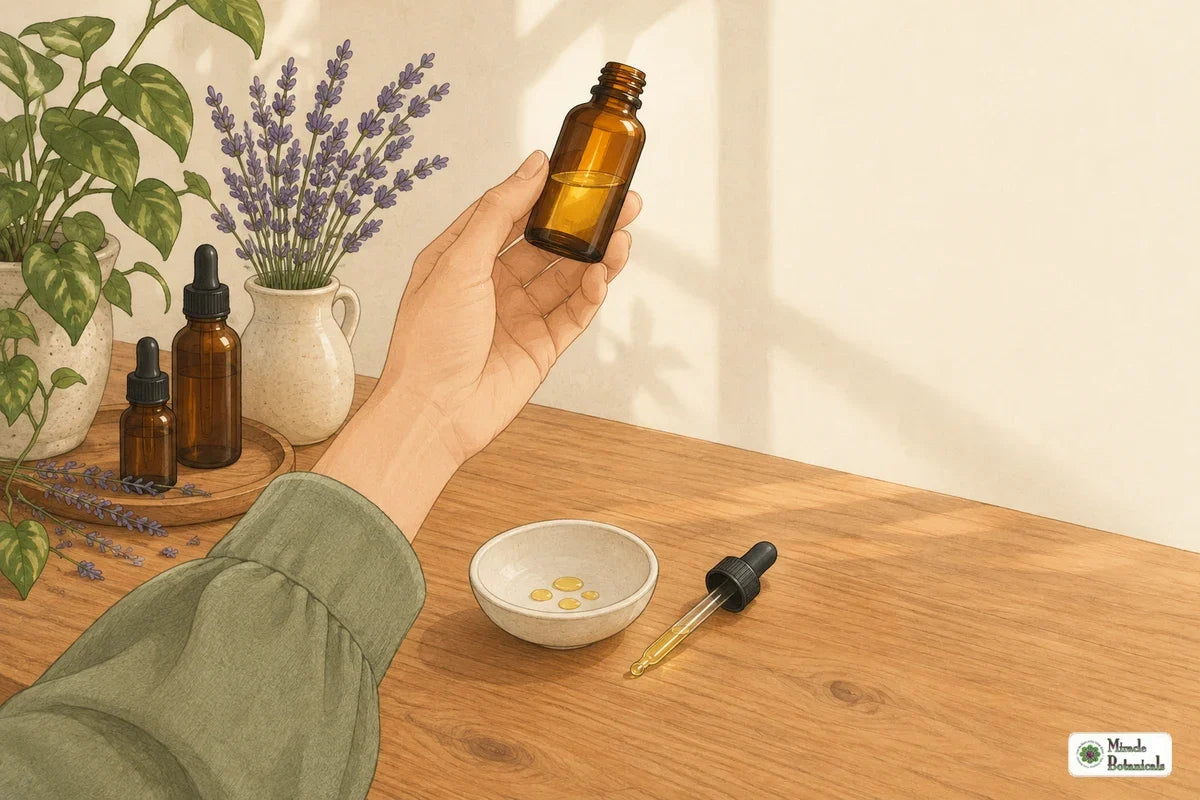
Yes, a high-quality essential oil is sold in amber or cobalt glass, because amber glass blocks most ultraviolet light below about 450 nm, the light that starts oxidation. Lined aluminium bottles serve the same purpose for bulk sizes. Undiluted essential oils soften polystyrene and some other plastics, and the plastic can leach into the oil.
9. Does the cap hold an orifice reducer under a sealed closure?
Yes, a high-quality essential oil ships with an orifice reducer under a screw cap and a tamper-evident seal, because the reducer limits air contact and releases about 1 drop at a time. A rubber dropper bulb stored on the bottle lets air in, and undiluted oils break down rubber. A child-resistant cap marks a careful seller, and the European Union's CLP Regulation requires one on oils classed as an aspiration hazard and sold to the public.
10. Does the price fit the plant?
Yes, the price of a high-quality essential oil fits the plant's yield, so rose otto, melissa, neroli and sandalwood cost many times more per mL than sweet orange, lemon or lavender from the same seller. Rose otto and melissa need hundreds or thousands of kilograms of plant material per kilogram of oil, so a rare oil priced like a common one is diluted, blended or synthetic. A high price proves nothing alone, because the sales model and the bottle size move prices, as the page on essential oil price differences shows.
What is the best quality essential oil?
The best quality essential oil is the batch that shows all 10 signs and whose GC/MS report places its marker compounds inside the reference range for the species, and no independent body ranks essential oils or brands by quality. Each oil has its own markers. The table below gives them for 5 common oils, with the range a good batch meets and the reading that marks a weaker or substituted oil.
| Oil (Latin name) | Marker compounds | Range a good batch meets | Reading that marks a weaker or substituted oil |
|---|---|---|---|
| Lavender (Lavandula angustifolia) | Linalool, linalyl acetate, camphor | Linalool 25% to 38%, linalyl acetate 25% to 45%, camphor 0.5% at most (ISO 3515) | Camphor at 5% to 8%, the level found in lavandin |
| Tea tree (Melaleuca alternifolia) | Terpinen-4-ol, 1,8-cineole, p-cymene | Terpinen-4-ol 30% to 48%, 1,8-cineole 15% at most (ISO 4730) | p-cymene near the top of its 0.5% to 8% range, a sign of age |
| Peppermint (Mentha × piperita) | Menthol, menthone, menthofuran | Menthol 30% to 55%, menthone 14% to 32%, menthofuran 1% to 9% (ISO 856) | No menthofuran, which points to cornmint (Mentha arvensis) |
| Lemon (Citrus limon), cold-pressed | Limonene, citral | Limonene 56% to 78% (ISO 855) | Citral below 2%, which points to added distilled terpenes |
| Indian sandalwood (Santalum album) | (Z)-alpha-santalol, (Z)-beta-santalol | Alpha 41% to 55%, beta 16% to 24% (ISO 3518) | Santalol below 41% or absent, which points to amyris or a synthetic |
The table holds 1 stance, which is that the best oil is the best-evidenced batch and not the best-known name. Grade words such as "therapeutic grade" and "Grade A" have no regulator behind them and take no part in the ranking, as the page on the therapeutic grade label explains. The markers come from choices made long before the oil reaches a shop.
What makes a good essential oil?
A good essential oil is made by 4 factors, which are the right plant, a full distillation, careful handling after the still, and a short time between distillation and sale. The first 2 factors are set at the farm and the still, and the last 2 by the distiller and the seller.
The 4 factors act on the oil in this order.
- The plant sets the raw chemistry through its species, chemotype, growing site and harvest time. Wild thyme (Thymus vulgaris) in southern France forms phenol chemotypes at hot, dry sites and alcohol chemotypes at cooler sites, according to a 1973 study by Granger and Passet in Phytochemistry.
- The distillation sets which compounds reach the oil, because light compounds come over first and heavy ones last.
- The handling after the still keeps the oil as it was made, in full, sealed drums away from heat, with any redistillation stated on the label.
- The time to sale sets how much shelf life reaches the buyer.
Ylang ylang shows the second factor in a single oil. Distillers collect ylang ylang in stages over a 12 to 20 hour run, and the first 1 to 2 hours give the ylang ylang Extra grade, followed by First, Second and Third, with Complete as the whole run or a reblend. The buyer reads all 4 factors from the label and the report, in the 4 steps below.
How do you judge essential oil quality?
You judge essential oil quality in 4 steps, which are reading the label, counting the shelf life from the date, comparing the batch GC/MS report with the reference range, and comparing the price per mL with other sellers. The 4 steps take under 5 minutes per oil once the reference range is at hand.
Judging the quality of 1 essential oil takes 4 steps.
- Read the label for the Latin name, plant part, chemotype, origin, method and strength.
- Count the remaining shelf life from the distillation date.
- Compare the main constituents on the batch GC/MS report with the ISO range, and match the batch number to the bottle.
- Compare the price per mL with 2 or 3 other sellers of the same Latin name, origin and method.
An oil that fails step 1 is rejected at once, because no report or price can make up for a missing species. The seller behind the oil is judged separately, by its testing, sourcing and claims, through the 10 questions for a brand. The bottle colour, sign 8, needs an answer of its own.
Does a dark bottle mean an essential oil is high quality?
No, a dark bottle does not mean an essential oil is high quality, because amber or cobalt glass protects the oil after bottling and says nothing about the oil poured into it, so sign 8 counts only beside the other 9. A fragrance oil can be sold in amber glass with an orifice reducer. Clear glass and plastic are signs against quality for an oil meant to last, because clear glass passes the ultraviolet light that starts oxidation. Amber glass blocks more ultraviolet light than cobalt blue glass, as the page on amber vs cobalt glass explains. The 10 signs are read at different points in a purchase, which the next question sorts out.
Which of the ten signs can you check before you pay?
You can check 8 of the 10 signs before you pay, from the product page and the label photo, and the other 2, the distillation date and the batch GC/MS report, often need a request to the seller. A seller who cannot answer that request has not shown the batch on sale. The table below sets out where each sign is found before payment and what a missing answer means.
| Sign | Where to check it before you pay | What a missing answer means |
|---|---|---|
| 1 Latin name and plant part | Product title, label photo | The species and the oil are unknown |
| 2 Chemotype | Product title or description | The main constituent is unknown for rosemary, thyme, basil and other variable species |
| 3 Country of origin | Product description | The species or chemistry cannot be traced |
| 4 Extraction method | Product description, label photo | The type of extract and its phototoxicity are unknown |
| 5 Batch number and date | Label photo, or a request to the seller | The remaining shelf life cannot be counted |
| 6 Batch GC/MS report | Product page download, or a request to the seller | Purity and quality are unproven |
| 7 Stated strength | Product title, label photo | A diluted oil may be sold as neat |
| 8 Amber or cobalt glass | Product photo | The oil may have been exposed to light |
| 9 Orifice reducer and sealed cap | Product photo or description | Air and rubber may have aged the oil |
| 10 Price that fits the plant | Price per mL against 2 or 3 other sellers | A rare oil may be cut or synthetic |
Signs 1, 4 and 6 carry the most weight, because no other sign makes up for a missing species, method or report. The 2 sections below cover the checks after the bottle arrives and the place of quality in the full purchase.
Which quality signs show only after the bottle arrives?
Four quality signs show only after the bottle arrives, which are a scent that matches the plant and develops on a blotter, a colour typical of the oil, a clear liquid with no haze, and a batch number that matches the report. A fresh lemon oil smells of the peel rather than of solvent, and a German chamomile oil is deep blue from chamazulene. These checks confirm the evidence and cannot replace it, because a skilled adulteration passes the nose. The home tests that prove nothing, such as the paper test and the freezer test, are set out in the guide to purity checks and myths.
Where do quality signs sit in a buyer's checklist?
The 10 quality signs sit in the first of 5 decisions in a buyer's checklist, which is choosing the oil, ahead of the brand, the size, the price and the storage. Signs 8 to 10 look ahead to the later decisions, because the bottle sets the storage and the price per mL sets the comparison. The full sequence, with the 10 quality signs as its first step, is set out in the guide on how to buy pure essential oils by quality, safety and price.
High-quality single essential oils from Miracle Botanicals
Miracle Botanicals sells about 200 single essential oils, each one steam-distilled, cold-pressed or CO2-extracted and tested by a third-party laboratory with GC/MS. Every product page names the Latin name, the plant part, the chemotype where one exists, the country of origin and the extraction method, and the GC/MS report for the batch is available on request. Miracle Botanicals bottles its oils in amber glass with an orifice reducer and is based in Hawaii. Browse the single essential oils collection to read the 10 signs on each listing before you buy.