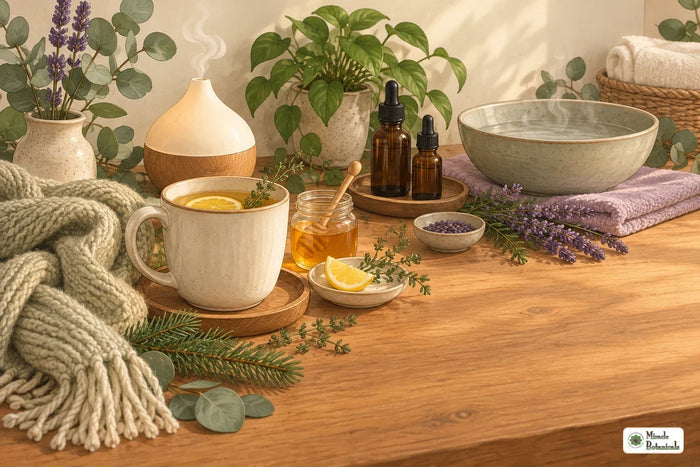

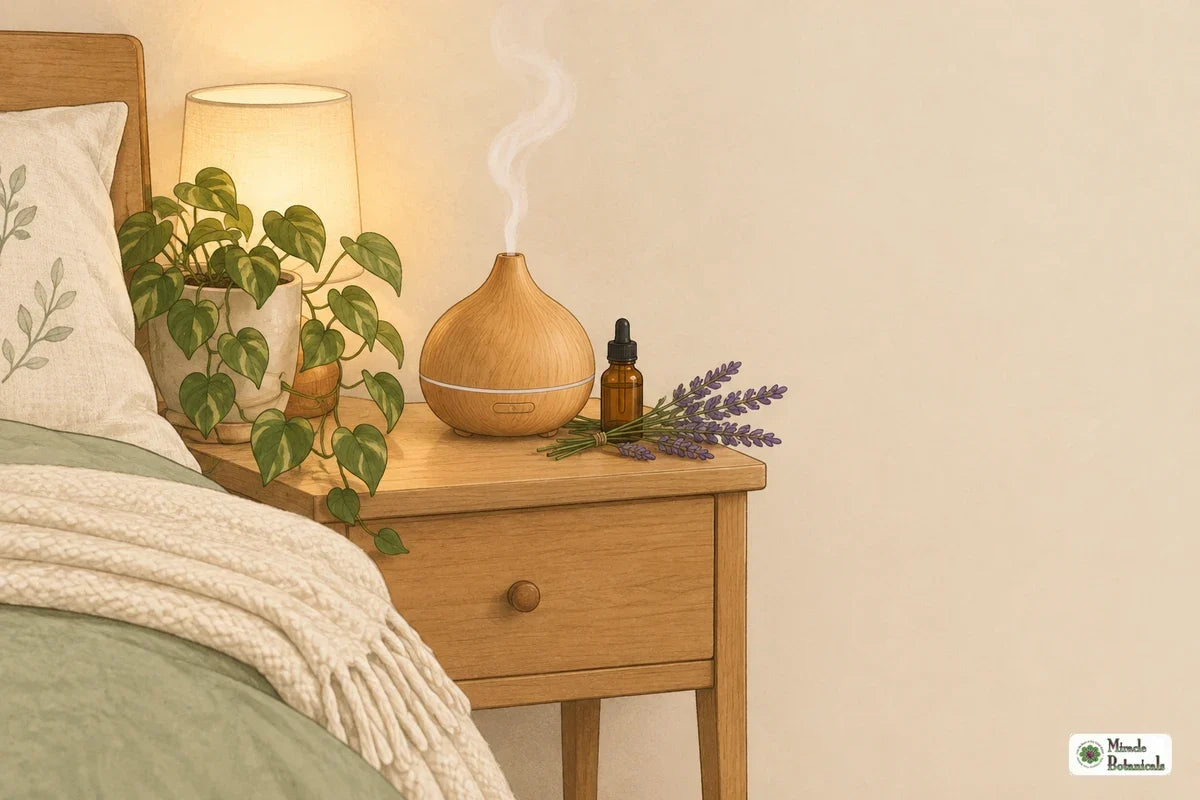

Essential oils for sleep and relaxation are concentrated plant oils inhaled or applied diluted in the hour before bed, and they work through the sense of smell. Lavender (Lavandula angustifolia) is the best of them, because it is the only oil with several controlled sleep trials behind it. The safe bedtime routine is a diffuser at 3 to 5 drops per 100 mL of water for 30 to 60 minutes, switched off at lights out, or a 1% to 2% roller, which is 2 to 4 drops in 10 mL of carrier oil. The sections below list 10 sleep oils, match them to 5 sleep problems, give 5 methods, compare them with the strongest natural sleep remedy and set the limits for children, pregnancy and pets. Later sections answer how to buy a pure sleep oil, how to make a sleep blend and where sleep oils sit among the uses of essential oils.
Which essential oils help with sleep and relaxation?
The essential oils that help with sleep and relaxation are lavender, Roman chamomile, bergamot, sweet orange, mandarin, ylang ylang, clary sage, sweet marjoram, cedarwood atlas and vetiver, and lavender is the only one of the 10 with several controlled sleep trials behind it.
Essential oils for sleep and relaxation are concentrated plant extracts that are diffused, sprayed or applied diluted before bed. Their scent molecules bind to receptors in the nose, and the olfactory bulb passes the signal to the limbic system, the brain's centre for emotion and arousal, within seconds. The main calming constituents of these oils are linalool and linalyl acetate, which make up 50% to 83% of lavender oil under the ISO 3515 standard. The table below gives the 10 oils with their Latin name, plant part, main constituent and evidence.
| Oil (Latin name) | Plant part | Main constituent | Evidence for sleep or calm |
|---|---|---|---|
| Lavender (Lavandula angustifolia) | Flowering tops | Linalool 25% to 38%, linalyl acetate 25% to 45% | Several controlled sleep trials and a 2015 meta-analysis |
| Roman chamomile (Chamaemelum nobile) | Flowers | Angelate esters 75% to 85% | Tradition; no controlled sleep trial |
| Bergamot (Citrus bergamia) | Peel | Limonene, linalyl acetate | Small study on heart rate and blood pressure |
| Sweet orange (Citrus sinensis) | Peel | Limonene 84% to 96% | Small trials on situational anxiety |
| Mandarin (Citrus reticulata) | Peel | Limonene 65% to 75% | Tradition; no controlled human trial |
| Ylang ylang (Cananga odorata) | Flowers | Linalool and germacrene D, 8% to 20% each (Extra grade) | Small trials on calm and blood pressure |
| Clary sage (Salvia sclarea) | Flowering tops | Linalyl acetate 45% to 73% | Small study on cortisol |
| Sweet marjoram (Origanum majorana) | Leaves | Terpinen-4-ol, sabinene hydrate | Tradition |
| Cedarwood atlas (Cedrus atlantica) | Wood | Himachalenes | Tradition |
| Vetiver (Chrysopogon zizanioides) | Roots | Khusimol 7% to 15% | Tradition; animal studies only |
Lavender carries the sleep trials, 4 oils carry small studies on calm, and 5 oils carry tradition. The clary sage study found lower cortisol in 22 menopausal women after inhalation, according to a 2014 trial by Lee, Cho and Kang in Phytotherapy Research. The same oils are ordered by research and by aroma on the page of 10 sleep oils ranked by research, where lavender comes first.
What is the best essential oil for sleep and relaxation?
The best essential oil for sleep and relaxation is lavender (Lavandula angustifolia), because lavender is the only oil with several controlled sleep trials, each with 31 to 79 adults, and a 2015 meta-analysis behind it.
The consensus finding is that inhaled lavender improves self-rated sleep quality by a small amount over 5 to 15 nights. Lavender inhalation for 5 nights, added to sleep hygiene, improved sleep quality more than sleep hygiene alone in 79 college students with sleep complaints, according to a 2015 trial by Lillehei, Halcón, Savik and Reis in the Journal of Alternative and Complementary Medicine. Lavender raised the share of deep, slow-wave sleep in 31 healthy young adults in a sleep laboratory, according to a 2005 study by Goel, Kim and Lao in Chronobiology International. Lavender inhaled for 15 nights improved sleep quality in 60 coronary intensive care patients, according to a 2017 trial by Karadag, Samancioglu, Ozden and Bakir in Nursing in Critical Care. A 2015 meta-analysis of 13 small studies by Hwang and Shin in the Journal of Alternative and Complementary Medicine found better sleep with aromatherapy.
The opposing finding is that expectation explains part of the effect. Relaxation after lavender depended on what 96 young women were told to expect, not on the aroma, according to a 2008 study by Howard and Hughes in the British Journal of Health Psychology.
The largest lavender trials use an 80 mg oral capsule licensed as a herbal medicine in Germany, which improved anxiety and sleep quality over 10 weeks in 221 adults, according to a 2010 trial by Kasper and colleagues in International Clinical Psychopharmacology. A retail essential oil is not that product or that dose. The trials, doses and gaps are weighed on the page about lavender oil for sleep.
Which essential oils are best for calming?
The essential oils best for calming are lavender, sweet orange, bergamot and ylang ylang, because each has at least 1 controlled study in which inhaling the oil lowered anxiety scores, heart rate or blood pressure in a single session.
Orange and lavender aromas in a dental waiting room lowered anxiety and improved mood in 200 patients, according to a 2005 study by Lehrner, Marwinski, Lehr, Johren and Deecke in Physiology and Behavior. Sweet orange inhaled before a stress test kept anxiety from rising in 40 men at 2.5 and 10 drops but not at 5 drops, according to a 2012 trial by Goes, Antunes, Alves and Teixeira-Silva in the Journal of Alternative and Complementary Medicine. Ylang ylang inhalation lowered blood pressure and raised calmness in 24 healthy adults, according to a 2004 study by Hongratanaworakit and Buchbauer in Planta Medica. Bergamot vapour lowered blood pressure and heart rate in 100 spa workers during the first hour and raised both after it, according to a 2014 study by Chuang and colleagues in the European Journal of Preventive Cardiology.
The bergamot result sets the rule for calming oils, which is a short session at a dose that is easy to smell. The grades of ylang ylang and its 0.8% skin limit are set out in the ylang ylang Extra profile.
Which is calmer, sweet orange or mandarin?
Sweet orange is the calmer citrus oil on published evidence, with 3 controlled trials on anxiety, and mandarin is the calmer oil on scent, with no controlled human trial behind it. Mandarin carries 65% to 75% limonene against 84% to 96% in sweet orange, and aromatherapists choose mandarin for a child's bedroom. The 2 oils are compared on the page about sweet orange vs mandarin.
Which essential oil is best for each kind of sleep problem?
The best essential oil for each kind of sleep problem is lavender for falling asleep, bergamot or sweet orange for a racing mind, vetiver or cedarwood atlas for light sleep, sweet marjoram for evening muscle tension, and mandarin for a child over 2.
Only the first match rests on sleep trials. The table below gives the 5 sleep problems with the oils, the constituent behind each choice and the evidence.
| Sleep problem | Oils most used | Constituent behind the choice | Evidence |
|---|---|---|---|
| Trouble falling asleep | Lavender, Roman chamomile | Linalool, linalyl acetate, angelate esters | Controlled trials for lavender; tradition for chamomile |
| A racing mind at bedtime | Bergamot, sweet orange, ylang ylang | Limonene, linalyl acetate, linalool | Small studies on calm |
| Light or broken sleep | Vetiver, cedarwood atlas | Khusimol, himachalenes | Tradition |
| Evening muscle tension | Sweet marjoram, lavender | Terpinen-4-ol, linalool | Tradition |
| A child's bedtime, over 2 | Mandarin, lavender | Limonene, linalool | Tradition; lowest-risk oils for children |
Vetiver and cedarwood atlas are base notes rich in heavy sesquiterpenes, and vetiver holds its scent on a paper strip for more than 48 hours. There is no published evidence that vetiver essential oil improves human sleep, and its studies to date are in rats or on daytime attention, as the vetiver essential oil profile sets out. The methods that deliver these oils come next.
How do you use essential oils for sleep?
You use essential oils for sleep in 5 ways, which are a diffuser before bed, a pillow or linen spray, a 1% to 2% roller or massage oil, a warm bath with dispersed oil, and a bedside inhaler stick.
The table below gives the amount and the timing for each method.
| Method | Amount | When |
|---|---|---|
| Diffuser | 3 to 5 drops per 100 mL of water | 30 to 60 minutes before bed; off at lights out |
| Pillow or linen spray | 10 to 20 drops per 250 mL of water, with 30 mL of high-proof alcohol or a solubiliser | On the pillowcase 10 minutes before bed, left to dry |
| Roller or massage oil | 1% to 2%, which is 2 to 4 drops in 10 mL of carrier | On the wrists, upper chest or soles at bedtime |
| Bath | 5 to 10 drops dispersed in 15 mL of carrier oil or a solubiliser | 1 to 2 hours before bed |
| Inhaler stick | 10 to 15 drops on the cotton wick | 3 to 5 slow breaths at bedtime or on waking at night |
Step-by-step instructions for all 5 methods, with where to place a roller and when to start, are on the page about how to use oils for sleep. The diffuser and the roller are used most, so each has its own answer below.
How do you use a sleep diffuser?
You use a sleep diffuser by adding 3 to 5 drops of essential oil per 100 mL of water, running it for 30 to 60 minutes before bed with the door open, and switching it off at lights out.
The diffuser sits at least 1 m (3 ft) from the bed, and a 100 mL tank scents a bedroom of up to about 15 m² (160 sq ft). The nose adapts to a constant smell within 15 to 20 minutes, so a longer session adds exposure without adding aroma. Children aged 2 to 6 take 2 to 3 drops for 15 to 30 minutes. Larger tanks and the 4 diffuser types are covered on the page about diffuser drops and timing.
How much essential oil goes in a sleep roller or massage oil?
A sleep roller or massage oil takes 1% to 2% essential oil, which is 2 to 4 drops in a 10 mL roller or 6 to 12 drops in 30 mL (1 oz) of carrier oil, at 20 drops per mL.
Nightly use sits at 1%, because skin that receives a blend every evening for weeks needs the lower dose. The face and temples take 0.5% to 1%, and a new blend is patch tested on the inner forearm for 24 hours first. The percentage for each area of the body is on the page about skin dilution by body area.
What is the strongest natural sleep remedy?
The strongest natural sleep remedy on published evidence is cognitive behavioural therapy for insomnia (CBT-I), a drug-free programme that the American College of Physicians recommended in 2016 as the first-line approach for adults with chronic insomnia.
Chronic insomnia means trouble falling or staying asleep on at least 3 nights a week for at least 3 months. Essential oils sit lower on the evidence scale than CBT-I and work as an add-on to a sleep routine, as in the 2015 Lillehei trial, which added lavender to sleep hygiene. The table below compares 5 natural approaches by the strength of their evidence.
| Approach | Strength of evidence | Source |
|---|---|---|
| CBT-I (sleep restriction, stimulus control, sleep education) | Strongest; first-line for chronic insomnia in adults | American College of Physicians guideline, Qaseem and colleagues, 2016, Annals of Internal Medicine |
| Sleep hygiene on its own | Weak alone; useful inside CBT-I | American Academy of Sleep Medicine guideline, Edinger and colleagues, 2021, Journal of Clinical Sleep Medicine |
| Oral lavender oil capsule, 80 mg | Moderate, in anxiety trials that measured sleep | Kasper and colleagues, 2010, 221 adults |
| Inhaled lavender oil | Small effect in small trials | Hwang and Shin, 2015 meta-analysis, 13 studies |
| Melatonin and valerian root supplements | Weak; not suggested for chronic insomnia | American Academy of Sleep Medicine guideline, Sateia and colleagues, 2017, Journal of Clinical Sleep Medicine |
Sleep problems that last 3 months, or that come with loud snoring, pauses in breathing or heavy daytime sleepiness, are a reason to see a doctor before adding any aroma.
Are essential oils for sleep safe?
Yes, essential oils for sleep are safe for most adults when they are diffused for 30 to 60 minutes before bed or applied at 1% to 2%, and the limits tighten for children, pregnancy, asthma, sleep medicine and pets.
A diffuser that runs all night adds hours of exposure while the sleeper cannot notice a headache or a dry throat, so the session ends at lights out. The rules for dose, time, room and people are on the page about diffuser safety limits.
Safety and precautions for sleep oils
Six groups need specific limits at bedtime.
- Children. No essential oil goes on the skin of a baby under 3 months, according to Tisserand and Young's Essential Oil Safety (2014), and children aged 2 to 6 use at most 1%. Peppermint stays away from the face of children under 3, and 1,8-cineole-rich oils such as eucalyptus stay away from the face of children under 10, because menthol and cineole can slow a young child's breathing. The limits for each age band are on the page about essential oils for kids by age.
- Pregnancy. Most oils are avoided in the first trimester. Lavender, sweet orange, Roman chamomile and frankincense at 1% are the oils most midwives and aromatherapists accept after it, and wintergreen, pennyroyal, sage, wormwood and camphor-rich oils are avoided throughout. Clary sage is traditionally avoided until term, a precaution rather than a contraindication in Tisserand and Young.
- Skin limits. Ylang ylang has a maximum skin dilution of 0.8%, from IFRA standards cited by Tisserand and Young. Cold-pressed bergamot is phototoxic above 0.4% on skin that meets sunlight within 12 to 18 hours, so a night roller uses bergamot FCF (furanocoumarin-free).
- Asthma. A person with asthma diffuses in a neighbouring room or not at all, and stops at the first wheeze or cough.
- Sleep medicine. Lavender, Roman chamomile and valerian oils add a small calming effect by inhalation, so a person taking a sedative asks a pharmacist before combining them.
- Pets. Cats lack the liver pathway called glucuronidation that clears terpenes, so ylang ylang and citrus oils such as bergamot, sweet orange and mandarin are hazardous to cats, according to the ASPCA Animal Poison Control Center. The ASPCA lists lavender as toxic to cats and dogs when eaten, and a diffuser runs only in a room a cat cannot enter and a dog can leave.
A person who swallows an essential oil calls Poison Control (1-800-222-1222 in the United States) and does not induce vomiting. The next question is how to tell a pure bottle from a stretched one.
Which pure oils are worth buying for sleep and relaxation, and how do you check their quality?
The pure oils worth buying for sleep and relaxation are true lavender (Lavandula angustifolia), one citrus oil such as sweet orange or bergamot FCF, and one base oil such as vetiver or cedarwood atlas, each with a batch GC/MS report.
Lavender is one of the most adulterated essential oils, because synthetic linalool and linalyl acetate are cheap and raise the percentages on paper. Four questions separate a pure sleep oil from a stretched one.
- Which bottle names Lavandula angustifolia, rather than "lavender" alone, which can be lavandin with 5% to 12% camphor?
- Which GC/MS report shows linalool at 25% to 38% and linalyl acetate at 25% to 45%, the ISO 3515 range for lavender?
- Which chamomile is labelled Chamaemelum nobile, rather than German chamomile (Matricaria chamomilla) or wild Moroccan chamomile?
- Which bottle gives the distillation or pressing date, so the 1 to 2 year shelf life of a citrus oil and the 2 to 3 years of lavender can be counted?
The bottle that answers all 4 is the one to buy, and the checks that separate true lavender from lavandin are in the true lavender oil profile. The remaining 2 sections cover a simple sleep blend and where sleep oils sit among the uses of essential oils.
How do you make a simple sleep blend?
To make a simple sleep blend, combine 3 parts lavender, 1 part cedarwood atlas and 1 part sweet orange, which is 30, 10 and 10 drops in a 5 mL amber glass bottle, then diffuse or dilute the stock.
Sweet orange is the fresh top note, lavender the middle note and cedarwood atlas the base note that holds the scent. The 50-drop stock, which is 2.5 mL, makes 3 bedtime products.
- Diffuse 4 to 5 drops of the stock per 100 mL of water for 30 to 60 minutes before bed.
- Dilute 2 to 4 drops of the stock in a 10 mL roller of jojoba or fractionated coconut oil.
- Dilute 12 drops of the stock in 30 mL (1 oz) of carrier oil for a 2% massage oil.
The stock is labelled with the oils and the date and rested for 24 hours before first use. Why a sleep blend leans on its middle note is explained in the guide to blend notes and ratios.
Where do sleep oils sit among the uses of essential oils?
Sleep oils sit first among the 12 everyday purposes for essential oils in the root guide, beside the oils for focus, everyday stress, skin care and cleaning, and they share the same rules for purity and dilution.
Lavender, Roman chamomile and vetiver are the 3 oils the root guide to choosing pure essential oils names for sleep, and this page expands that row into the full set of oils, methods and limits.
Essential oils for sleep from Miracle Botanicals
Miracle Botanicals sells about 200 single essential oils, each one steam-distilled, cold-pressed or CO2-extracted and tested by a third-party laboratory with GC/MS. Every product page names the Latin name, the plant part, the country of origin and the extraction method. Lavender from Bulgaria, France, Kashmir and New Zealand, sweet orange, red mandarin from Italy, cedarwood atlas, sweet marjoram, clary sage and vetiver are sold as single oils, and the bedtime oils and blends are grouped in the essential oils for sleep collection. Miracle Botanicals is based in Hawaii.