

Yes, an essential oil diffuser is safe for healthy adults when it runs at 3 to 5 drops per 100 mL of water for 30 to 60 minutes, pauses for at least as long, and sits in a room with an open door or window, according to the intermittent diffusion guidance in Tisserand and Young's Essential Oil Safety (2014). A diffuser puts volatile organic compounds into indoor air, and 24 commercial essential oils emitted 595 of them in a 2018 analysis by Nematollahi, Kolev and Steinemann, which is why the time and the ventilation matter more than the brand. The documented harms are headache, nausea, eye and throat irritation and asthma symptoms, and all 4 rise with continuous running in a closed room. The documented benefit is modest, with the strongest evidence for sleep quality and short-term calm. The sections below answer whether a diffuser is safe, bad for you, good for health, safe in its oil and non-toxic in its device. The later sections answer who should avoid a diffuser indoors, the 6 rules for diffusing safely, and how a diffuser compares with candles, incense and air fresheners.
Is an essential oil diffuser safe?
Yes, an essential oil diffuser is safe for healthy adults when it runs intermittently, at 3 to 5 drops per 100 mL of water for 30 to 60 minutes followed by a pause of at least as long, in a ventilated room, according to Tisserand and Young (2014) and the National Association for Holistic Aromatherapy. Safety depends on 4 variables, which are the dose, the time, the room and the people in it.
The dose is the drop count per 100 mL of water, and more drops raise the concentration in the air in proportion. The time is the run length, and continuous running raises the concentration past the point where the nose registers it, because olfactory adaptation sets in after 15 to 20 minutes. The room is its volume and ventilation, and a closed 10 m² bedroom concentrates the same drops 4 times more than a 40 m² open-plan room. The people are the infants, pets, pregnant women and people with asthma who share the air and did not choose the dose. There is no published evidence that intermittent diffusing within these limits harms the lungs of a healthy adult. The wider evidence on essential oil safety by every route, and what the safety bodies say, is set out in the guide to essential oil safety research.
Is an essential oil diffuser bad for you?
An essential oil diffuser is bad for you when it runs continuously in a closed room, and the documented effects are headache, nausea, eye and throat irritation, asthma symptoms and a rise in blood pressure and heart rate after more than 1 hour of exposure, with the blood pressure and heart rate rise measured in a 2014 study of 100 spa workers by Chuang, Chen, Liu, Chuang and Lin in a European cardiology journal. The same study found that exposure under 1 hour lowered blood pressure and heart rate, which is the basis for the 30 to 60 minute limit.
Terpenes from evaporated essential oils, such as limonene and alpha-pinene, react with indoor ozone to form formaldehyde and secondary ultrafine particles, according to a 2007 chamber study by Su, Chao, Chang and Wu in Atmospheric Environment, and the reaction is faster in a room with an ozone-emitting device or open windows on a high-ozone day. Twenty-four commercial essential oils emitted 595 volatile organic compounds in total, 188 of them classed as potentially hazardous under United States regulatory lists, with no difference between oils labelled natural or organic and the rest, according to a 2018 analysis by Nematollahi, Kolev and Steinemann in Air Quality, Atmosphere and Health. Fragranced consumer products caused health problems in 34.7% of a United States population sample, with a higher share among people with asthma, according to a 2016 survey by Steinemann in the same journal, and essential oil diffusers belong to the class of products surveyed. Indoor volatile organic compound levels are commonly 2 to 5 times outdoor levels, according to the United States Environmental Protection Agency, and a diffuser adds to that load for the time it runs. People with asthma, chronic obstructive pulmonary disease, migraine or epilepsy carry a higher chance of a reaction, and the limits for each condition are set out in the guide to essential oil safety by health condition.
Is an essential oil diffuser good for health?
An essential oil diffuser is good for health in 2 measured ways, which are improved self-rated sleep quality and short-term calm, and there is no published evidence that a diffuser purifies air, kills airborne viruses in a room, or relieves any respiratory illness. The benefit comes from the inhaled constituents acting on the olfactory system, not from any change to the air itself.
Two studies set the size of the benefit. Lavender inhalation for 5 nights improved self-rated sleep quality in 79 college students with sleep complaints, according to a 2015 trial by Lillehei, Halcón, Savik and Reis in the Journal of Alternative and Complementary Medicine. Bergamot vapour exposure under 1 hour lowered blood pressure and heart rate in the 100 spa workers studied by Chuang and colleagues in 2014, a short-term relaxation effect that reversed after the first hour. Both effects are small, both are short-term and both depend on a dose the person can smell but not find strong. The oils, times and methods with the most sleep evidence, and how they compare, are set out in the guide to essential oils for sleep and relaxation.
Is the essential oil in a diffuser safe?
The essential oil in a diffuser is safe when it is a pure, unoxidised essential oil with a GC/MS report and a Latin name, used within its shelf life, and chosen from oils with no inhalation limit for the people in the room. Three properties of the oil decide its safety in the air, which are purity, age and constituent profile.
Purity comes first. A pure essential oil contains only the compounds the plant made, and a GC/MS report lists them with their percentages. A fragrance oil is a compounded perfume material, is usually wholly or partly synthetic, and often holds phthalates and synthetic musks that a diffuser aerosolises along with the scent. The 7 differences in source, chemistry and safety are set out in the guide to essential oil vs fragrance oil differences. Age comes second. Cold-pressed citrus oils last 1 to 2 years and most distilled oils 2 to 3 years, and the oxidation products of limonene and linalool are the compounds that irritate airways and sensitise skin. Constituent profile comes third. Peppermint oil, rich in menthol, is not diffused near a child under 3, and 1,8-cineole-rich oils, such as eucalyptus globulus and rosemary cineole, are not diffused near a child under 10, according to Tisserand and Young (2014). Phenol-rich and aldehyde-rich oils, such as clove bud, oregano and cinnamon bark, irritate the eyes and throat in a diffuser at the same 3 to 5 drops that lavender tolerates, and they are used at 1 to 2 drops in a blend.
Is an essential oil diffuser non toxic?
An essential oil diffuser is non toxic when its tank is glass or polypropylene, its water is emptied daily and its mist is cool, and 3 parts of a device can fail that test, which are a plastic that limonene softens, standing water that grows microbes, and a heating element that changes the oil's chemistry. Non toxic describes the device and its materials, not the oil in it.
Limonene, the main constituent of citrus oils, is a solvent that softens polystyrene and some other plastics, and a tank that clouds, cracks or smells of plastic after citrus oils is leaching into the mist, which a glass or polypropylene tank avoids. Standing water in an ultrasonic tank aerosolises minerals and any microbes growing in it, which is the finding behind the United States Environmental Protection Agency's guidance to empty and dry ultrasonic humidifiers daily, and the same rule applies to a diffuser tank. A heat diffuser or candle burner warms the oil above the temperature at which linalyl acetate, citral and other heat-sensitive constituents break down, and a cool-mist unit avoids the change. A humidifier shares the ultrasonic plate and the standing water with a diffuser, but its larger plastic tank, wick and heating element are built for water alone, and the damage essential oils do to each type is set out in the guide to oils in humidifiers.
Who should avoid using a diffuser indoors?
Six groups should avoid using a diffuser indoors, or share a room with one only when they can leave it, which are infants under 2, people with asthma or chronic obstructive pulmonary disease, people with migraine, people who are pregnant in the first trimester, cats and birds.
The table below gives the 6 groups with the reason and the alternative that suits each.
| Group | Reason | Alternative |
|---|---|---|
| Infants under 2 | Small airways; menthol and cineole can slow breathing; cannot leave the room | No diffuser in the room; a hydrosol linen mist in the next room |
| People with asthma or COPD | Fragranced products trigger symptoms in a higher share of people with asthma (Steinemann 2016) | A personal inhaler stick, tested one breath at a time |
| People with migraine | Strong scents are a documented trigger for a share of migraine sufferers | A 1% roller on the wrists, chosen scent only |
| Pregnancy, first trimester | Most oils avoided as a precaution; nausea worsens with strong scent | Lavender or sweet orange on a tissue after the first trimester |
| Cats | Lack glucuronidation; cannot clear phenols and terpenes | No diffuser in a room the cat uses; no oil on fur |
| Birds | Reactive airways; any aerosol or mist is a risk | No diffuser in the room |
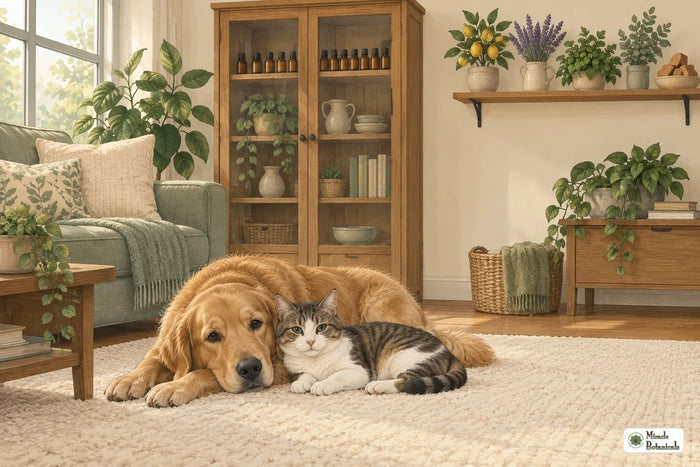
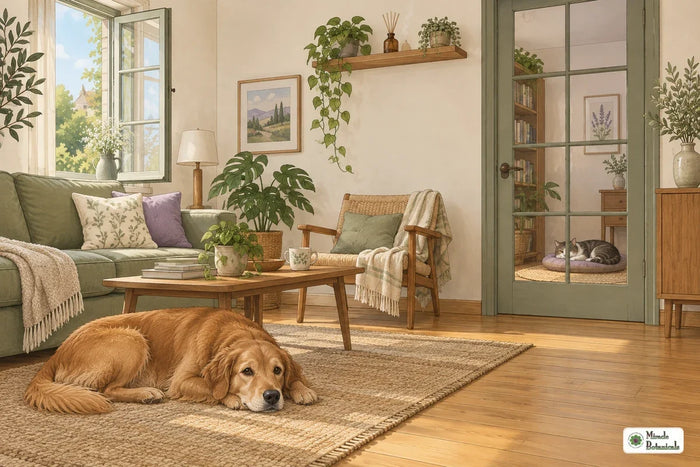
Cats are the group most often harmed at home, because a diffuser runs in a living room the cat cannot be kept out of. Tea tree, peppermint, eucalyptus, cinnamon, clove, pine, ylang ylang and citrus oils are the oils the ASPCA Animal Poison Control Center lists as hazardous to cats, and signs such as drooling, unsteady walking or laboured breathing after a diffusing session mean the room is aired and a veterinarian is called. Which oils, if any, a cat household can diffuse, and the room rules that make it workable, are set out in the guide to essential oils for cats.
How do you diffuse safely?
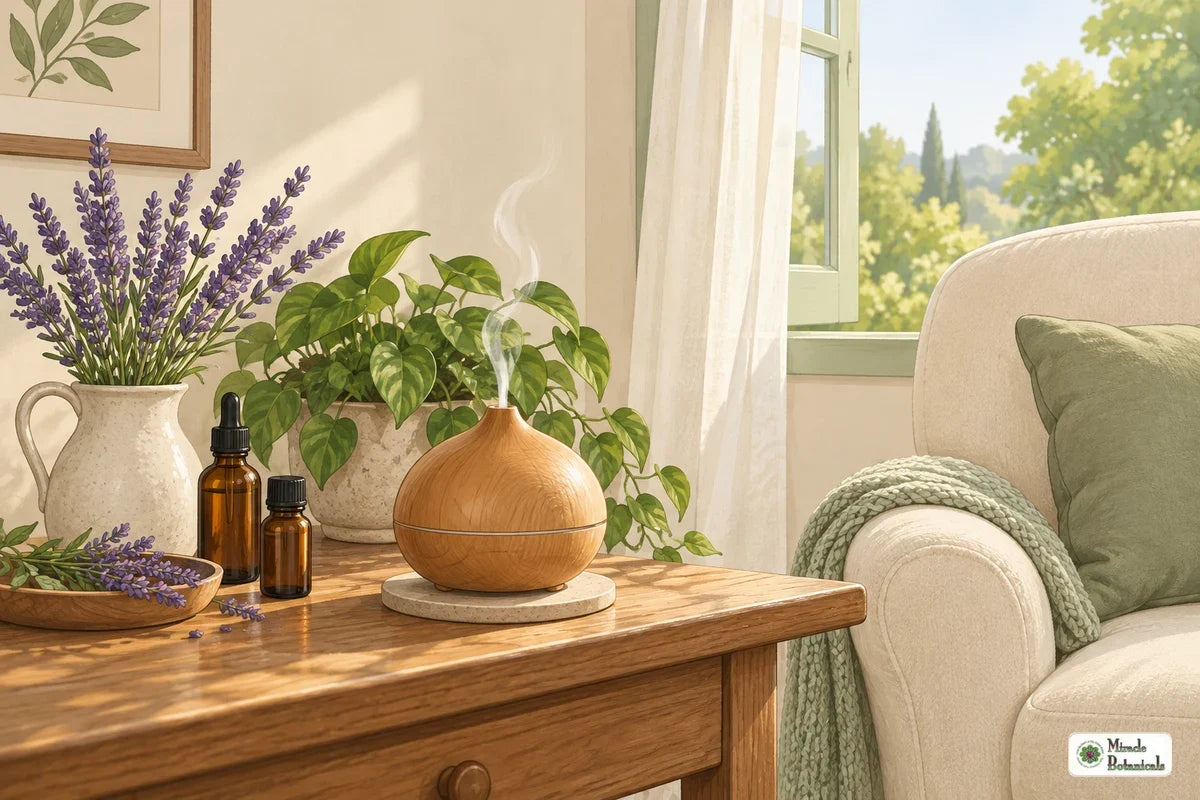
You diffuse safely by following 6 rules, which are 3 to 5 drops per 100 mL, 30 to 60 minutes on then off, an open door or window, a distance of at least 1 m (3 ft) from where people sit or sleep, a daily rinse of the tank, and no diffusing while anyone in the room sleeps, is under 2, or has asthma.
The 6 rules for safe diffusing follow.
- Add 3 to 5 drops per 100 mL of water, and start at 3 for a new oil or a shared room.
- Run the diffuser for 30 to 60 minutes, then switch it off for 30 to 60 minutes or longer, or use an interval timer.
- Open the door or a window for the whole session, so the compounds disperse rather than accumulate.
- Place the diffuser at least 1 m (3 ft) from the bed, sofa or desk, so the mist spreads before it reaches a face.
- Empty and wipe the tank after every session, so no oil or water stands in it overnight.
- Switch the diffuser off at lights out, and keep it out of any room with an infant, a cat, a bird or a person with asthma.
Headache, nausea, a sore throat, watering eyes or dizziness during a session are the signs the dose or the time is too high, and the response is to switch the unit off and air the room. The sixth rule covers the bedroom, where the most common breach is a diffuser left running through the night, and whether an interval timer changes the risk is the subject of the guide to overnight diffusing.
How do diffusers compare with candles, incense and air fresheners?
An ultrasonic essential oil diffuser compares favourably with scented candles, incense and plug-in air fresheners on 2 of 3 air-quality measures, because it produces no combustion particles and no smoke, and compares equally on the third, because all 4 add volatile organic compounds to indoor air. The table below compares the 4 on particles, volatile compounds and run time.
| Product | Combustion particles and soot | Volatile organic compounds | Typical run time | Main concern |
|---|---|---|---|---|
| Ultrasonic essential oil diffuser | None | Terpenes and other oil constituents; secondary particles when ozone is present | 30 to 60 minutes intermittent | Continuous running; oxidised oils; pets and infants |
| Scented candle | Soot and fine particles from the flame and wax | Fragrance compounds, often synthetic; benzene and toluene from paraffin | 2 to 4 hours | Particles; open flame |
| Incense | High fine-particle output from burning resin and binder | Combustion by-products and fragrance compounds | 30 to 60 minutes per stick | Particle load is the highest of the 4 |
| Plug-in or spray air freshener | None | Synthetic fragrance, solvents and propellants, released continuously | Continuous for weeks | Phthalates and synthetic musks; no off switch |
A diffuser with a pure, fresh oil and an off switch is the lowest-particle choice of the 4 and the only one whose compounds come from a plant with a published constituent profile. The drop counts, run times and room sizes that keep a diffuser inside its safe range for every room in a house, which this page's rules rest on, are set out in the parent guide to diffusing essential oils and its diffuser safety limits.
Diffuser blends from Miracle Botanicals
Miracle Botanicals sells diffuser blends made from its about 200 third-party GC/MS-tested single essential oils, each blend labelled with the Latin name of every oil inside and sold with no fragrance oil, carrier or synthetic additive. The GC/MS report for any batch is available on request, so what goes into the air is the constituent profile on the report. Browse the diffuser blends collection to pick a blend for a morning, evening or seasonal session at 3 to 5 drops per 100 mL of water.